Where is everybody? · Working papers
Fully enclosed stars: a census by gravity alone
Revised after a second, separate analysis run for this project tried to break it. Neither analysis is an outside expert.
Fully enclosed stars: a gravitational census that does not depend on light or waste heat
Revised after refereeing, 2026-10-12.
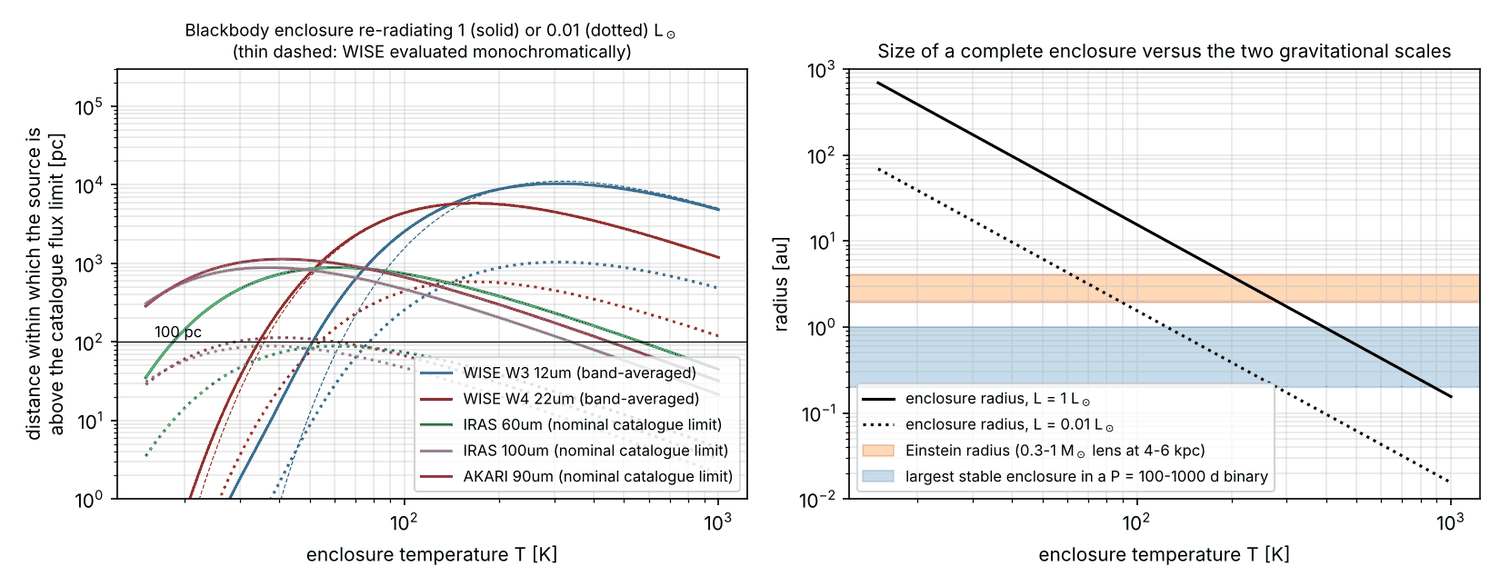
Result. No evidence for fully enclosed stars is found, and how tightly they are bounded depends strongly on the handle. All limits are 95% upper limits. (1) The only limit that holds at any temperature and for any emission law is the local mass budget: enclosed stars amount to less than 18 Msun/pc2 at the Sun, which is less than 42% of the local stellar mass (29-50% across individual dynamical determinations; 58-63% if there were no dark-matter halo locally). It rests on pre-Gaia determinations compiled by McKee et al. 2015 and is a re-reading, not a new measurement. (2) Among 26,900 Gaia DR3 astrometric binaries within 300 pc there are 1,128 dark-companion candidates. If companions were enclosed stars, fewer than about 5% / 30% / 4% of companions of 0.1-0.5 / 0.5-0.8 / 0.8-1.4 Msun are, uncertain by a factor of about 2 from the selection model; the middle bin is the white-dwarf peak. This covers only companions less massive than the visible star at periods of 100-1000 days. Their enclosure must fit inside a Roche lobe of 0.2-0.7 au and is therefore hotter than 233-521 K, and AllWISE excludes a blackbody enclosure between that temperature and 1500 K for all 1,091 candidates it covers. (3) New in this revision and not seen by the referee: counting every AllWISE source that is bright at 22 um and absent at shorter wavelengths over 10,596 deg2 gives a ceiling on complete blackbody enclosures of single Sun-like stars of 2e-4 to 6e-4 at 100 K, 3e-3 to 4e-3 at 50 K and 5% at 40 K, and no constraint below about 35 K; for M dwarfs it is about 1e-3 at 100 K, 8% at 50 K, and nothing below about 45 K. The ranges span two Galactic disc models; the ceiling assumes single-temperature blackbody emission and 80% completeness. (4) A 1 Lsun blackbody sphere at 50-100 K is above the AllWISE 22 um catalogue limit out to 0.7-4.4 kpc, and falls below it beyond 100 pc only when colder than about 32-36 K (50-55 K for 0.01 Lsun). Main caveats: enclosures colder than about 35-45 K, or ones that do not radiate as blackbodies, are bounded only by the 42% figure; the microlensing number (below 37%) is indicative only; the occultation number is a forecast, not a limit.
1. Question
Infrared searches for Dyson spheres look for waste heat around stars that are still visible. A star that is completely enclosed has no optical counterpart, and if its shell is large and cold the waste heat moves to wavelengths where all-sky surveys are shallow. Gravity is unaffected by any of this. The question is how many fully enclosed stars the solar neighbourhood could contain, using handles that need no light from the star: dark companions in binaries, the local mass budget, and microlensing. In the revision I also ask what the mid-infrared catalogue itself allows for complete enclosures, because the first pass answered that with a published limit that does not apply.
2. Data
| Data set | Source | Size | Role |
|---|---|---|---|
Gaia DR3 astrometric orbits (nss_two_body_orbit) |
Gaia archive | 169,227 rows | binary census |
| Gaia DR3 parent sample within 300 pc | Gaia archive | 3,455,411 stars (cell counts and a 1-in-40 sample) | selection model, local luminosity function |
| AllWISE photometry of the orbit sources | Gaia archive cross-match | 25,551 with a 12 um measurement | thermal test |
| Shahaf et al. 2023 Tables 1-2; Shahaf et al. 2024 Table A1 | VizieR J/MNRAS/518/2991; Zenodo 14799795 | 101,380 / 177; 9,786 rows | cross-check, candidate classes |
| AllWISE source catalogue, 144 cones of radius 5 deg | VizieR II/328/allwise | 51,671 rows | source-count ceiling (new) |
| WISE relative spectral response curves | IRSA | 4 files | band-averaged fluxes (new) |
| Local mass budgets | McKee et al. 2015 and the determinations it compiles | published values | Oort limit |
| Microlensing | 36 published events with lens mass and imaging; Mroz et al. 2019; Nunota et al. 2024; Smith et al. 2021 | published values | lens light, forecast |
3. Method
Enclosure model. An enclosure is an isotropic blackbody sphere of temperature T that re-radiates the star's full luminosity L, so its radius is R = sqrt(L / 4 pi sigma T^4): 1.7 au at 300 K, 15.5 au at 100 K, 62 au at 50 K and 172 au at 30 K for 1 Lsun.
Flux limits. The flux in each WISE band is averaged over the published response curve in the way the catalogue calibrates fluxes, and compared with the nominal 5-sigma catalogue limits (5 mJy at 22 um). "Above the limit" means only that the source would be in the catalogue.
Source-count ceiling (new). A complete enclosure of 30-300 K is bright at 22 um (band W4) and dark at 3.4 and 4.6 um. I downloaded every AllWISE source with W4 < 7.7 mag and no or very faint 3.4 um flux in 144 non-overlapping cones at Galactic latitude |b| >= 31 deg. Nine cones whose count exceeded three times the median (bright moving objects, scattered light) were dropped, leaving 135 cones and 10,596 deg2 (25.7% of the sky). For each temperature I count the sources with W4 < 7.0 mag (13 mJy) whose 3.4, 4.6 and 12 um measurements or upper limits are within 1 mag of the blackbody prediction. Every such source is counted as a possible enclosure, whatever it is. The ceiling is f(T) <= N95(N_obs) / (C x N_stars), where N95 is the Poisson 95% upper limit, C = 0.8 is an assumed completeness, and N_stars is the number of main-sequence stars in the same cones whose enclosure would exceed W4 = 7.0. N_stars comes from the local luminosity function measured in this study's Gaia parent sample (d < 100 pc; 0.0056 Sun-like stars and 0.030 M dwarfs per pc3) and the thin-plus-thick disc of Juric et al. 2008 (ApJ 673, 864); a thin disc alone with a 250 pc scale height is the conservative variant.
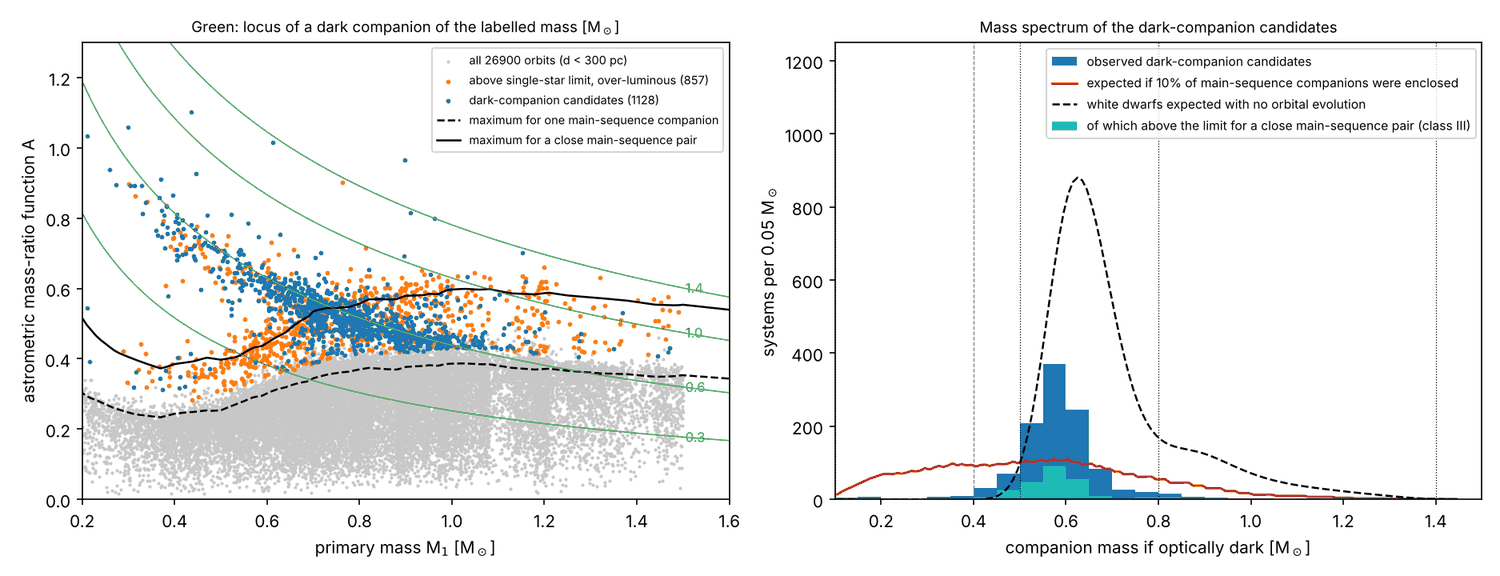
Binaries. Cuts, with rows surviving: all astrometric solutions 169,227; unique sources 169,129; Orbital or AstroSpectroSB1 168,034; distance < 300 pc 34,425; G < 17.5 with colour 34,393; period 100-1000 d 29,668; primary on the main sequence 27,593; primary mass 0.2-1.5 Msun 26,900. Orbits are classified with the astrometric mass-ratio function of Shahaf et al., which compares the size of the photocentre orbit with the largest value a single main-sequence companion (class I) or a close pair of main-sequence stars (class II) could produce; class III is above both. A candidate lies 3 sigma above the single-star limit and is not more than 0.2 mag above the main sequence. The number expected if every companion in a mass bin were an enclosed star is forward-modelled: the catalogue's 20,732 luminous binaries calibrate companion frequency times efficiency in cells of period and primary mass, and dark companions of mass ratio 0.1-1 are passed through the acceptance cuts. Two treatments of the detection threshold are carried: Gaia's published cuts only (headline; fewer expected, so weaker limits) and an extra threshold fitted to the distance and magnitude distributions of the luminous binaries. The limit is N95(N_obs) / N_expected, with every candidate counted as an enclosure.
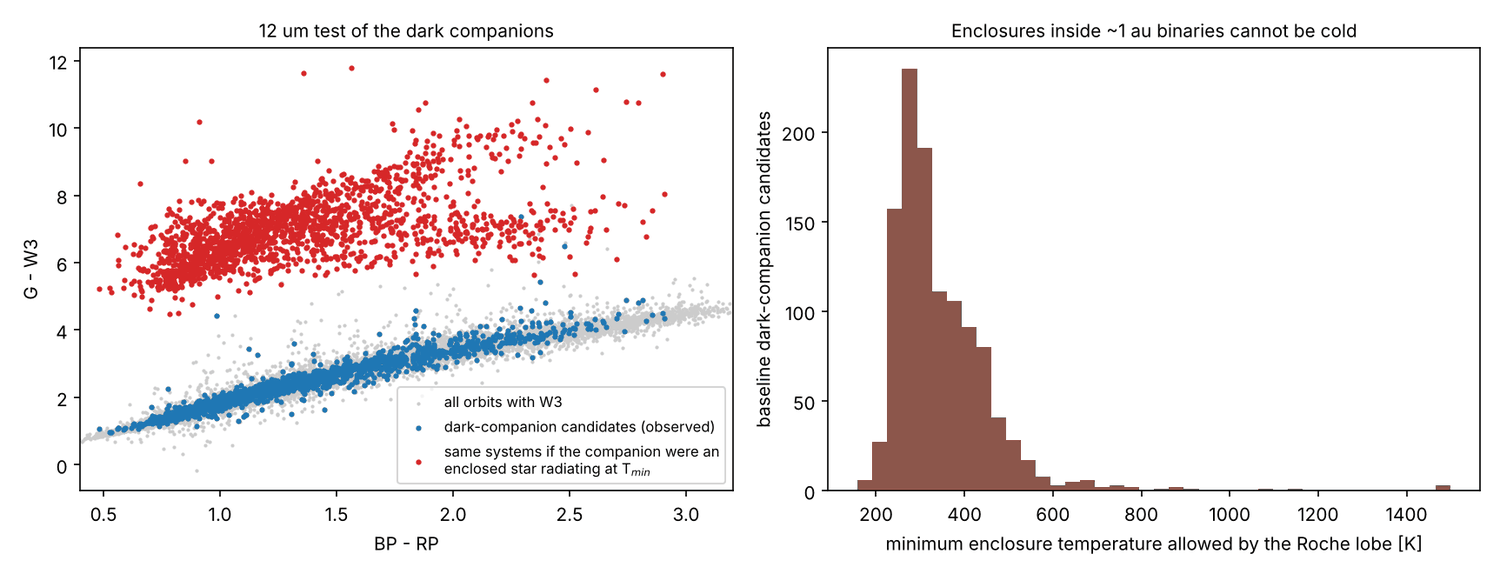
Thermal test. An enclosure around a companion must fit inside its Roche lobe, which sets a minimum temperature. For each candidate the predicted 12 um excess of a blackbody enclosure is compared with AllWISE at every temperature from that minimum to a cap of 1500 K, and the significance is taken at the temperature that hides best.
Oort limit. Dynamical disc surface density minus visible baryons, following McKee et al. 2015 Sec. 7.2, converted to a 95% limit with a prior that the excess is non-negative, and divided by the 25.4 Msun/pc2 of visible stars.
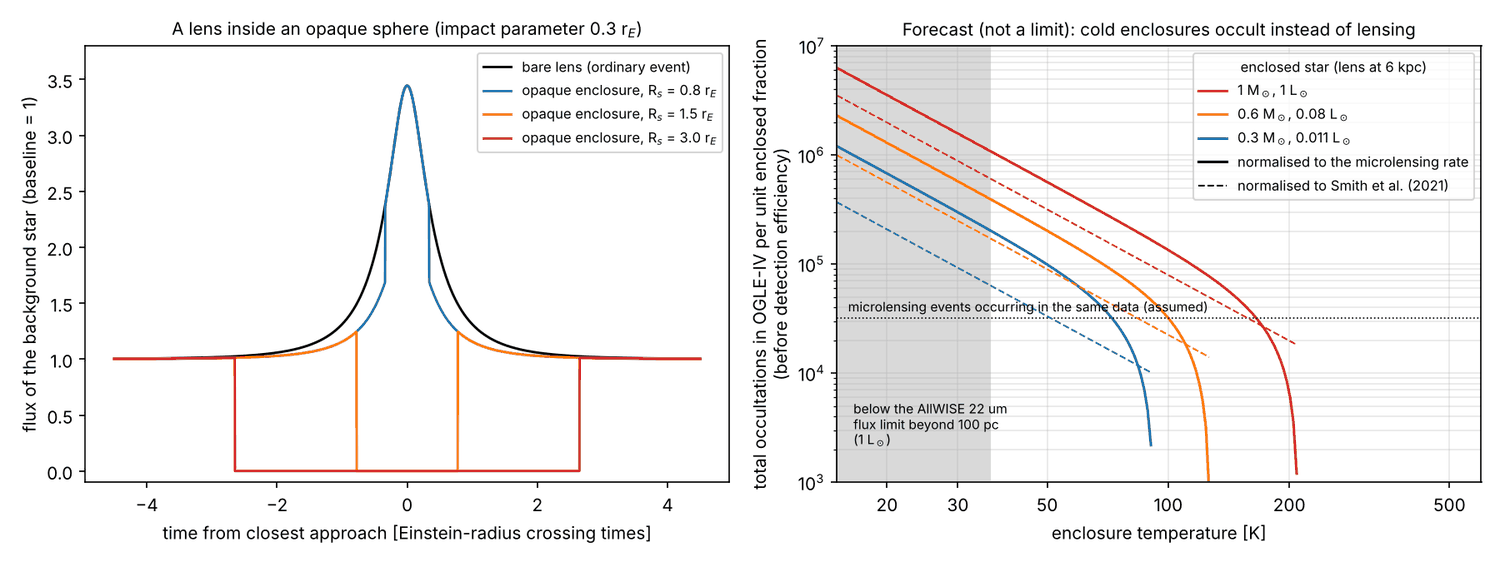
Microlensing. An opaque sphere of radius R_s around a lens with Einstein radius r_E leaves a normal event if R_s is below about 0.6 r_E (the lens is simply dark) and blocks both images if R_s > r_E, so the star is occulted with no magnification. The dark fraction of published lenses with imaging is a Clopper-Pearson limit. The occultation count is a forecast with two normalisations.
4. Results
4.1 Where a complete enclosure would be in the infrared catalogues
| T (K) | Radius, 1 Lsun (au) | Reach at the 22 um limit, 1 Lsun (pc) | 0.01 Lsun (pc) |
|---|---|---|---|
| 100 | 15.5 | 4,413 | 441 |
| 75 | 27.5 | 2,707 | 271 |
| 50 | 62 | 754 | 75 |
| 40 | 97 | 254 | 25 |
| 30 | 172 | 37 | 3.7 |
A 1 Lsun enclosure beyond 100 pc is under the AllWISE limit only below 34.4 K (band-averaged) or 35.8 K (monochromatic); the referee's approximate band gave 32.2 K, so I quote about 32-36 K, and 50-55 K for 0.01 Lsun. The nominal IRAS and AKARI far-infrared limits would push this to 11 K at 100 pc, but those catalogues are confusion-limited and I do not rely on them. This is a statement about flux limits. A source seen only at 22 um has no distance and looks like a dusty galaxy, so being in the catalogue is not the same as being recognised (Fig. 1).
4.2 Ceiling from AllWISE source counts (new)
In the clean fields 9,255 sources have W4 < 7.0; 980 are dark at 3.4 and 4.6 um and 588 are also dark at 12 um (0.055 per deg2).
| T (K) | Sources counted | Reach, 1 Lsun (pc) | Sun-like stars in reach | Ceiling, Sun-like (two disc models) | M dwarfs in reach | Ceiling, M dwarfs |
|---|---|---|---|---|---|---|
| 35 | 588 | 69 | 1.6e3 | 48% / 50% | 39 | none |
| 40 | 588 | 156 | 1.6e4 | 4.9% / 5.4% | 424 | none |
| 45 | 588 | 288 | 8.0e4 | 0.98% / 1.2% | 2.6e3 | 31% / 32% |
| 50 | 588 | 463 | 2.5e5 | 0.32% / 0.41% | 1.0e4 | 7.9% / 8.2% |
| 60 | 590 | 908 | 9.9e5 | 8.0e-4 / 1.3e-3 | 6.5e4 | 1.2% / 1.3% |
| 75 | 614 | 1,662 | 2.6e6 | 3.1e-4 / 7.0e-4 | 3.2e5 | 0.26% / 0.30% |
| 100 | 709 | 2,710 | 4.8e6 | 2.0e-4 / 6.3e-4 | 1.0e6 | 9.1e-4 / 1.2e-3 |
| 150 | 596 | 3,553 | 6.3e6 | 1.3e-4 / 5.0e-4 | 1.9e6 | 4.2e-4 / 5.9e-4 |
| 200 | 282 | 3,483 | 6.2e6 | 6.3e-5 / 2.5e-4 | 1.8e6 | 2.2e-4 / 3.0e-4 |
| 300 | 73 | 2,781 | 4.9e6 | 2.2e-5 / 7.3e-5 | 1.1e6 | 1.0e-4 / 1.3e-4 |
Sun-like means 0.8-1.2 Msun, M dwarfs 0.2-0.6 Msun; the first ceiling uses the thin-plus-thick disc, the second the thin disc alone. At 30 K nothing is constrained. The counted sources are mostly not point sources: about 69% have another counted source within 2 arcmin and are fragments of extended objects such as the planetary nebula NGC 246. Counting each group once lowers the ceilings by a factor of 1.8-2 (1.0e-4 for Sun-like stars at 100 K), and counting only isolated point-like sources lowers them by about 5 (3.6e-5). The remaining sources are at the colour of the "W1W2-dropout" dusty galaxies of Eisenhardt et al. 2012. I did not vet individual sources, so this is a ceiling and not a search.
4.3 Dark companions in Gaia binaries
| Companion mass (Msun) | Candidates | Expected if all enclosed (published cuts / fitted threshold) | 95% limit, published cuts | Fitted threshold | Range over variants | White dwarfs expected |
|---|---|---|---|---|---|---|
| 0.1-0.5 | 134 | 3,344 / 6,048 | 4.6% | 2.6% | 1.3-7.4% | 0 |
| 0.5-0.8 | 956 | 3,412 / 5,326 | 30% | 19% | 11-38% | 3,098 |
| 0.8-1.4 | 36 | 1,232 / 1,823 | 3.9% | 2.6% | 1.3-5.1% | 667 |
| 0.1-0.4 (sub-bin) | 31 | 2,209 / 4,133 | 1.9% | 1.0% | 0.35-4.7% | 0 |
The limits are fractions of companions in the mass bin, for companions less massive than the visible star. The white-dwarf expectation ignores orbital evolution and is an upper bound.
There is no excess that requires a new population, but the first-pass sentence "no excess anywhere, accounted for by white dwarfs" was wrong as written. The white-dwarf model predicts none below 0.5 Msun, yet 134 candidates lie at 0.1-0.5 Msun. Of these, 75 are within 1 sigma of 0.5 Msun and 11 are white-dwarf-class objects in Shahaf et al. 2023 Table 2, so most are the low-mass wing of the white-dwarf peak. The 31 below 0.4 Msun (15 below 0.3 Msun) have median primary mass 0.57 Msun and median eccentricity 0.25. All 31 lie below the close-pair limit, 27 of them by more than 1 sigma, so each can be a hierarchical triple with a close pair of faint main-sequence stars; 5 of the 7 that are in Shahaf et al. 2024 show a red colour excess, which points the same way. None has been tested individually. Counting only companions too heavy to be a close pair, the sub-bin has 0 observed against 809 expected (limit 0.37%).
Two candidates lie above 1.4 Msun. Gaia DR3 3509370326763016704 (3.7 Msun, period 109 d, 125 pc) is in Shahaf et al. 2023 Table 2 as a black-hole candidate flagged "refuted". Gaia DR3 4482912934572480384 (1.8 Msun, period 182 d, eccentricity 0.70, 249 pc) is their neutron-star-class candidate; I did not check later follow-up. In all, 54 baseline candidates are in that table (Fig. 2).
4.4 Thermal test of the candidates
For the 1,128 baseline candidates the Roche-lobe radius is 0.18 / 0.42 / 0.68 au (5th / 50th / 95th percentile), so an enclosure is hotter than 233 / 315 / 521 K and would add 3.9 / 4.7 / 6.2 mag at 12 um. The observed excess has median 0.003 mag (5-95%: -0.23 to +0.29). All 1,091 candidates with AllWISE photometry are excluded as blackbody enclosures at every temperature from their minimum to 1500 K: the lowest significance is 3.98 sigma, the median 10.0 sigma, and 1,082 exceed 5 sigma. These significances are evaluated at the best-hiding temperature, which is the 1500 K cap for 1,079 objects (98.9% of the 1,091 tested, 96% of all 1,128). A hotter shell would give a still larger near-infrared excess and is in effect a star. Thirty-seven candidates have no AllWISE match (Fig. 3).
4.5 Local mass budget
| Dynamical determination | Excess over visible baryons (Msun/pc2) | 95% limit (Msun/pc2) | Share of stellar mass |
|---|---|---|---|
| McKee et al. 2015 average of four (baseline) | 6.4 +- 6.8 | 18.2 | < 42% |
| Kuijken & Gilmore 1991 | 5.9 +- 8.7 | 21.4 | 46% |
| Bovy & Rix 2013 | 6.6 +- 5.3 | 15.5 | 39% |
| Zhang et al. 2013 | 13.1 +- 6.9 | 24.5 | 50% |
| Bienayme et al. 2014 | 0.0 +- 5.3 | 10.4 | 29% |
| Holmberg & Flynn 2004 | 11.6 +- 6.9 | 23.1 | 48% |
| Mean of five | 7.4 +- 6.9 | 19.3 | 44% |
| Variant: Bovy & Rix minus all baryons (referee) | 3.9 +- 5.3 | 13.2 | 35% |
| No dark-matter halo within 1.1 kpc | 24-30 | 33-41 | 58-63% |
Mid-plane densities give 40-63%. No Gaia-era dynamical determination enters the baseline. As context only, the A-star result of Buch et al. 2019 minus a standard halo gives 0.003 +- 0.010 Msun/pc3 (39%). The difference between local and global dark-matter densities reviewed by de Salas & Widmark 2021 would give 21%, but it is not a limit because the local analyses fit the disc mass themselves.
4.6 Microlensing (indicative) and the occultation forecast
Of 36 published events with a lens mass and high-resolution imaging, 26 lenses of 0.19-1.12 Msun at 0.5-7.7 kpc are luminous, 2 are dark (both white dwarfs: MOA-2010-BLG-477, KMT-2020-BLG-0414), 4 are ambiguous and 4 are not counted. Counting the ambiguous events and one disputed identification as dark gives 7 of 32, a dark fraction below 37%; the nominal count (2 of 28) gives 21%, and counting four weak identifications as dark as well gives 47%. The sample is hand-compiled and mostly planet hosts. With the roughly 20% remnant fraction expected among bulge lenses (Gould 2000), 2 or fewer dark lenses in 28 has probability 0.061, so the sample is probably biased towards luminous lenses. The number is not a limit on stars in general. The first-pass optical-depth "ceiling" is withdrawn: it was the ratio of the MOA-II to OGLE-IV optical depths (1.75e-6 against 1.36e-6) times 1.1, and Nunota et al. 2024 report that their value is inconsistent with a Galactic-model prediction.
An enclosure covers both lensed images when it is colder than about 210 K (1 Msun) or 92 K (0.3 Msun) for a lens at 6 kpc. For a 0.3 Msun, 50 K enclosure (radius 6.5 au, mean duration 108 d) an OGLE-IV-like survey would contain 3.3e4 to 9.9e4 x f total occultations before detection efficiency, where f is the enclosed fraction. The lower value scales the rate of Smith et al. 2021 and the upper one scales the measured microlensing rate. Survey totals (4e8 sources, 8 years) are upper bounds from Mroz et al. 2019; the mean rate, the relative velocity of 150 km/s and any efficiency are assumed. A null search at an assumed 10% efficiency would reach f of 3e-4 to 9e-4. No efficiency-calibrated search for chance total occultations in bulge survey data has been published (Fig. 4).
4.7 Synthesis
| Handle | Status | Population | 95% value |
|---|---|---|---|
| Local mass budget | limit | local stellar mass, any temperature | 42% (29-50%) |
| Gaia binaries | limit | companions of 0.1-0.5 / 0.5-0.8 / 0.8-1.4 Msun at 100-1000 d | 4.6% / 30% / 3.9%, factor ~2 |
| Same candidates, AllWISE | test | blackbody enclosures, Roche minimum to 1500 K | 1,091 of 1,091 excluded |
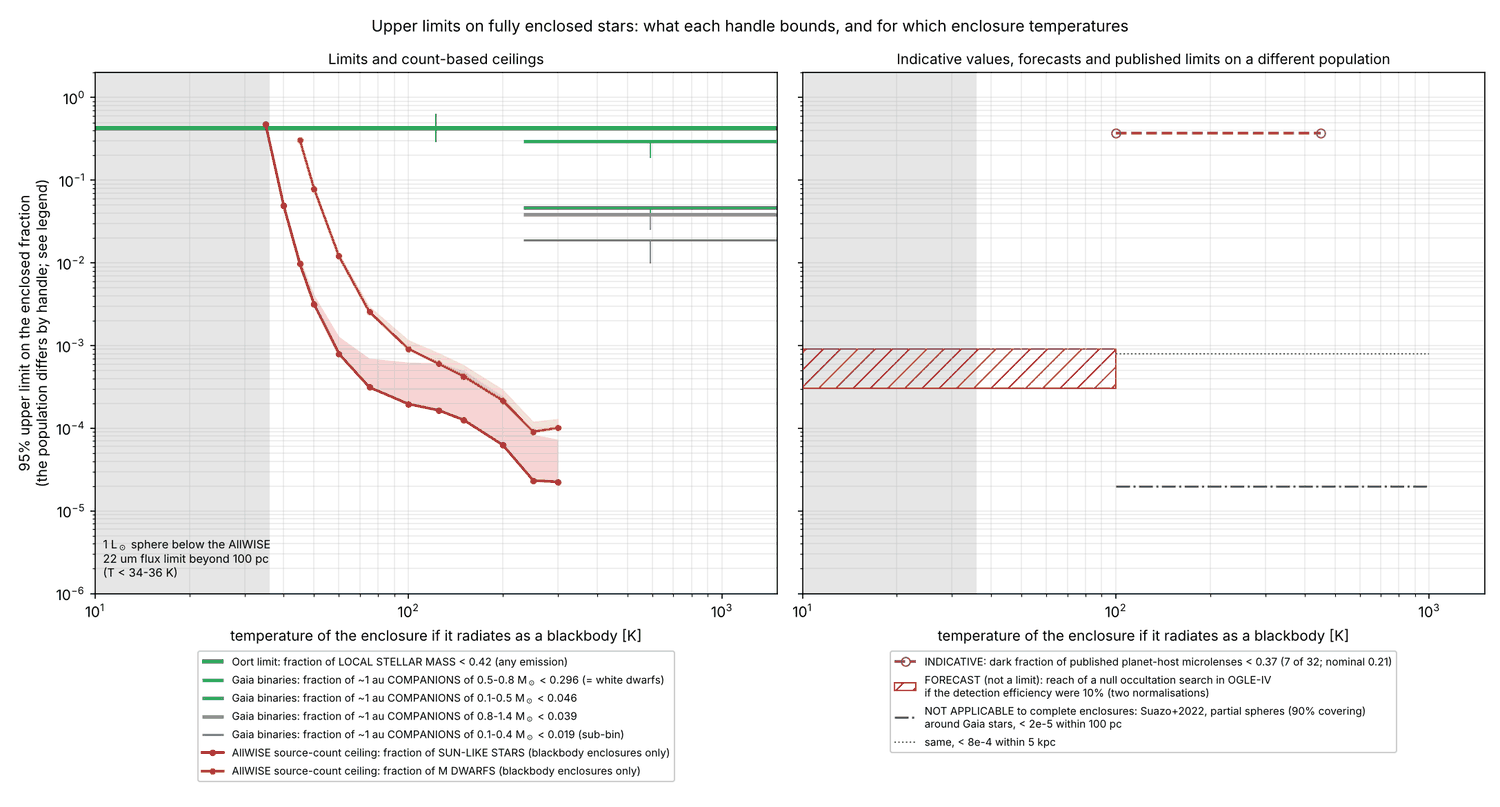
| AllWISE source counts | ceiling from counts | complete blackbody enclosures, Sun-like stars | 2e-4 to 6e-4 (100 K); 0.3-0.4% (50 K); 5% (40 K) |
| AllWISE source counts | ceiling from counts | same, M dwarfs | about 1e-3 (100 K); 8% (50 K) |
| Microlens lens light | indicative | published, mostly planet-host lenses | 37% |
| Bulge occultations | forecast | stars on bulge sightlines | 3e-4 to 9e-4 if a null search reached 10% efficiency |
| Suazo et al. 2022 | not applicable | partial spheres around stars with a Gaia source | 2e-5 (100 pc) |
Fig. 5 shows the limits and ceilings in one panel and the indicative, forecast and not-applicable items in another.
5. Robustness checks
- Binary limits were computed for 108 variants (three detection thresholds, 2 / 3 / 5 sigma candidate cuts, four excess-light cuts, three mass-ratio distributions). The ranges in the table use the variants with an excess-light cut and a threshold no stricter than the fit. With no excess-light cut at all the worst cases are 13% / 38% / 10%.
- The two threshold treatments differ by a factor of 1.8 / 1.6 / 1.5 / 1.9 in the four bins. The fitted threshold describes the luminous binaries far better (chi-square 282 against 2,476), but I keep the weaker published-cuts limits as the headline.
- The referee reproduced the three main-bin limits by three independent routes to within a factor of 2 (for example 4.8% / 28.7% / 3.9% from an independent Monte Carlo).
- My mass-ratio function equals Shahaf's to 1 part in 1e9 for the same primary mass; my primary masses over Gaia's have median 0.994; I recover 1,291 of the 1,320 Shahaf et al. 2024 systems in my sample.
- Band-averaged and monochromatic WISE fluxes differ by less than 0.2% at 100 K and by 11% in reach at 50 K. The response-curve integration reproduces the published WISE flux corrections for a Rayleigh-Jeans source.
- The source-count ceiling was computed for two disc models, three stellar classes and three ways of counting. Sources within 0.15 mag of the W4 cut have a median signal-to-noise of 12.5 (1st percentile 6.2), so the cut is well above the detection limit.
- The Oort code asserts that the four McKee determinations average to the published 6.4 Msun/pc2.
6. Limitations
- For enclosures colder than about 35 K (Sun-like stars) or 45 K (M dwarfs), and for ones that do not radiate as blackbodies, the only limit is the 42% Oort figure. It is a re-reading of 1991-2014 determinations and depends on the disc-halo split.
- The binary limits concern compact, warm enclosures around the lighter star of a pair at about 1 au. That is not the cold, large-shell case that matters most for the question.
- The Gaia selection model is my own empirical estimate, not the El-Badry et al. 2024 or Lam et al. 2025 forward models.
- The 0.5-0.8 Msun bin cannot separate white dwarfs from enclosures.
- The source-count ceiling has not been refereed. It assumes blackbody emission, a completeness of 0.8 that I did not measure by injection, and a disc model that matters at the factor-3 level for Sun-like stars above 75 K. It covers only |b| > 31 deg.
- The thermal test stops at 1500 K and assumes isotropic blackbody emission.
- The microlensing number is indicative and the occultation number is a forecast.
- Sibling studies
dim_starsandcold_occultershad no report when this was written, so there is no cross-check with them.
7. Closest prior work and what is new
Shahaf et al. 2023 (arXiv:2209.00828) and 2024 (arXiv:2309.15143)
built the triage and the white-dwarf census I reuse. El-Badry et al.
2024 (arXiv:2411.00088) and Lam et al. 2025 (arXiv:2411.00654) model the
orbit-catalogue selection. McKee et al. 2015 (arXiv:1509.05334) provide
the local budget and the residual I re-read. Using dynamical mass
against light to bound star-enclosing civilisations is the Tully-Fisher
method of Annis 1999 (JBIS 52, 33) and Zackrisson et al. 2015
(arXiv:1508.02406) at galaxy scale; this project's tf_kiii
study extends it (2.6% of discs with at least 75% of starlight
intercepted). Carrigan 2009 (arXiv:0811.2376) searched IRAS
low-resolution spectra for pure and partial spheres at 100-600 K,
reaching solar-luminosity objects to about 300 pc, and is the only
published search that includes complete spheres. Taken at face value his
few ambiguous candidates among about a million solar-type stars imply a
bound of order 1e-5 there, but the paper does not quantify completeness.
Suazo et al. 2022 (arXiv:2201.11123), Zackrisson et al. 2018
(arXiv:1804.08351) and this project's dyson100 study
(2.3e-5 at 90% covering, 300 K, within 100 pc) bound partial spheres
around stars that have a Gaia source. Smith et al. 2021
(arXiv:2106.05300) computed chance-occultation rates for dark occulters
at stellar density, 18 expected in VVV for 0.5 au occulters, and noted
that no concerted search exists. Lucas et al. 2024 (arXiv:2401.14471)
and the ASAS-SN big-dipper search (arXiv:2507.19594) are systematic
dipper searches.
New here, at the stellar scale inside the Milky Way: the Gaia dark-companion census read as a per-mass-bin limit on enclosed companions; the Roche-lobe minimum temperature with an object-by-object AllWISE test; a temperature-dependent ceiling on complete enclosures from AllWISE counts down to 40 K and for M dwarfs; the Oort residual read as a bound on enclosed stellar mass; and the link between enclosure size and Einstein radius that turns Smith et al.'s rate into a forecast for cold enclosures. I found no paper that does these, from web and arXiv searches only.
8. Implications for the Fermi Paradox
Gravity alone cannot rule out a Galaxy in which a large minority of stars near the Sun is already enclosed: up to 42% of local stellar mass could be dark at any temperature. For enclosures that radiate their waste heat as a blackbody, what the AllWISE catalogue contains bounds the enclosed fraction of Sun-like stars at a few times 1e-4 for 75-300 K, a few times 1e-3 at 50 K and 5% at 40 K. An integrator should not use the Suazo et al. 2022 figure of about 1e-4 as a bound on complete enclosures; it concerns partial spheres around visible stars. The defensible statement is "below about 1e-3 for warm thermal enclosures of Sun-like stars, below 42% for cold or non-thermal ones". The binary census adds that enclosed stars are not common as companions, and that none of the dark companions Gaia sees is a thermal enclosure. The open gap is cold, large shells around single stars, and an efficiency-calibrated search for long total occultations of bulge stars is the test that could close it.
9. Reproduction
python3 code/run_all.py runs eight steps (download, flux
limits, source counts, binary census, thermal test, Oort limit,
microlensing, synthesis) in about a minute once the raw files are cached
in raw/. A first run downloads about 160 MB. Outputs are in
data/ and figures/
(fig1_ir_detectability.png,
fig2_amrf_dark_companions.png,
fig3_wise_thermal_test.png,
fig4_microlensing_occultation.png,
fig5_synthesis.png).
10. Response to referee
The referee's verdict was "sound with fixes", with one major and ten minor errors and twelve required changes. Numbers refer to the required changes.
- Infrared comparison (major). Accepted. Suazo et al.
2022 and
dyson100are now labelled as limits on partial spheres around stars with a Gaia source, not applicable to complete enclosures, in the table and in Fig. 5. The "5,000 times weaker", "10^3-10^4 times deeper" and "bounded at about 1e-4" statements are removed. Carrigan 2009 is cited. Beyond the request, I replaced the withdrawn comparison with a ceiling derived from AllWISE counts (Sec. 4.2); the referee has not seen it. - "The premise is wrong". Accepted. Replaced by the flux-limit statement; threshold quoted as about 32-36 K (50-55 K for 0.01 Lsun). I also recomputed the WISE fluxes with the real response curves.
- "No excess anywhere". Accepted. The text now states the 134 unpredicted candidates and their composition; the lower-mass ones are compatible with triples but untested.
- Candidates above 1.4 Msun. Accepted. Both are identified from Shahaf et al. 2023 Table 2.
- How the binary limits are quoted. Accepted: about 5% / 30% / 4% with a factor of about 2, for companions less massive than the visible star. The optional 0.1-0.4 Msun sub-bin is added (31 observed, 2,209 expected, 1.9%; the referee estimated about 2,100 and 2%).
- Thermal test scope. Accepted. The cap, the evaluation at the best-hiding temperature and the baseline percentiles are stated. The cap applies to 1,079 objects, which is 96% of the 1,128 candidates as the referee wrote and 98.9% of the 1,091 that have AllWISE data.
- Microlens fraction. Accepted. Labelled indicative, 37% leads, and the 6% tension is stated.
- Optical-depth ceiling. Accepted. Withdrawn from the key numbers, the table and Fig. 5; kept as a remark.
- Occultation forecast. Accepted. Quoted as 3e4 to 1e5 x f before efficiency, inputs marked, Smith et al. 2021 credited, the dipper searches cited, and "nobody has searched" replaced.
- Novelty. Accepted. The claim is restricted to the
stellar scale inside the Milky Way, crediting Annis 1999, Zackrisson et
al. 2015 and
tf_kiii. - Oort bookkeeping. Accepted in substance, with one disagreement on a number. The first-pass Bovy & Rix subtraction was wrong. McKee et al. 2015 Sec. 7.2 subtract the baryons with the ionised gas removed (44.4 Msun/pc2 for whole-disc determinations), and only that reproduces their published 6.4 average, so the row is now 6.6 +- 5.3 (limit 15.5 Msun/pc2) instead of the referee's 3.9 +- 5.3 (13.2), which is shown as a variant. The baseline is unchanged. The text now says that no Gaia-era determination enters and that the 10% error on the stellar density is the source's own.
- Fig. 5. Accepted. Two panels, a new axis label, and status and population columns in the table.
Strongest objection. Accepted for the binaries: their limits concern compact, warm enclosures, and this is now stated in the first paragraph and in the limitations. The statement that the Oort figure is the only limit for cold, large enclosures around single stars is accepted only below about 35-45 K or for non-thermal emission; between there and 100 K the new count ceiling applies, subject to its own assumptions and to review.
Other. run_all.py --fresh used to
delete the whole raw cache, which would have removed the referee's
scratch directory; it now leaves it in place.
Key numbers
| Quantity | Value | Uncertainty | Note |
|---|---|---|---|
| Enclosed stellar surface density at the Sun, 95% upper limit (any temperature, any emission law) | 18.2 Msun/pc2 | 10-25 Msun/pc2 across five individual dynamical determinations; 33-41 if no dark halo within 1.1 kpc | McKee et al. 2015 average of four pre-Gaia determinations, dynamical disc minus visible baryons = 6.4 +- 6.8 Msun/pc2; no Gaia-era determination enters |
| Same, as a fraction of local stellar mass (25.4 Msun/pc2 visible stars) | < 42% | 29-50% across determinations; 58-63% with no local halo; 40-63% from mid-plane densities | Re-reading of published budgets, not a new measurement |
| Gaia DR3 astrometric orbits in the analysis sample / dark-companion candidates | 26,900 / 1,128 | 1,985 lie 3 sigma above the single-main-sequence limit before the no-excess-light cut | d < 300 pc, G < 17.5, P = 100-1000 d, main-sequence primaries 0.2-1.5 Msun; candidates split 134 / 956 / 36 in 0.1-0.5 / 0.5-0.8 / 0.8-1.4 Msun plus 2 above 1.4 |
| 95% upper limit on fraction of 0.1-0.5 Msun companions that are enclosed stars | 4.6% | 2.6% with fitted detection threshold; 1.3-7.4% over analysis variants (factor ~2) | 134 observed against 3,344 expected if all were enclosed; companions less massive than the visible star only |
| Same, 0.5-0.8 Msun companions (white-dwarf peak) | 30% | 19% with fitted threshold; 11-38% over variants | 956 observed against 3,412 expected; limit is on white dwarfs plus enclosures together |
| Same, 0.8-1.4 Msun companions | 3.9% | 2.6% with fitted threshold; 1.3-5.1% over variants | 36 observed against 1,232 expected |
| Same, white-dwarf-free sub-bin 0.1-0.4 Msun | 1.9% | 1.0% with fitted threshold; 0.35-4.7% over variants; 0.37% if only companions too heavy to be a close main-sequence pair are counted (0 observed, 809 expected) | 31 observed against 2,209 expected; all 31 are compatible with a close pair of main-sequence stars (hierarchical triple) |
| Baseline candidates excluded as blackbody enclosures by AllWISE 12 um photometry | 1,091 of 1,091 with AllWISE (37 have no AllWISE match) | lowest significance 3.98 sigma, median 10.0 sigma, 1,082 above 5 sigma | Test covers Roche-lobe minimum temperature (233 / 315 / 521 K at 5/50/95%) up to a 1500 K cap; significance evaluated at the best-hiding temperature, which is the cap for 1,079 objects |
| AllWISE source-count ceiling, complete blackbody enclosures of Sun-like stars at 100 K (95%) | 2.0e-4 to 6.3e-4 | range = thin+thick disc model to thin-disc-only model; about 5 times lower if only isolated point-like sources are counted | 709 sources counted in 10,596 deg2 at |b| > 31 deg, W4 < 7.0 mag; completeness 0.8 assumed; new in revision, not refereed |
| Same, Sun-like stars at 50 K and at 40 K | 3.2e-3 to 4.1e-3 (50 K); 4.9% to 5.4% (40 K) | no useful constraint at 35 K (48-50%) and none at 30 K | 588 sources dark at 3.4, 4.6 and 12 um |
| Same, M dwarfs (0.2-0.6 Msun) | 9.1e-4 to 1.2e-3 (100 K); 7.9% to 8.2% (50 K) | 31% at 45 K; unconstrained at 40 K and below | M-dwarf enclosures are bright enough only within tens to a few hundred pc |
| Distance to which a 1 Lsun blackbody enclosure exceeds the AllWISE 22 um catalogue limit (5 mJy) | 4,413 pc (100 K), 754 pc (50 K), 254 pc (40 K), 37 pc (30 K) | monochromatic instead of band-averaged: 4,406 / 678 / 208 / 25 pc | One tenth of these distances for 0.01 Lsun; a flux statement, not a search |
| Temperature below which a 1 Lsun enclosure beyond 100 pc is under the AllWISE 22 um limit | about 32-36 K | 34.4 K band-averaged with the real response curve, 35.8 K monochromatic, 32.2 K in the referee's approximate band | 50-55 K for 0.01 Lsun; on the Wien tail, so not better than two significant figures |
| Dark fraction of published microlenses with measured mass and high-resolution imaging (indicative only) | < 37% (7 of 32, conservative count) | < 21% nominal (2 of 28); < 47% most conservative (10 of 32) | Hand-compiled, mostly planet hosts, probably biased towards luminous lenses: P(2 or fewer of 28 | 20% remnants) = 0.061 |
| Forecast number of total occultations of bulge stars in an OGLE-IV-like survey per unit enclosed fraction f (0.3 Msun, 50 K reference) | 3.3e4 to 9.9e4 x f before detection efficiency | factor 3 between two normalisations; survey totals are upper bounds, mean rate and velocity assumed | Forecast, not a limit; a null search at an ASSUMED 10% efficiency would reach f of 3e-4 to 9e-4 |
| Candidates above 1.4 Msun | 2 | Gaia DR3 3509370326763016704 (3.7 Msun) is flagged 'refuted' in Shahaf et al. 2023 Table 2; Gaia DR3 4482912934572480384 (1.8 Msun) is their neutron-star-class candidate |
Changes made after the referee report
- Infrared comparison rewritten: Suazo et al. 2022 and this project's dyson100 result are now labelled as limits on partial spheres around stars with a Gaia counterpart, 'not applicable to complete enclosures', in the synthesis table and Fig. 5; the '5,000 times weaker', '10^3-10^4 times deeper' and 'bounded at about 1e-4' statements are removed; Carrigan 2009 is cited as the only published search including complete spheres.
- 'The premise is wrong' replaced by a flux-limit statement: a 1 Lsun blackbody sphere at 50-100 K is above the AllWISE W4 catalogue limit to 0.7-4.4 kpc; threshold quoted as about 32-36 K (50-55 K for 0.01 Lsun); Fig. 1 axis relabelled.
- WISE fluxes are now band-averaged with the published response curves (new code/wiselib.py, data/ir_detectability_bandavg.csv); monochromatic values kept for comparison.
- New analysis (code/02b_w4_dark_counts.py and download of 144 AllWISE cones in 01_download.py): a source-count ceiling on complete blackbody enclosures as a function of temperature, for Sun-like stars, M dwarfs and all 0.2-1.5 Msun stars, with disc-model, grouping and point-source variants. Flagged as not seen by the referee.
- 'No excess of dark objects is found anywhere' replaced: the 134 candidates at 0.1-0.5 Msun are not predicted by the white-dwarf model; 75 are within 1 sigma of 0.5 Msun (white-dwarf wing), 31 lie below 0.4 Msun and all 31 are compatible with a close main-sequence pair; none is individually tested. New data/candidate_breakdown.csv.
- White-dwarf-free sub-bin 0.1-0.4 Msun added (31 observed, 2,209 expected, limit 1.9%; 0.37% counting only class III).
- The two candidates above 1.4 Msun are identified from Shahaf et al. 2023 Table 2 (one flagged 'refuted', one neutron-star class); new data/candidates_above_1p4.csv; all candidates now carry their Table 2 class.
- Binary limits quoted as 'about 5% / 30% / 4%, uncertain by a factor of about 2', with the statement that they refer to companions less massive than the visible star.
- Thermal test: scope stated (blackbody, Roche-lobe minimum temperature up to a 1500 K cap, significance evaluated at the best-hiding temperature); percentiles now for the 1,128 baseline candidates (233 / 315 / 521 K; 0.18 / 0.42 / 0.68 au); Fig. 3 uses the baseline sample.
- Microlens dark fraction relabelled indicative; conservative 37% leads; 6% binomial tension with the 20% remnant fraction stated; weakly identified 'luminous' lenses listed and a most-conservative count (47%) added.
- Optical-depth 'ceiling' of about 0.3 withdrawn from the key numbers, the synthesis table and Fig. 5; kept only as a remark with its caveats.
- Occultation forecast quoted as 3e4 to 1e5 x f before detection efficiency everywhere; inputs marked as upper bounds (Mroz et al. 2019 Sec. 2) or assumed; Smith et al. 2021 credited; Lucas et al. 2024 and the ASAS-SN big-dipper search cited; 'nobody has searched' replaced.
- Novelty claim restricted to the stellar scale inside the Milky Way, crediting Annis 1999, Zackrisson et al. 2015 and this project's tf_kiii study.
- Oort section: baryon subtraction now follows McKee et al. 2015 Sec. 7.2 for every row (reproducing their 6.4 average; asserted in code); Bovy & Rix row corrected to 6.6 +- 5.3 with the referee's 3.9 +- 5.3 shown as a variant; statement that no Gaia-era determination enters the baseline; +-0.004 marked as confirmed by the source; Gaia-era values added as context rows only.
- Fig. 5 split into two panels (limits and count ceilings; indicative, forecast and not-applicable items) with a y-axis label that no longer calls every quantity 'fraction of stars that are fully enclosed'; the synthesis table has explicit status and population columns.
- run_all.py --fresh no longer deletes the referee's scratch directory under the raw cache; the whole pipeline was rerun from the entry point (58 s with cached raw data) and all data files and figures regenerated.
Referee points not accepted
- Specific value for the Bovy & Rix row (referee: subtract 47.1, giving 3.9 +- 5.3 and a limit near 13 Msun/pc2). I accept that the first-pass subtraction (43.8) was wrong, but McKee et al. 2015 Sec. 7.2 subtract the baryons with the ionised gas removed (44.4 Msun/pc2 for whole-disc determinations, 42.1 within 1.1 kpc), and only that procedure reproduces their published average of 6.4 for the four determinations (checked by an assert in code/05_oort.py). I therefore use 6.6 +- 5.3, limit 15.5 Msun/pc2 (39%), and report the referee's number as a variant (13.2 Msun/pc2, 35%). The baseline (18.2 Msun/pc2, 42%) is unchanged either way.
- The statement in the strongest objection that for cold, large enclosures around single stars 'the only limit is the Oort figure of 42%' is accepted only below about 35 K (Sun-like stars) or 45 K (M dwarfs), and for enclosures that do not radiate as blackbodies. For thermally radiating enclosures down to 40-50 K the AllWISE source-count ceiling added in this revision applies (e.g. 5% at 40 K and 0.3-0.4% at 50 K for Sun-like stars). This is new analysis the referee has not seen, and it carries its own assumptions (blackbody emission, disc model, assumed completeness).
Figures
Code
Every number above is produced by these scripts from public data. The data tables themselves are not hosted here; the scripts download them.
01_download.py 02_ir_detectability.py 02b_w4_dark_counts.py 03_dark_census.py 04_wise_test.py 05_oort.py 06_microlensing.py 07_synthesis.py common.py mslib.py run_all.py wiselib.py
Referee report
A second, separate analysis re-ran the code, recomputed the main numbers by its own route and tried to break the result. Like the first, it was run by Claude for this project; it is not an outside expert. In its report “the analyst” is the first analysis, which wrote the paper, and file names that are not linked on this page are its own working files. The paper above is the version revised in response.
Verdict: sound with fixes. Results reproduced: yes.
The headline numbers reproduce, and the binary limits hold up under three independent routes.
Rerun. I copied code/ to scratch, pointed DARKCOMP_RAW at symlinks of the cached raw files and reran steps 02-07 (step 03 takes 28 s). All 25 files in data/ are byte-identical to the analyst's. I did not rerun the downloads; instead I checked the raw files against the servers:
- Gaia archive: the six astrometric solution types sum to 169,227 rows, as reported.
- A server-side count with the distance, magnitude and period cuts gives 29,693 rows, against 29,668 after the analyst's de-duplication.
- The parent cell counts (3,455,411) agree with 40 x the 1-in-40 sample (3,458,640) to 0.1%.
- Zenodo record 14799795 and the future-dated arXiv IDs (2610.07133, 2607.18408, 2512.07924) resolve live with the stated titles.
Binary limits, three independent routes (analyst: 3,344 / 3,412 / 1,232 expected, limits 4.6% / 30% / 3.9%):
| Route | Expected if all enclosed (0.1-0.5 / 0.5-0.8 / 0.8-1.4 Msun) | 95% limit |
|---|---|---|
| My own Monte Carlo (mycode/indep_mc.py), published cuts, per-cell calibration | 3,218 / 3,519 / 1,235 | 4.8% / 28.7% / 3.9% |
| Same, restricted to d < 100 pc and G < 14 | 344 / 287 / 89 (observed 8 / 44 / 0) | 4.2% / 20% / 3.4% |
| Absolute normalisation, no class-I counts (mycode/absolute.py), efficiency 0.27 | 4,789 / 3,193 / 988 | not computed |
- My Monte Carlo is a separate implementation: individual parent stars, my own parsing of the Mamajek table, my own AMRF limits and sigma(G) fit. It recovers the same sample (26,923 orbits, 20,756 class I, candidates 134 / 956 / 36).
- The absolute route uses approximate literature companion frequencies that I recalled from Raghavan 2010 and Winters 2019 rather than re-read, so it supports factor-2 consistency only. The efficiency 0.27-0.38 is from the Lam et al. 2025 abstract (Gaia BH1/BH2). With 0.27 it also predicts 21,759 class-I orbits against 20,756 observed.
- Closure test (mycode/closure.py): the model predicts the distance distribution of the 869 observed dark candidates at 0.5-0.8 Msun, which were not used in calibration, with chi-squared 1.6 over 6 bins. The magnitude distribution fits less well (chi-squared 27 over 6 informative bins).
- White-dwarf contamination of the class-I calibrators, estimated from the low-eccentricity excess, is about 0%, 5% and 17% for primaries below 1.0, 1.0-1.2 and 1.2-1.5 Msun. That is too small to matter.
Infrared detectability. An independent astropy calculation gives the W4 5 mJy limit at 4,406 pc (100 K), 678 pc (50 K) and 24.5 pc (30 K), and a hidden-beyond-100-pc threshold of 35.8 K for 1 Lsun and 54.8 K for 0.01 Lsun. Averaging over an approximate W4 band instead of using 22 um lowers these to 32.2 K and 50.3 K. The critical temperatures 210.5 K and 92.1 K and Einstein radii 3.50 and 1.91 au also reproduce.
Oort limit. I extracted the McKee et al. 2015 PDF text and confirmed:
- visible stars 27.0 total and 25.4 within 1.1 kpc; baryons 43.8 +- 3.4 and 43.1 +- 3.3;
- the Table 4 values 48 +- 8, 51 +- 4, 55 +- 5, 43 +- 4, with totals 73.5, 68, 69, 70.5;
- "average of all four ... 6.4 +- 6.8";
- eq. 38 printed as 0.043 +- 0.04 with the words "estimated the error to be 10%", so the analyst's reading of +-0.004 is correct.
By hand, the truncated-Gaussian 95% limit is 18.2 Msun/pc2, and 18.2 / (18.2 + 25.4) = 0.42.
Microlensing. Clopper-Pearson for 2 of 28 is 0.208. The Smith et al. 2021 rates were confirmed in the full text (0.80 per deg2 per yr for durations over 10 d, 0.5 au occulters at stellar density, 1e6 sources per deg2, 18 expected in VVV). I checked 16 of the 36 event rows against their arXiv abstracts and they match.
Thermal test. A hand calculation for a typical system (0.78 + 0.59 Msun, minimum temperature 315 K) gives a 12 um excess of 4.8 mag, against the reported median of 4.6.
Strongest objection
The one piece of new data analysis, the Gaia binary census, tests a scenario that the study's own Roche-lobe argument shows is not the one in the study plan. An enclosure around one member of a 100-1000 day binary must fit inside 0.15-0.7 au, so it is warmer than about 230-670 K, and WISE already excludes every such candidate as a thermal radiator. The 3-5% 'gravity-only' limits therefore apply only to compact enclosures that hide their waste heat, around one star of a pair at about 1 au. For the case that matters to the Fermi question, cold and large enclosures around single stars, the only limit is the Oort figure of 42%. That is a re-reading of pre-Gaia published budgets, not a new measurement, and it depends on the disc-halo split (58-63% with no local halo). The reassurance that warm complete enclosures are 'bounded at about 1e-4' rests on Suazo et al. 2022, whose sample (G <= 21, covering 90% or less) cannot contain a fully enclosed star.
The numbers survive this objection: the binary limits reproduce by three routes to within a factor of 2, and the Oort arithmetic is correct. So does the central conclusion, that gravity alone cannot exclude a large minority (up to about 40%) of local stellar mass being enclosed and that nothing positive is seen. The infrared comparison and the implied tight bound on warm complete enclosures do not survive as written.
Errors found
- major. The infrared comparison uses Suazo et al.
2022 as if it limited fully enclosed stars. It does not. The same misuse
appears in the synthesis table row 'Infrared, for comparison', in the
two black lines of Fig. 5 (whose y-axis reads 'fraction of stars that
are fully enclosed'), in the '5,000 times weaker' comparison, and in the
advice that the hidden fraction is 'bounded at about 1e-4 for warm
enclosures by infrared data'.
- Evidence: The Suazo et al. 2022 abstract limits 'the fraction of stars at G <= 21 that may potentially host non-reflective Dyson spheres that absorb 1 - 90% of the bolometric luminosity'. A 100% enclosed star has no Gaia source and is outside that sample by construction.
- Fix: Relabel the row and the Fig. 5 lines as 'partial spheres (covering 90% or less) around stars with a Gaia counterpart; not applicable to complete enclosures'. For complete enclosures cite Carrigan 2009 (arXiv:0811.2376), an IRAS LRS search for fully cloaked spheres at 100-600 K that reaches solar-luminosity objects to about 300 pc. State that no published search exists for optically dark WISE-only sources, especially at M-dwarf luminosities. Present the 1e-4 figure for warm complete enclosures as the analyst's inference from flux limits, not a published limit, and drop or reword the '5,000 times' and '10^3-10^4 times deeper' comparisons.
- minor. 'The premise is wrong' is true only as a
statement about catalogue flux limits. A W4-only source at
signal-to-noise 5 with no optical counterpart has no distance and is
confused with dusty galaxies, so it is not thereby recognised or
excluded. The threshold is also on the Wien tail, so three significant
figures are not justified.
- Evidence: My astropy recomputation gives 35.8 K at 22 um and 32.2 K averaged over an approximate W4 band (54.8 and 50.3 K for 0.01 Lsun).
- Fix: Say 'detectable in principle above the AllWISE W4 flux limit; no search of such sources has been published'. Quote the threshold as about 30-36 K for 1 Lsun and 50-55 K for 0.01 Lsun.
- minor. The short answer says 'No excess of dark
objects is found anywhere. The dark companions Gaia sees are accounted
for by white dwarfs.' The report's own table contradicts this: 134
candidates at 0.1-0.5 Msun against a white-dwarf expectation of 0, plus
2 above 1.4 Msun.
- Evidence: From data/dark_companion_candidates.csv: 75 of the 134 are within 1 sigma of 0.5 Msun, and the median is 0.45. Only 31 lie below 0.4 Msun and 15 below 0.3; the lowest-mass ones have M-dwarf primaries and eccentricities of 0.2-0.7, which is not white-dwarf-like. In my Monte Carlo a 0.1-0.4 Msun bin has 31 observed against 2,082 expected, a limit of 2.0% (1.1% with the fitted threshold).
- Fix: Reword to: 'no excess that requires a new population; the 0.1-0.5 Msun bin is mostly the low-mass wing of the white-dwarf peak, and about 15-30 lower-mass candidates around M dwarfs are unexplained and untested'. Consider moving the bin edge to 0.4 Msun, which gives a white-dwarf-free bin.
- minor. The two candidates above 1.4 Msun are
reported as 'not investigated', but both are in Shahaf et al. 2023 Table
2, which the analyst downloaded.
- Evidence: shahaf2023_table2.csv: recno 3 has Class 'BH' and n_Class 'refuted'; recno 9 has Class 'NS'.
- Fix: State that Gaia DR3 3509370326763016704 (3.7 Msun) is flagged 'refuted' there, and that Gaia DR3 4482912934572480384 (1.8 Msun) is a Shahaf neutron-star-class candidate.
- minor. The novelty statement 'I found no prior
paper using dynamical or occultation data to bound Dyson spheres' and
the line 'Nobody has searched for this' are too strong.
- Evidence: Annis 1999 and Zackrisson et al. 2015 (arXiv:1508.02406) use the Tully-Fisher relation, i.e. dynamical mass against light, for exactly this purpose; this project's tf_kiii study extends them. Smith et al. 2021, section 4.2.2, computes rates for dark occulters 'equal to the stellar space density' (18 expected in VVV) and says a concerted search 'to our knowledge has not been undertaken in earnest'.
- Fix: Restrict the claim to the stellar scale inside the Milky Way and credit Annis 1999 and Zackrisson et al. 2015 for the galaxy-scale version. Credit Smith et al. 2021 for the chance-occultation rate and for noting that no search exists. Cite the systematic dipper searches (Lucas et al. 2024 in VVV; the ASAS-SN 'big dipper' search, arXiv:2507.19594) and change the line to 'no efficiency-calibrated search for chance total occultations in bulge survey data'.
- minor. The microlens result 'dark fraction < 21%
(95%)' is presented as a limit, but the 28 events are a hand-compiled,
non-representative set of published planet-host follow-ups.
- Evidence: The report cites an expected remnant fraction of about 20% (Gould 2000). With p = 0.2, the chance of 2 or fewer dark lenses in 28 is 0.061, so the sample is probably biased toward luminous lenses. Several 'luminous' entries are unresolved excess flux (KMT-2018-BLG-0029, OGLE-2019-BLG-0960), a 'candidate' host (MOA-2011-BLG-262) or disputed (OGLE-2016-BLG-1195).
- Fix: Label it indicative, like the optical-depth number, and lead with the conservative 37%. State that it refers to published planet-host lenses, not to stars in general.
- minor. The optical-depth ceiling of about 0.3 is
not a measurement of room above models. It is the MOA-II/OGLE-IV ratio
times 1.1.
- Evidence: 06_microlensing.py: room = tau_moa / tau_ogle * (1 + sys_src). The Nunota et al. 2024 abstract says MOA-II is 'consistent with' OGLE-IV yet 'inconsistent with a prediction based on Galactic models'. Bulge models are partly normalised dynamically, so hidden stellar mass would already be partly included.
- Fix: Remove it from the key numbers and from Fig. 5, or keep it only as a remark with these caveats.
- minor. The thermal-test significances ('minimum 4.0
sigma, median 10 sigma') are values at an arbitrary 1500 K cap. The
quoted Roche-lobe percentiles also refer to all 1,985 candidates, not
the 1,128 baseline ones.
- Evidence: In wise_thermal_test.csv the best-hiding temperature equals 1500 K for 1,079 of the 1,128 baseline candidates. Baseline percentiles are 233 / 315 / 521 K and 0.18 / 0.42 / 0.68 au, against the reported 226 / 324 / 673 K and 0.15 / 0.37 / 0.67 au. The lowest significance is 3.98 sigma.
- Fix: Say explicitly that the exclusion is for blackbody enclosures up to 1500 K and that the significance is evaluated at the cap. Add one sentence that hotter shells give still larger near-infrared excesses and are effectively stars. Quote percentiles for the baseline sample.
- minor. The Oort section has three bookkeeping
problems that do not change the baseline. The Bovy & Rix row
subtracts the wrong baryon figure. The baseline rests entirely on
1991-2014 determinations as re-analysed by McKee et al. 2015, with the
Gaia-era papers named in the study plan used only for context. The 10%
uncertainty on 25.4 Msun/pc2 is an assumption.
- Evidence: McKee Table 4, footnote d: 'The authors neglected the difference between Sigma_b and Sigma_b1.1', so 51 +- 4 is a total-disc value. Subtracting 47.1 instead of 43.8 gives 3.9 +- 5.25 and a limit near 13 Msun/pc2, not 16.1. McKee eq. 38 is followed by 'we have estimated the error to be 10%'.
- Fix: Correct the Bovy & Rix row. State plainly that no Gaia-era dynamical determination enters the limit. State the +-0.004 as confirmed by the source text rather than assumed.
- minor. The headline quotes 'about 1e5 x f'
occultations, which is the upper of two normalisations that differ by a
factor of 3. The assumed OGLE-IV totals (4e8 sources, 1e-5 per star per
year, 8 years) are not taken from a source.
- Evidence: microlensing_summary.json: 99,226 (rate normalisation) against 33,279 (Smith normalisation). 06_microlensing.py sets N_SRC, T_YR, GAMMA = 4.0e8, 8.0, 1.0e-5 and comments them as 'order of magnitude'.
- Fix: Quote '3e4 to 1e5 x f before detection efficiency' wherever the number appears, and mark the inputs as assumed.
- minor. Fig. 5 and the synthesis table put 'fraction
of companions at about 1 au', 'fraction of local stellar mass',
'fraction of published planet-host lenses' and a forecast on one axis
labelled 'fraction of stars that are fully enclosed'.
- Evidence: figures/fig5_synthesis.png.
- Fix: Relabel the axis '95% upper limit on the enclosed fraction (population differs by handle; see legend)' and move the forecast and the indicative optical-depth value to a separate panel or use open symbols.
Overclaims
- 'The premise that a solar-luminosity sphere at 50-100 K escapes WISE is wrong': correct for catalogue flux limits only; no search of such sources exists and they could not be identified without an optical counterpart.
- 'An integrator should treat the hidden-starlight fraction as bounded at about 1e-4 for warm (above 100 K) enclosures by infrared data': the cited Suazo et al. 2022 limit does not cover fully enclosed stars.
- 'Infrared limits are 10^3-10^4 times deeper than anything gravity offers' and 'about 5,000 times weaker': these compare limits on different populations (partial spheres with optical counterparts against complete enclosures).
- 'No excess of dark objects is found anywhere. The dark companions Gaia sees are accounted for by white dwarfs': the 134 candidates at 0.1-0.5 Msun are not predicted by the report's own white-dwarf model and were not tested.
- 'I found no prior paper using dynamical or occultation data to bound Dyson spheres' and 'the first gravitational census': Annis 1999 and Zackrisson et al. 2015 did this at galaxy scale; Smith et al. 2021 computed the dark-occulter rate.
- 'Nobody has searched for this' (occultations): systematic dipper searches exist in VVV and ASAS-SN, though none is efficiency-calibrated for chance occultations toward the bulge.
- 'Microlenses with imaging give a dark fraction below 21%' stated as a 95% limit: the sample is hand-compiled, planet-host-only and probably biased toward luminous lenses.
- 'The occultation test ... could tighten the second number by three orders of magnitude': this assumes a 10% detection efficiency and order-of-magnitude survey totals that were not verified.
- 'About 1e5 x f' occultations in OGLE-IV: this is the upper of two normalisations a factor of 3 apart, before any efficiency.
Novelty check
Novel: partly. I found no prior paper that reads the Gaia dark-companion census, the local mass budget or microlens lens-light detections as limits on enclosed stars within the Milky Way. The Roche-lobe argument with the per-candidate WISE test also appears to be new. Three claims are less new than stated. (1) Using dynamical mass against light to bound enclosed stars is the Annis 1999 and Zackrisson et al. 2015 Tully-Fisher method at galaxy scale. (2) The occultation idea is substantially anticipated by Smith et al. 2021, who compute chance-occultation rates for dark occulters at stellar space density and note that no concerted search exists; the new step is linking enclosure size to the Einstein radius and scaling the rate. (3) The Oort limit is a re-reading of McKee et al. 2015 (6.4 +- 6.8 Msun/pc2, their 1-sigma bound 13), not a new measurement. The binary part reproduces the Shahaf et al. 2023/2024 triage and adds a selection model and a per-mass-bin limit. My search was limited to web and arXiv queries.
- Shahaf et al. 2023 (arXiv:2209.00828) and 2024 (arXiv:2309.15143): AMRF triage and white-dwarf census of Gaia DR3 astrometric orbits
- El-Badry et al. 2024 (arXiv:2411.00088) and Lam et al. 2025 (arXiv:2411.00654): selection function of the Gaia DR3 orbit catalogue
- McKee, Parravano & Hollenbach 2015 (arXiv:1509.05334): local baryon budget and thin-dark-disc bound
- Annis 1999 and Zackrisson et al. 2015 (arXiv:1508.02406): Tully-Fisher (dynamics against light) limits on galaxy-scale Dyson-sphere populations; not credited by the analyst
- Zackrisson et al. 2018 (arXiv:1804.08351): Gaia search for optically dim near-complete Dyson spheres; best candidate attributed to an unseen companion
- Carrigan 2009 (arXiv:0811.2376): IRAS search that includes fully cloaked Dyson spheres at 100-600 K; not cited by the analyst
- Suazo et al. 2022 (arXiv:2201.11123): WISE limits on partial (1-90%) Dyson spheres around Gaia stars with G <= 21
- Smith et al. 2021 (arXiv:2106.05300): chance-occultation rates for a dark occulter population at stellar density; states no concerted search exists
- Lucas et al. 2024 (VVV dipping giants) and the ASAS-SN 'big dipper' search (arXiv:2507.19594): systematic searches for long, deep dimming events; not cited by the analyst
- Agol 2002 (astro-ph/0207228), Bailey 2026 (arXiv:2608.24009), Baghram 2025 (arXiv:2512.07924): occultation by opaque or disc-bearing lenses
- Blain 2024 (arXiv:2409.11447), section 7.1: microlensing of Dyson structures as sources, a tangential use
Required changes
- Infrared comparison (synthesis table last row, Fig. 5 black lines and title, the 'Implications' paragraph, and the 'about 1e-4' advice): state that Suazo et al. 2022 covers only partial spheres (covering 90% or less) around Gaia stars with G <= 21. Cite Carrigan 2009 as the only published search that includes complete spheres. Present any bound on warm complete enclosures as an inference from flux limits, and remove the '5,000 times weaker' and '10^3-10^4 times deeper' comparisons or restrict them to partial spheres.
- Headline and first bullet of the short answer: change 'The premise ... is wrong' to 'A 1 Lsun blackbody sphere at 50-100 K is above the AllWISE W4 catalogue limit out to 0.7-4.4 kpc, but no search of optically dark W4 sources has been published'. Quote the threshold as about 30-36 K (50-55 K for 0.01 Lsun).
- Short answer, third bullet: replace 'No excess of dark objects is found anywhere. The dark companions Gaia sees are accounted for by white dwarfs' with a statement that the 0.1-0.5 Msun bin has 134 candidates that the report's own white-dwarf model does not predict, mostly the low-mass wing of the white-dwarf peak, with about 15-30 lower-mass candidates around M dwarfs untested.
- Results, binaries: identify the two candidates above 1.4 Msun from Shahaf et al. 2023 Table 2 (one flagged 'refuted', one neutron-star class) instead of 'not investigated'.
- Binary limits: quote them as 'about 5% / 30% / 4%, uncertain by a factor of about 2 from the selection model', and say they refer to companions less massive than the visible star. Optionally add a white-dwarf-free 0.1-0.4 Msun bin (my estimate: 31 observed, about 2,100 expected, limit about 2%).
- Thermal test: state that the significances are evaluated at the 1500 K cap, which is the best-hiding temperature for 96% of candidates, and that the test covers blackbody enclosures up to 1500 K. Quote the Roche-lobe and minimum-temperature percentiles for the 1,128 baseline candidates (233 / 315 / 521 K; 0.18 / 0.42 / 0.68 au).
- Microlensing lens light: relabel '< 21% (95%)' as indicative, from a non-representative sample of published planet-host follow-ups, and lead with the conservative 37%. Note the mild tension (probability about 6%) between 2 of 28 and the roughly 20% remnant fraction the report cites.
- Optical-depth ceiling: remove 'about 0.3' from the key numbers and from Fig. 5, or keep it as a remark stating that it is the MOA/OGLE ratio times 1.1 and that Nunota et al. 2024 report disagreement with Galactic models.
- Occultation forecast: quote '3e4 to 1e5 x f before detection efficiency' everywhere, including the headline. Credit Smith et al. 2021 for the rate calculation and the 'no concerted search' remark. Cite Lucas et al. 2024 and the ASAS-SN big-dipper search, and replace 'Nobody has searched for this' with 'no efficiency-calibrated search for chance total occultations in bulge survey data'.
- Novelty paragraph: replace 'no prior paper using dynamics or occultations to bound Dyson spheres' with a claim limited to the stellar scale inside the Milky Way, crediting Annis 1999 and Zackrisson et al. 2015 (Tully-Fisher) and this project's tf_kiii study.
- Oort section: correct the Bovy & Rix row (51 +- 4 is a total-disc value; subtract 47.1, giving 3.9 +- 5.3 and a limit near 13 Msun/pc2). State that the baseline uses only 1991-2014 determinations as re-analysed by McKee et al. 2015 and that no Gaia-era measurement enters. State the +-0.004 as confirmed by McKee's text ('error ... 10%').
- Fig. 5: relabel the y-axis so that it does not call every quantity 'fraction of stars that are fully enclosed', and separate the forecast and the indicative value from the limits.