Where is everybody? · Working papers
How long between oxygen and intelligence?
Revised after a second, separate analysis run for this project tried to break it. Neither analysis is an outside expert.
Do evolutionary innovations follow their environmental gates?
Revised after referee review. Everything below is regenerated by
code/run_all.py (11 to 15 minutes, fixed seed; two full
runs gave identical tables).
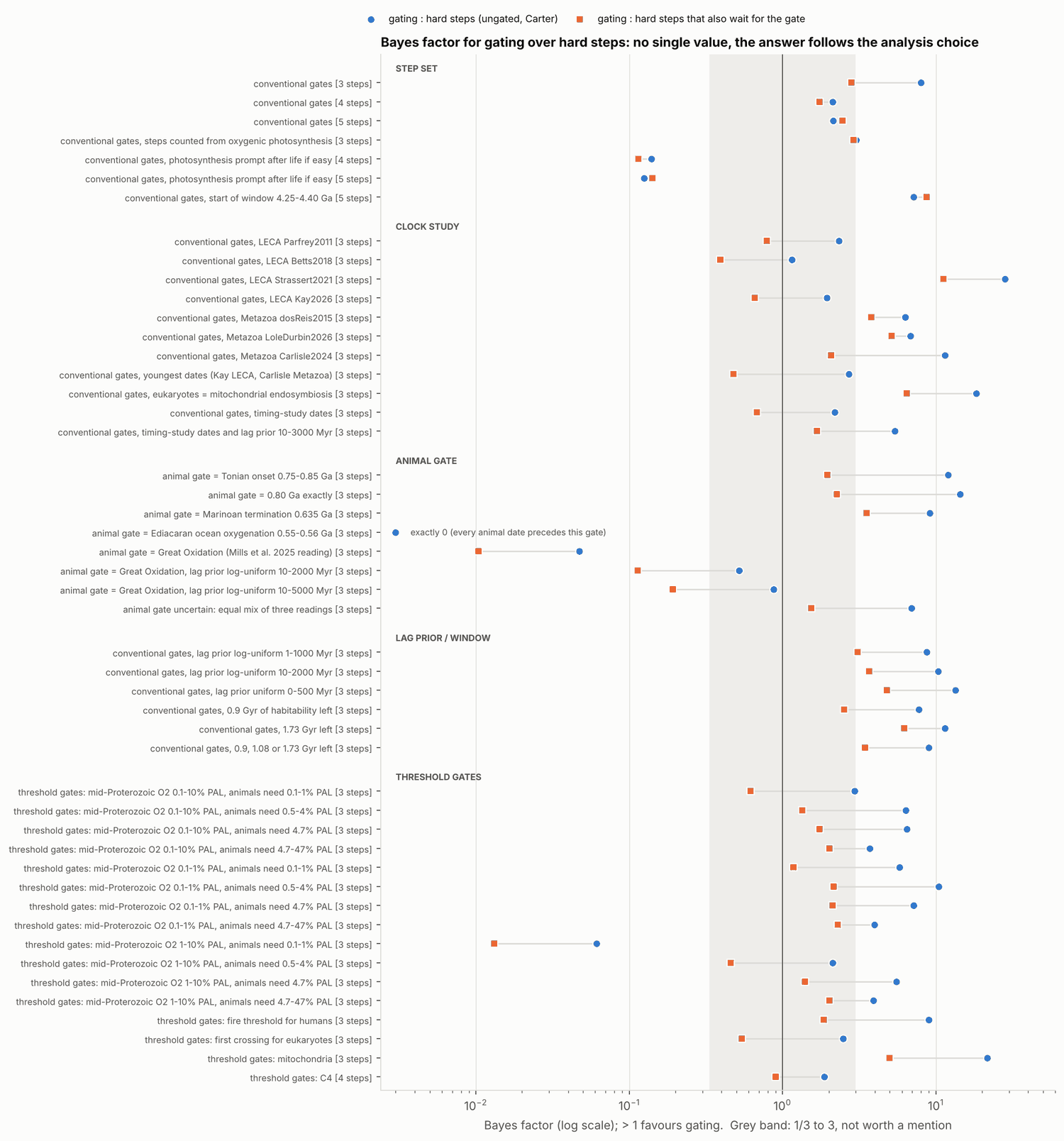
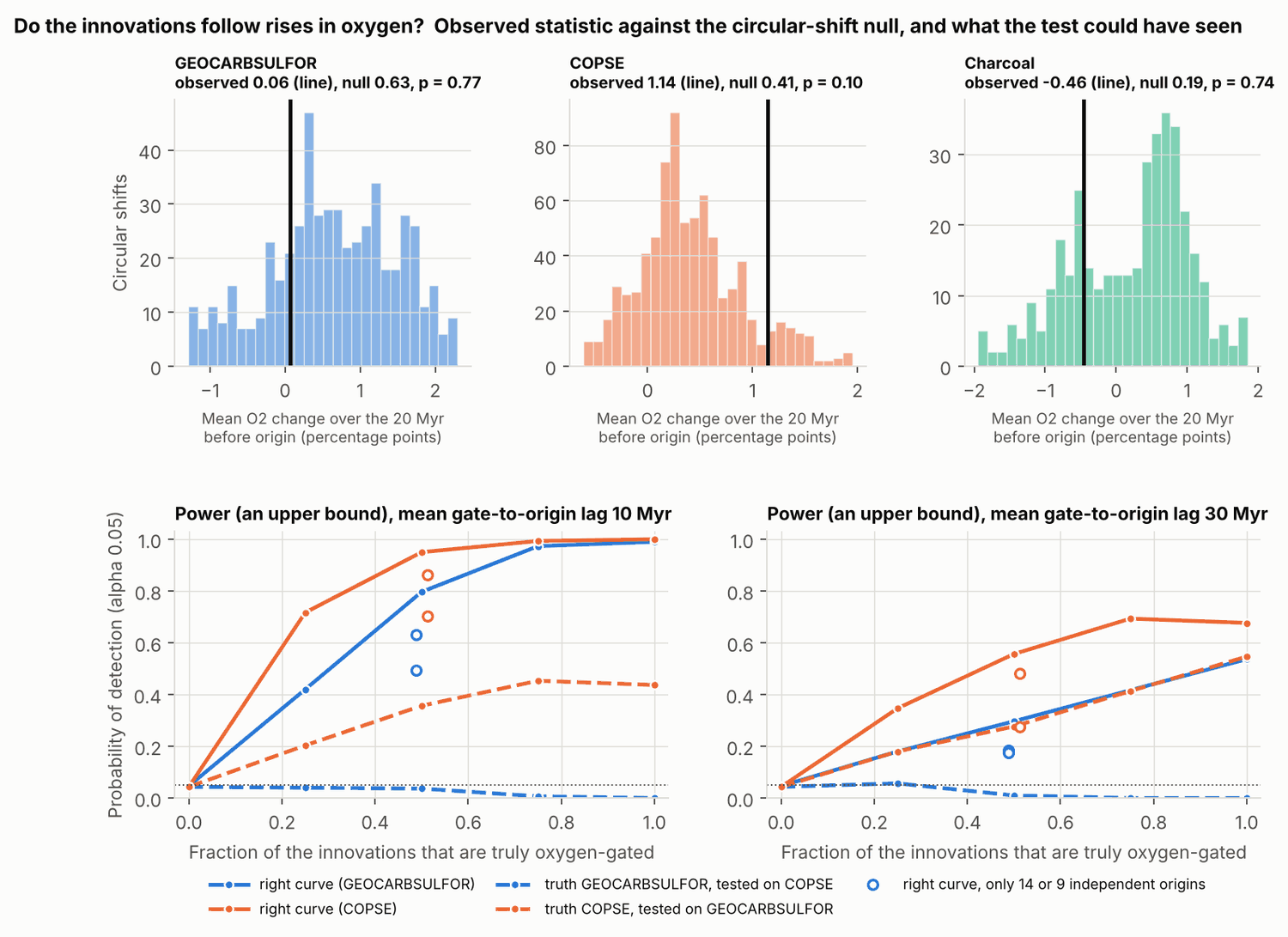
Summary. The dated record cannot separate hard steps from environmental gating, and it gives gating no net support. For eukaryotes, animals and humans set against the conventional oxygenation events, the Bayes factor for gating over Carter's hard steps is 1.2, 1.9 and 2.3 for three of the four published eukaryote dates and 28 for the fourth (Strassert et al. 2021). The equal-weight average is 8.1 (Monte Carlo ±2.4%), falling to 2.1-3.0 once photosynthesis or LUCA is counted. Against hard steps that also wait for the gate it is 0.4-0.8 for those three dates and 11 for Strassert (average 2.8). Changing only the animal gate moves the answer from exactly 0 through 0.05 to 14; over 48 analysis choices the range is 0 to 28. The Bayes factor for no hard steps against at least one is 0.87 with conventional gates and never exceeds 1.3; it is 0.03-0.34 if oxygen was already sufficient for animals after the Great Oxidation. In the Phanerozoic, 31 dated innovations show no association with oxygen rises (p = 0.77, 0.10, 0.74 on three reconstructions that disagree on sign), with power of at most 0.5-0.9 for 10-Myr lags. Main caveats: one planet and three gated transitions; gates that are neither independently defined nor independent of life, which caused the oxygen rises; and an average dominated by one clock study (83% of the gating likelihood) and by the 7% of draws in which a transition lands within 20 Myr of its gate (62%).
Question
The hard-steps model says the major transitions were intrinsically improbable, so their dates are uniform order statistics on Earth's habitable window. The gating alternative (Mills et al. 2025) says each transition happened once an environmental gate, usually oxygen, opened. Does the dated record prefer one, and does it move this project's prior on the number of hard steps?
Data
Classic transitions (Part 1). 16 published date
estimates for 7 transitions, 17 dated environmental events and 7 oxygen
thresholds (data/part1_inputs.csv). 32 entries were checked
against abstracts or full text, 6 come from this project's timing study,
and 6 (Snowball and boundary ages) were recalled without re-verification
and are used only in the candidate-gate pool.
| Transition | Date estimates used (Ga) | Conventional gate (Ga) |
|---|---|---|
| LUCA | 4.20 (4.09-4.33), Moody 2024 | habitable from 4.40-4.51 |
| Oxygenic photosynthesis | 2.96 (2.78-3.28) Fournier 2021; 2.99 Moody 2024; 2.43-2.60 Shih 2017; 2.39-2.73 Fournier 2021 alt. | none dated |
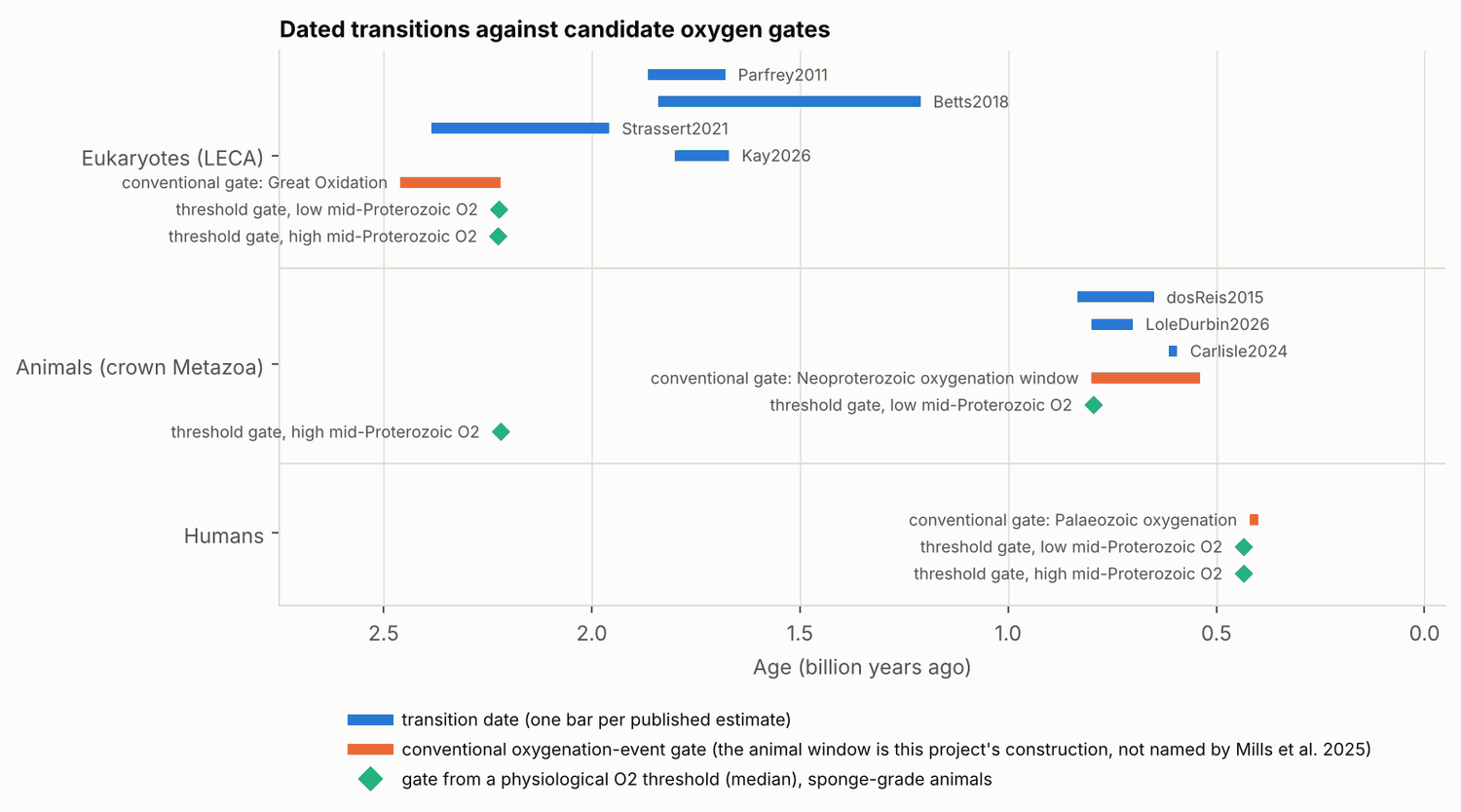
| Eukaryotes (LECA) | 1.68-1.87 Parfrey 2011; 1.21-1.84 Betts 2018; 1.96-2.39 Strassert 2021; 1.67-1.80 Kay 2026 | Great Oxidation, 2.22-2.46 |
| Animals (crown Metazoa) | 0.65-0.83 dos Reis 2015; 0.70-0.80 Lole Durbin 2026; 0.593-0.613 Carlisle 2024 | Neoproterozoic window, 0.539-0.80 |
| Humans | 0 | Palaeozoic oxygenation, 0.40-0.42 |
The animal window is this project's construction, not a gate named by Mills et al. 2025. Their text says the lower oxygen limit for animal multicellularity is "controversial and essentially unknown", that it is "debated whether animal multicellularity originated only shortly after its minimum O2 requirements became established", and commits only to eukaryotes and animals being excluded before about 2.2 Ga and humans before about 0.40 Ga.
Phanerozoic (Part 2).
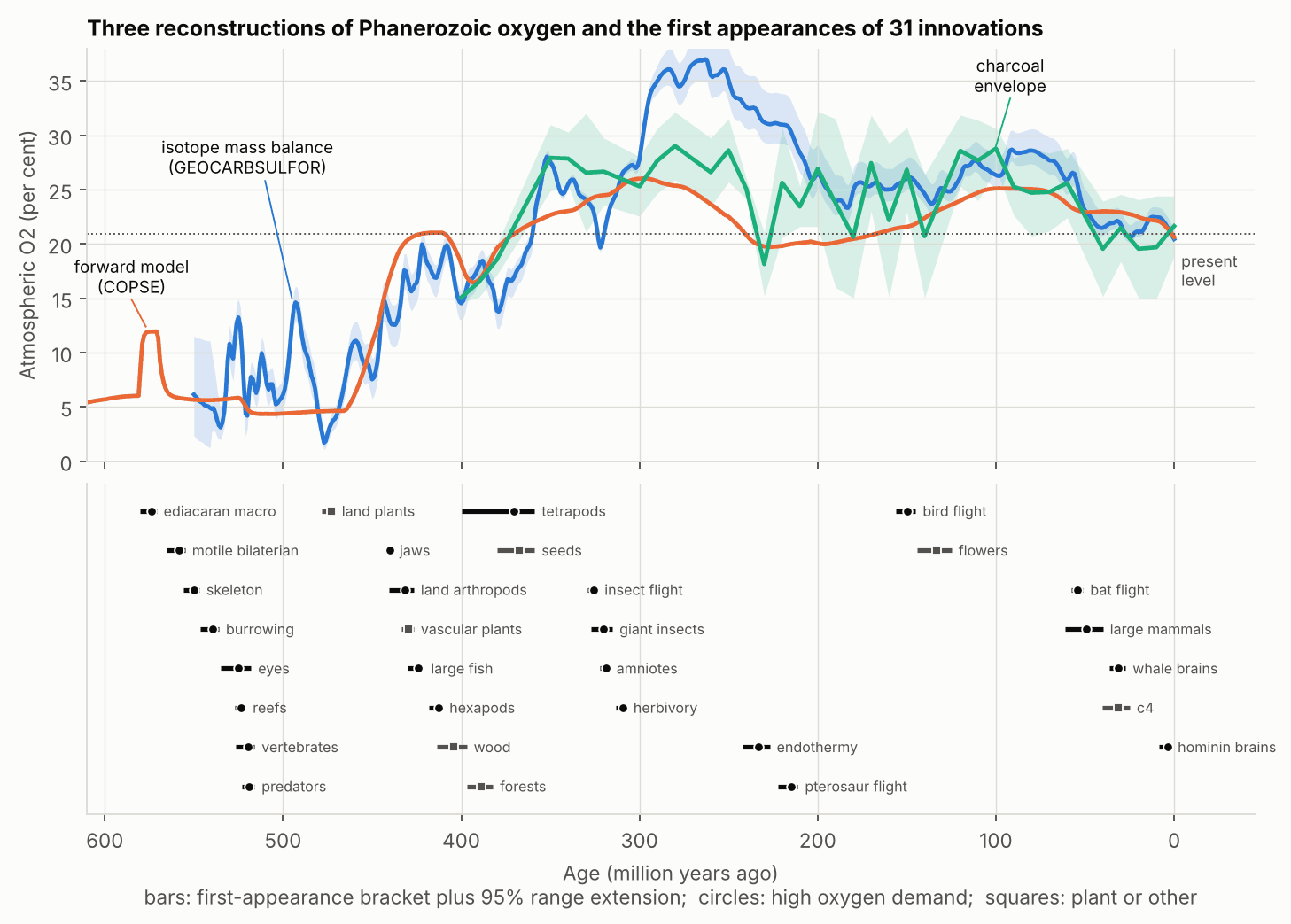
- 31 innovations with a physiological oxygen, temperature or CO2 requirement, listed before any statistic was computed: 24 with high oxygen demand, 6 plant-grade, 1 other.
- 18 are dated from the Paleobiology Database: 6,696 occurrence records, 5,627 after cuts. Cuts: flagged form or trace taxa, open nomenclature, rank above genus, age span over 15 Myr, and five curated exclusions (for example lungfish filed under Tetrapoda, and the lungfish "Pentlandia" entered in the Silurian).
- 13 are dated from the literature; six of those dates were recalled, not re-verified.
- Oxygen: GEOCARBSULFOR (947 usable Monte Carlo realisations, 550-0 Ma); COPSE (10 variants, 800-0 Ma); charcoal envelope (400-0 Ma). Temperature: PhanDA and Scotese 2021. CO2: PhanDA.
- Not obtained as numbers: the Krause et al. 2022 and Stockey et al. 2024 curves.
Method
Part 1. One chain model covers all hypotheses. Each step is easy and gated (waits for its gate and its predecessor, then an exponential lag), hard and gated (uniform over the time allowed), or hard and ungated (Carter). Conditional on all steps finishing before habitability ends, the joint density is normalised numerically (checked against closed forms to 2e-4). Marginal likelihoods average over draws of dates, gates, window start, remaining habitable time (1.0 Gyr primary) and mean lags (log-uniform 10-500 Myr primary). Clock studies enter as an equal-weight mixture and one at a time.
Gates are taken three ways: the conventional events, with eight alternative definitions of the animal gate; physiological thresholds fixed in advance (eukaryotes 0.001-0.4% PAL; animals 0.1-1%, 0.5-4%, 4.7% or 4.7-47% PAL; humans 53-59% PAL) applied to a parametric Proterozoic oxygen history plus GEOCARBSULFOR; and a fixed pool of candidate events.
Photosynthesis has no dated gate. It is handled three ways: left out; given a flat kernel under gating; or required to follow life promptly if easy ("strict"). The flat treatment is not neutral: Carter's model gains an ordered early step while the gating step is spread over the whole 5.2-Gyr window, which lowers gating : hard steps about 3.7-fold.
Part 2. Origin = first appearance plus a Strauss-Sadler range extension (median 0.3-3.6 Myr, 95% up to 27 Myr). The primary statistic is the mean change in O2 over the 20 Myr before origin. The primary null shifts all origins together around the record, which preserves the autocorrelation of the curve and the clustering of origins. Secondary statistics and nulls (50-Myr jitter; redrawing from PBDB genus originations) are reported in full.
Results
Part 1: gating against hard steps
| Configuration | Gating : hard steps | Gating : gated-hard |
|---|---|---|
| Reference: conventional gates, 3 steps, clock studies averaged | 8.1 | 2.8 |
| LECA from Betts / Kay / Parfrey / Strassert alone | 1.2 / 1.9 / 2.3 / 28 | 0.39 / 0.66 / 0.79 / 11 |
| Metazoa from Lole Durbin / dos Reis / Carlisle alone | 6.8 / 6.3 / 11 | 5.1 / 3.8 / 2.1 |
| Youngest dates (Kay, Carlisle) | 2.7 | 0.48 |
| Steps counted from photosynthesis, not LUCA | 3.0 | 2.9 |
| Photosynthesis added, flat (4 steps) / LUCA too (5 steps) | 2.1 / 2.1 | 1.7 / 2.5 |
| Photosynthesis strict (4 steps) | 0.14 | 0.12 |
| Animal gate 0.80 Ga exactly / Tonian onset 0.75-0.85 Ga | 14 / 12 | 2.3 / 2.0 |
| Animal gate Marinoan end 0.635 Ga | 9.1 | 3.5 |
| Animal gate Ediacaran oxygenation 0.55-0.56 Ga | 0 | both excluded |
| Animal gate Great Oxidation (lag means to 0.5 / 2 / 5 Gyr) | 0.047 / 0.52 / 0.87 | 0.010 / 0.11 / 0.19 |
| Animal gate: equal mix of window, Tonian onset, Great Oxidation | 6.9 | 1.5 |
| Lag prior 1-1000 / 10-2000 Myr / uniform 0-500 Myr | 8.7 / 10 / 13 | 3.1 / 3.7 / 4.8 |
| Threshold gates, mid-Proterozoic O2 0.1-1% PAL | 4.0 to 10 | 1.2 to 2.3 |
| Threshold gates, mid-Proterozoic O2 1-10% PAL | 0.06 to 5.5 | 0.013 to 2.0 |
- Where the average comes from. 83% of the gating likelihood comes from the quarter of draws using Strassert's LECA range, which overlaps the Great Oxidation window. The top 1% of draws carry 53%. For three of four LECA studies gating loses to gated-hard steps.
- The animal gate decides the sign. Every clock date for animals precedes the Ediacaran oxygenation, so that gate excludes gating outright. With Mills et al.'s own numbers (animals need 0.1-1% PAL; mid-Proterozoic oxygen "usually" 1-10% PAL) the gate opened at the Great Oxidation, animals waited 1.5 Gyr, and the factor is 0.05-0.06.
- Monte Carlo. Reference: ±2.4% from 8 batches. Other rows 1-9% (lag prior 1-1000 Myr: 20%); repeat runs with other seeds moved rows by 5-10%. In 62% of draws a transition precedes its gate.
- Independent check without the study code: 7.96, 2.96 and 0.047 for the reference, from-photosynthesis and Great-Oxidation rows.
Lags.
| Transition | Lag after conventional gate (Gyr), median (16-84%) | P(before gate) |
|---|---|---|
| Eukaryotes | 0.57 (0.23 to 0.75) | 0.04 |
| Animals | -0.03 (-0.15 to +0.09) | 0.60 |
| Humans | 0.41 (0.40 to 0.42) | 0 |
Flexibility of gate choice.
| Check | 8 oxygen events | 14 events of any kind |
|---|---|---|
| Equal prior over the pool | 0.41 | 2.1 |
| Equal prior over events that precede the transition | 1.4 | 12 |
| Best single assignment chosen after the fact | 28 | 386 |
| Ratio, best : equal prior (ceiling = pool size cubed) | 67 (512) | 181 (2,744) |
| Assignments fitting at least as well as the conventional gates | 7 of 512 | 68 of 2,744 |
| Hard-step histories in which the best assignment reaches that value | 19-21% | 17-22% |
The best choices are end of the Lomagundi excursion, Tonian onset, and the Permo-Carboniferous peak (or the Eocene-Oligocene glaciation) for humans. The ratio mostly measures list length, and the equal-prior value includes impossible pairings; neither is a correction to apply. The useful number is the last row: picking gates after the fact produces a "strong" Bayes factor from one hard-step history in five. With the conventional gates held fixed, random gate-date triples reach 8.1 in 1.3% of cases and hard-step histories in 2.7-3.7%.
Spacing corollary. For the four transitions after LUCA the five intervals are more even than uniform order statistics predict (coefficient of variation 0.31 against 0.75; p = 0.03-0.04), weakening to 0.08-0.10 with LUCA and 0.18-0.24 with land plants. Time remaining is consistent with the null (p = 0.52-0.86). The step set was historically chosen partly for its spacing, so this is not counted for either model.
Part 3: the number of hard steps
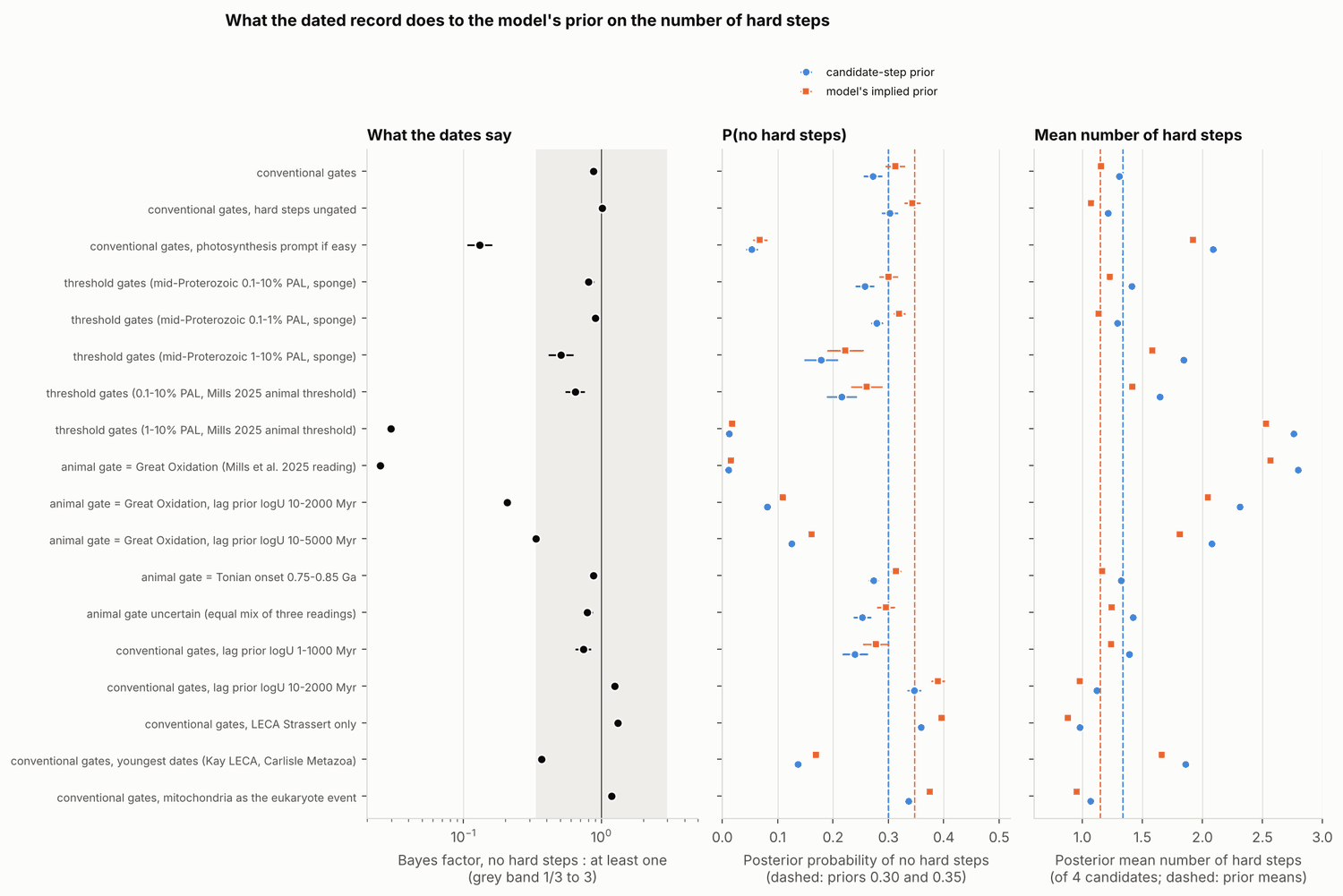
Four candidates (photosynthesis, eukaryotes, animals, humans). The model's 0.30/0.30/0.22/0.12/0.06 is a prior on candidate steps; its implied prior on hard steps has P(none) = 0.35 and mean 1.15. Both are shown. The Bayes factor is the transferable result.
| Variant | BF, none : at least one | P(none), prior 0.30 | P(none), prior 0.35 |
|---|---|---|---|
| Conventional gates | 0.87 | 0.27 | 0.31 |
| Animal gate: equal mix of three readings | 0.79 | 0.25 | 0.30 |
| Threshold gates, mid-Proterozoic 0.1-10% PAL | 0.81 | 0.26 | 0.30 |
| Lag prior 10-2000 Myr | 1.24 | 0.35 | 0.39 |
| Strassert LECA alone (highest) | 1.31 | 0.36 | 0.40 |
| Youngest dates (Kay, Carlisle) | 0.37 | 0.14 | 0.17 |
| Photosynthesis strict | 0.13 | 0.05 | 0.07 |
| Animal gate = Great Oxidation, lag means to 0.5 / 2 / 5 Gyr | 0.025 / 0.21 / 0.34 | 0.01 / 0.08 / 0.13 | 0.02 / 0.11 / 0.16 |
| Threshold gates with Mills et al.'s numbers | 0.030 | 0.01 | 0.02 |
Across 18 variants the Bayes factor runs from 0.025 to 1.31. The record never favours "no hard steps" by more than 1.3. It leaves the prior alone if a Neoproterozoic oxygen rise really was the animal gate, and counts 3- to 40-fold against "no hard steps" if oxygen sufficed from the Great Oxidation, with P(animals are a hard step) of 0.65-0.95. Which holds depends on the mid-Proterozoic oxygen level and the animal threshold, both unresolved.
Part 2: Phanerozoic innovations
| Reconstruction | n | O2 change before origin (points per 20 Myr) | Shift null, mean (5-95%) | p, shift | p, literature dates only |
|---|---|---|---|---|---|
| GEOCARBSULFOR median | 27 | 0.06 | 0.63 (-0.92 to 1.94) | 0.77 | 0.77 |
| COPSE standard | 31 | 1.14 | 0.41 (-0.32 to 1.37) | 0.10 | 0.13 |
| COPSE, no feedbacks | 31 | 0.75 | 0.55 (-0.80 to 1.71) | 0.42 | 0.55 |
| Charcoal midpoint | 15 | -0.46 | 0.19 (-1.26 to 1.35) | 0.74 | 0.90 |
- Effect sizes. Origins per Myr while oxygen is rising, relative to falling: 0.76, 1.22 and 0.44; null ranges span roughly 0.4-2.9. The reconstructions disagree on the sign and agree on the sign of 20-Myr change only 62% of the time (correlation 0.41).
- Reconstruction sensitivity. 200 GEOCARBSULFOR realisations: z from -1.60 to 0.15, none with p < 0.05. Ten COPSE variants: p from 0.09 to 0.43.
- Multiplicity. Of 140 oxygen tests (5 curves, 4 subsets, 7 statistics), 8 reach one-sided p < 0.05 in the direction gating predicts and 5 in the opposite direction; 7 are expected by chance each way. Among the 35 full-set tests none is significant in the gating direction (minimum p 0.097) and 2 are in the opposite direction.
- One nominal association. Against ordinary PBDB originations, COPSE gives p = 0.003 and all three curves show innovations within 50 Myr of a new oxygen high (p = 0.005-0.007). This is one coincidence: 13 innovations between 432 and 305 Ma, when oxygen first reached modern levels. The shift null treats it as one event (p = 0.12-0.26), and it is confounded, since land plants drove that rise.
- Minimum gate lag. For 10 of 31 innovations oxygen had already reached its level at origin more than 100 Myr earlier under every reconstruction; for 10 others the minimum lag is 50 Myr or less.
- Temperature and CO2. No association: p = 0.52, 0.70, 0.41.
Power. If half the innovations followed an oxygen threshold with a 10-Myr mean lag, the test would detect it with probability 0.78 (GEOCARBSULFOR) or 0.98 (COPSE) for 27 independent origins on the correct curve. The real origins form only 14 to 17 clusters; for 14 and 9 independent origins the power is 0.63 and 0.49, or 0.86 and 0.70. It falls to 0.18-0.56 at 30-Myr lags and 0.01-0.36 on the wrong reconstruction. The null excludes only prompt gating on a known curve.
Robustness checks
- Remaining habitable time 0.9 or 1.73 Gyr (baseline 8.0): 7.7 or 11.5.
- Five steps with the window starting 4.25-4.40 Ga (baseline 2.1): 7.2, with 8% of LUCA draws redrawn to postdate the start. The rise is the early-life evidence acting on the life step.
- Threshold gates (baseline 6.3): fire threshold for humans 9.0; first rather than permanent crossing for eukaryotes 2.5.
- Mitochondrial endosymbiosis as the eukaryote event: 18 (6.4 against gated-hard).
- Phanerozoic subsets (GEOCARBSULFOR, COPSE, charcoal): high oxygen demand p = 0.58, 0.17, 0.80; PBDB-dated only 0.45, 0.03, 0.42; older contested claims 0.54, 0.59, 0.62.
- Look-back window 10 / 20 / 40 Myr: GEOCARBSULFOR p = 0.50 / 0.77 / 0.46 (n = 27, 27, 23; 0.61 / 0.89 / 0.46 on the common 23); COPSE 0.13 / 0.10 / 0.08 (n = 31); charcoal 0.48 / 0.74 / 0.87 (n = 15, 15, 13).
Limitations
- One planet and three gated transitions; the choice of which events are "transitions" is inherited.
- Reverse causation: photosynthesis caused the Great Oxidation, the Neoproterozoic rise is partly biological, and land plants drove the Palaeozoic rise. Gate dates are not independent of the transitions they are said to gate.
- The gating likelihood largely measures coincidence between overlapping uncertainty windows.
- The animal gate is unresolved and decides the sign; the three-reading mix is a judgement.
- "Easy" means a mean lag under 500 Myr in the primary run. The project's model calls a step hard only below a 0.3 success probability, which admits waits of several Gyr; the wide-lag rows show the effect.
- Candidate pools are my own lists; six pool dates and six innovation dates are unverified.
- The Proterozoic oxygen history is parametric, not a reconstruction.
- Cleaned PBDB dates for tetrapods and pterosaurs are 6-10 Myr younger than the literature dates; fossil first appearances lag true origins by an unknown amount.
- The primary Phanerozoic statistic was designated after the battery was written; the battery is reported in full.
Closest prior work and what is new
- This project's timing study (section 4) compared the same three models on the same transitions: pacing : ungated 3.8-5.0 and pacing : gated-hard 1.1-2.1. With its dates (Kay LECA; animals 0.574-0.80 Ga) this code gives 2.2 and 0.68; with its lag prior as well, 5.4 and 1.7. The higher average here comes from adding Strassert's LECA range.
- Mills et al. 2025 propose gating and supply thresholds but compute no likelihoods.
- Carter 2007 and 2008, Watson 2008 and Lenton & Watson 2011 use the equal-spacing prediction without a gating alternative. Snyder-Beattie et al. 2021 infer step rates within the hard-steps family. Lingam & Loeb 2019 apply the framework across stellar types.
- Betts et al. 2018 already state that a LECA younger than 1.84 Ga falsifies a Great-Oxidation trigger for eukaryotes; Cole et al. 2020 that the animal oxygen gate could precede animals by billions of years or a few million.
- Payne et al. 2009 and Clapham & Karr 2012 test one trait each against oxygen; Ward et al. 2006, Dahl et al. 2010 and Falkowski et al. 2005 test one or a few innovations against one curve.
- Whitmire 2025 concerns the anthropic treatment of abiogenesis and is not a competing test.
New here: (1) an extension of the timing study's comparison to a chain with any subset of steps hard, across clock studies, gate definitions and step sets; (2) a calibrated measure of gate-choice flexibility; (3) a Bayes factor and posterior for the number of hard steps, with its one-sidedness; (4) a 31-innovation, three-reconstruction shift test with a power analysis. Confidence that this combination is new: medium.
Implications for the Fermi Paradox
The model's paired runs give P(no other civilisation ever arose in the Galaxy) of 0.69 with no hard steps and 0.92 with three or four, against 0.78 on the base priors. This study finds the dated record cannot move that toward the gating side.
- Keep the prior. With conventional gates P(no hard steps) goes from 0.35 to 0.31, worth about +0.005 on the 0.78 (my linear interpolation, not a model run).
- Do not cite the timing of eukaryotes, animals or humans relative to oxygenation as evidence for gradual, gated evolution. No variant favours it by more than 1.3.
- The uncertainty is one-sided. If oxygen sufficed for animals from the Great Oxidation, or if photosynthesis had no gate, the record points to at least one hard step and toward the 0.92 end.
Two measurements would settle it: the mid-Proterozoic oxygen level against the animal threshold, and an independently dated gate (or its absence) for oxygenic photosynthesis.
Recommended citation: the timing of eukaryotes, animals and humans relative to oxygenation gives gating-versus-hard-steps Bayes factors between 0 and 28 depending on the clock study, the gate definition and the step set; it does not support the no-hard-steps camp and, under one unresolved reading of the animal oxygen gate, counts against it; a 31-innovation Phanerozoic test finds no association with oxygen rises but has limited power. Do not cite 8.1 or a flexibility factor on its own.
Response to referee
Major points.
- Flexibility factor was a per-draw maximum. Accepted. Replaced by the best single assignment (28 and 386; ratios 67 and 181), with the pool-size-cubed ceiling, a prior over possible events, and recalibration on hard-step histories (17-22%). My values differ slightly from the referee's 26 and 358 because lags in the pool now follow the chain rule of the main model.
- "Gates named by proponents" was wrong for animals. Accepted. Relabelled throughout; Mills et al. re-read and quoted; eight animal-gate rows added. Carrying the Great-Oxidation reading into Part 3 changed that conclusion.
- The 8.3 hid a mean of 1.1, 2.0, 2.4 and 26. Accepted. Per-study values now lead; tail diagnostics added (83%, 53%, 62%).
- Undated steps are not "no information". Accepted. Wording removed, the factor of about 3.7 stated and explained, and a row conditioned on the photosynthesis date added (3.0).
Minor points. 5. Robustness baselines. Accepted. Baselines stated; 1.73 Gyr is 11.5 on twice the draws. LUCA draws are now truncated, not clipped. I do not accept that the window-start rise was only an artefact: it is still 7.2 against 2.1 after the fix, and is the early-life evidence. 6. Camp table overstates the lever. Accepted. Replaced by the paired-run contrast 0.69 to 0.92. 7. Prior is on candidate steps. Accepted. Both priors reported; Bayes factors lead. 8. Reverse causation applies to Part 1. Accepted. Added to the summary and limitations. 9. Power is an upper bound; window table n. Accepted. Power given for 27, 14 and 9 origins; cluster counts and n added. 10. PBDB records. Accepted. "Pentlandia" excluded (date unchanged); younger PBDB dates flagged; an all-literature-dates run added. 11. Multiplicity count. Accepted. All 140 tests counted in both tails. 12. Timing study as prior work. Accepted. Cited, reconciled with two new rows, and four further papers added after checking their records.
Files
- Code:
code/run_all.py(entry point),part1.py,part2.py,chain.py,classic.py,innovations.py,pbdb.py,curves.py,fetch_data.py,figures.py. - Tables:
data/(21 files, 0.6 MB; headline numbers indata/results.json). - Figures:
figures/fig1_transitions_vs_gates.png,fig2_bayes_factor_sensitivity.png,fig3_posterior_hard_steps.png,fig4_phanerozoic_oxygen_and_origins.png,fig5_phanerozoic_null_and_power.png.
Key numbers
| Quantity | Value | Uncertainty | Note |
|---|---|---|---|
| Bayes factor, gating : ungated hard steps, by eukaryote (LECA) date study (eukaryotes, animals, humans; conventional oxygenation-event gates; lag-mean prior log-uniform 10-500 Myr) | Betts 1.2, Kay 1.9, Parfrey 2.3, Strassert 28; equal-weight average 8.1 | average: Monte Carlo +/-2.4% (8 batches of 12,000 draws, batch sd 6.8%); single-study rows +/-1-2% | 83% of the average gating likelihood comes from the 25% of draws that use Strassert's range; the top 1% of draws carry 53%; 62% comes from the 6.8% of draws with a lag under 20 Myr |
| Bayes factor, gating : hard steps that also wait for the gate, by LECA study | Betts 0.39, Kay 0.66, Parfrey 0.79, Strassert 11; average 2.8 | average +/-2.3% | Gated-hard : ungated-hard is 2.8, so part of the average is knowledge of the gate, not ease of the step |
| Gating : hard steps by step set (conventional gates) | 3 steps from LUCA 8.0; 3 steps from photosynthesis 3.0; 4 steps 2.1; 5 steps 2.1 | Monte Carlo 2-4%; repeat runs with other seeds differ by 5-10% | Against gated-hard steps: 2.8, 2.9, 1.7, 2.5. An undated photosynthesis step is not neutral: it lowers gating : hard steps about 3.7-fold |
| Gating : hard steps (and : gated-hard) by definition of the animal gate | 0.80 Ga exactly 14 (2.3); Tonian onset 12 (2.0); Marinoan end 9.1 (3.5); window 0.539-0.80 Ga 8.0 (2.8); equal mix of three readings 6.9 (1.5); Great Oxidation 0.047 (0.010); Ediacaran oxygenation 0 | Monte Carlo 2-9% | Great Oxidation as the animal gate is the reading closest to Mills et al. 2025; with lag means allowed to 2 or 5 Gyr it gives 0.52 or 0.87. Independent recomputation: 7.96, 2.96 and 0.047 for the reference, from-photosynthesis and Great-Oxidation rows |
| Range of gating : hard steps over 48 analysis configurations | 0 to 28 | per-configuration Monte Carlo 1-20% | 30 above 3, 10 above 10, 7 below 1; against gated-hard steps 0.010 to 11, with 12 above 3 and 15 below 1 |
| Bayes factor, no hard steps : at least one hard step (four candidates), conventional gates | 0.87 | Monte Carlo +/-4% | P(no hard steps) 0.30 -> 0.27 under the candidate-step prior and 0.35 -> 0.31 under the model's implied hard-step prior |
| Same Bayes factor across clock-study, lag-prior and threshold variants that keep a Neoproterozoic animal gate | 0.37 to 1.31 | Monte Carlo 1-10% per variant | 0.79 with the animal gate mixed equally over three readings; maximum over all 18 variants 1.31 (Strassert LECA alone) |
| Same Bayes factor if oxygen sufficed for animals from the Great Oxidation | 0.025 (lag means to 500 Myr), 0.21 (to 2 Gyr), 0.34 (to 5 Gyr) | Monte Carlo 2-3% | P(no hard steps) 0.01 to 0.16; P(animals are a hard step) 0.65 to 0.95. Threshold version with Mills et al.'s numbers (animals 0.1-1% PAL, mid-Proterozoic 1-10% PAL): 0.030 |
| Same Bayes factor if oxygenic photosynthesis, when easy, must follow life promptly | 0.13 | Monte Carlo +/-10% | P(no hard steps) 0.05 (candidate prior) or 0.07 (implied prior); rests on an assumption, not on a dated gate |
| Gate-choice flexibility, pool of 8 oxygen events: equal-prior pool versus best single assignment chosen after the fact | 0.41 versus 28 (factor 67; ceiling 512) | Monte Carlo about 10% (referee's independent run: 0.29 and 26 without the chain rule) | 1.4 with the prior restricted to events that precede the transition. Pool of 14 events of any kind: 2.1 versus 386 (factor 181; ceiling 2,744). The first-pass 64 and 205-fold were a per-draw maximum, not a procedure |
| Fraction of hard-step histories in which the best-assignment procedure reaches its observed value | 19-21% (8 events), 17-22% (14 events) | 300 simulations each; binomial +/-2.3 points | Random gate-date triples reach the reference 8.1 in 1.3% of cases; hard-step histories with the conventional gates in 2.7-3.7% |
| Gate-to-transition lag, crown animals relative to the Neoproterozoic window | -0.03 Gyr | 16-84%: -0.15 to +0.09 Gyr; 60% of draws have animals before the gate | Eukaryotes after the Great Oxidation: 0.57 (0.23-0.75) Gyr. Humans after Palaeozoic oxygenation: 0.41 Gyr. Animals after the Great Oxidation, if that is the gate: 1.51 (1.44-1.62) Gyr |
| Spacing test, four transitions after LUCA: coefficient of variation of the five intervals | 0.31 observed, 0.75 null median | one-sided p = 0.03-0.04 | Weakens to p = 0.08-0.10 with LUCA added and 0.18-0.24 with land plants; time remaining consistent with the null (p 0.52-0.86). Not counted for either model |
| Phanerozoic primary test, mean O2 change over the 20 Myr before origin, GEOCARBSULFOR (27 innovations) | 0.06 percentage points versus null mean 0.63 | null 5-95%: -0.92 to 1.94; p = 0.77 | 200 Monte Carlo realisations of the curve: z from -1.60 to 0.15, none with p < 0.05. Literature dates for all innovations: p = 0.77 |
| Same test, COPSE standard (31 innovations) | 1.14 percentage points versus null mean 0.41 | null 5-95%: -0.32 to 1.37; p = 0.10 | 10 COPSE variants: p 0.09 to 0.43. Literature dates: p = 0.13. Against ordinary PBDB genus originations p = 0.003, but COPSE's rise is forced by plant evolution |
| Same test, charcoal envelope midpoint (15 innovations) | -0.46 percentage points versus null mean 0.19 | null 5-95%: -1.26 to 1.35; p = 0.74 | Literature dates: p = 0.90 |
| Rate ratio of origins while O2 is rising versus falling | 0.76 (GEOCARBSULFOR), 1.22 (COPSE), 0.44 (charcoal) | null 5-95% roughly 0.4 to 2.9 in each case | The reconstructions disagree on the sign; GEOCARBSULFOR and COPSE agree on the sign of 20-Myr change 62% of the time (correlation 0.41) |
| Oxygen tests with one-sided p < 0.05 across the full battery of 140 (5 curves x 4 subsets x 7 statistics) | 8 in the direction gating predicts, 5 in the opposite direction | 7 expected by chance in each direction | Full-set tests (35): none in the gating direction (minimum p 0.097), 2 in the opposite direction (minimum p 0.013) |
| Power of the Phanerozoic test if half the innovations follow an oxygen threshold with a 10 Myr mean lag, correct curve | at most 0.78 (GEOCARBSULFOR) and 0.98 (COPSE); 0.49-0.86 for 9-14 independent origins | 300 simulations per cell; +/-0.03 | 30 Myr lag: 0.18-0.56. Wrong reconstruction: 0.01-0.36. The real origins form 14 to 17 clusters, so the 27-origin power is an upper bound |
| Innovations whose minimum possible oxygen-gate lag exceeds 100 Myr under every reconstruction | 10 of 31 | 10 others have a minimum lag of 50 Myr or less in every curve that covers them |
Changes made after the referee report
- Headline and answer rewritten around the spread, not the average: per-study Bayes factors (1.2, 1.9, 2.3 and 28; against gated-hard 0.39, 0.66, 0.79 and 11) are given beside the equal-weight averages (8.1 and 2.8), with the step-set range 2.1-8.0.
- 'Gates named by proponents' relabelled 'conventional oxygenation-event gates' in code, tables and Figures 1-3; Mills et al. 2025 re-read in full text and quoted ('controversial and essentially unknown'; animals excluded only before about 2.2 Ga).
- New rows for the animal gate: 0.80 Ga, Tonian onset, Marinoan end, Ediacaran oxygenation, Great Oxidation (with lag means to 500 Myr, 2 Gyr and 5 Gyr), and an equal-weight mix of three readings; the Great-Oxidation reading was also carried into the posterior over hard steps, which changed the Part 3 conclusion from 'stays near the prior' to 'never favours no hard steps; may count strongly against it'.
- Flexibility analysis redone: the per-draw maximum (64 and 1,899) replaced by the best single assignment (28 and 386; factors 67 and 181), with the pool-size-cubed ceiling, a prior restricted to possible events (1.4 and 12), the number of assignments beating the conventional gates (7 of 512; 68 of 2,744) and recalibration on hard-step histories (17-22%, with exact and blurred dates). Lags in the pool now follow the chain rule of the main model.
- 'Agnostic, no information' removed from text and docstring; the factor of about 3.7 from counting photosynthesis is stated and explained, and a new configuration conditions both models on the photosynthesis date (3.0 and 2.9).
- Tail diagnostics added to the reference run: share of the gating likelihood by clock study (Strassert 83%), in the top 1% of draws (53%) and in draws with a lag under 20 Myr (62% from 6.8% of draws).
- LUCA draws that predate the window start are now redrawn (truncation) instead of clipped to a 10-Myr lag; the late-window-start row is reported against its 5-step baseline (7.2 against 2.1, 8% of draws redrawn).
- Robustness rows given with their correct baselines; remaining habitable time rows run on twice as many draws (1.73 Gyr: 11.5); Bayes-factor table now on 3 batches with batch-scatter errors.
- Part 3: posteriors computed under both the candidate-step prior (0.30) and the model's implied hard-step prior (0.347, mean 1.15); Bayes factors presented as the transferable result; full range including strict and Great-Oxidation variants reported.
- Reverse causation added to Part 1 limitations and to the summary; implications rewritten with the paired-run contrast 0.69 to 0.92 instead of the camp table.
- Part 2: 'Pentlandia' excluded (2 records; date unchanged); PBDB dates younger than the literature flagged (tetrapods, pterosaurs); new run with literature dates for all 31 innovations (p = 0.77, 0.13, 0.90); all 140 oxygen tests counted in both tails; look-back-window table gives n and both innovation sets; power computed for 27, 14 and 9 independent origins and quoted as an upper bound; number of origin clusters reported.
- Prior work: timing study cited as closest prior and reconciled with two new rows (2.2 and 0.68 with its dates; 5.4 and 1.7 with its dates and lag prior); Betts 2018, Cole 2020, Payne 2009, Clapham & Karr 2012 and Carter 2007 added after checking their records; Whitmire 2025 retrieved and described.
- Independent recomputation (no study code) of the reference, from-photosynthesis and Great-Oxidation rows: 7.96, 2.96, 0.047 against 8.0, 3.0, 0.047. Two full runs of run_all.py give byte-identical tables (20 of 21 files; results.json differs only in the runtime field).
Referee points not accepted
- Partly rejected: 'the rise in the late-window-start row is an artefact of clipping'. Clipping did inflate it (8.8 to 7.2 once LUCA draws are truncated instead; the referee's exclusion gave 6.2), but the row is still 3.4 times its 5-step baseline of 2.1. The remainder is real: with a later start, LUCA follows habitability sooner, which is the early-life evidence acting on the life step, not gating of the later transitions. The row is kept and described that way.
- Adopted in substance but not in number: the referee's best-single-assignment values (26 against 0.29, factor 87; 358 against 2.0, factor 180). I report 28 against 0.41 (factor 67) and 386 against 2.1 (factor 181) because the pool calculation now measures each lag from the later of the gate and the previous transition, as the main chain model does; the referee measured from the gate alone. The conclusion is the same.
- Amended: the requested one-line citation 'does not move the prior on the number of hard steps'. That holds for the conventional gates (0.87) and for the three-reading mix (0.79), but the revision shows the uncertainty is one-sided: no variant favours 'no hard steps' by more than 1.3, while the reading closest to Mills et al.'s own numbers disfavours it 3- to 40-fold. The recommended citation says so. The quoted range is 0 to 28 rather than 0.01 to 26, since the referee's own Ediacaran-gate case is exactly zero.
- Minor numerical differences from the referee's quick checks, kept as computed: conditioning on the photosynthesis date gives 3.0 (dates are a mixture, not a point at 2.75 Ga), not 3.5; power for 9-14 independent origins is 0.49-0.86, not 0.45-0.82; the posterior under the implied prior with conventional gates is 0.31, not 0.33.
Figures
Code
Every number above is produced by these scripts from public data. The data tables themselves are not hosted here; the scripts download them.
chain.py classic.py config.py curves.py fetch_data.py figures.py innovations.py lit_lookup.py part1.py part2.py pbdb.py run_all.py
Referee report
A second, separate analysis re-ran the code, recomputed the main numbers by its own route and tried to break the result. Like the first, it was run by Claude for this project; it is not an outside expert. In its report “the analyst” is the first analysis, which wrote the paper, and file names that are not linked on this page are its own working files. The paper above is the version revised in response.
Verdict: sound with fixes. Results reproduced: yes.
The conclusion (the dated record cannot separate hard steps from gating; keep the prior) is true and every number reproduces. What is wrong is the labelling and framing of four headline numbers.
Full rerun. I copied the code to a separate working
folder and ran run_all.py (542 s, one core, cached raw
inputs). All 19 files in data/ are identical to the analyst's: every
numeric cell of the 16 CSVs, and the 3 JSON files apart from runtime.
Every number I checked in the report text against those tables matches
(Bayes-factor table, counts 24/8/3 and 10/11 of 37, lags, posterior
table, Part 2 table, subsets, rate ratios, power, curve agreement).
Independent recomputation of Part 1
(referee/indep_bf.py: my own date draws, analytic volume
for gated-hard steps, completion probability by forward simulation
instead of the grid pass, 400,000 draws):
| Quantity | Mine | Analyst |
|---|---|---|
| Gating : hard steps, headline | 8.18 +/- 0.10 | 8.33 |
| Gating : gated-hard | 2.89 +/- 0.03 | 2.95 |
| Gated-hard : hard | 2.83 | 2.82 |
| LECA Parfrey / Betts / Strassert / Kay | 2.30 / 1.16 / 27.4 / 1.96 | 2.4 / 1.1 / 26 / 2.0 |
| Metazoa dos Reis / Lole Durbin / Carlisle | 6.35 / 6.75 / 11.0 | 6.9 / 6.1 / 11 |
| Lag prior 1-1000 / 10-2000 Myr | 7.4 / 10.7 | 6.9 / 10 |
| Remaining habitable time 1.73 Gyr | 11.6 +/- 0.2 | 13.3 (a high Monte Carlo draw from 24,000 samples) |
| Fraction of draws with gating likelihood zero | 0.621 | 0.62 |
Independent recomputation of Part 2
(referee/indep_part2.py: GEOCARBSULFOR median rebuilt from
the raw .mat, 947 of 1000 realisations, agreeing with the analyst's
table to 5e-5; median origin dates):
| Curve | Observed vs null mean | p (mine) | p (analyst) |
|---|---|---|---|
| GEOCARBSULFOR | -0.04 vs 0.63 | 0.77 | 0.78 |
| COPSE standard | +1.12 vs 0.41 | 0.10 | 0.10 |
| Charcoal | -0.47 vs 0.19 | 0.74 | 0.75 |
With literature dates for all 31 innovations instead of PBDB dates: p = 0.75, 0.16, 0.84. The null is robust to the dating route.
Other checks.
- Part 3 posterior, named gates, six fresh seeds: P(no hard steps) =
0.280 +/- 0.005 (
referee/post_scatter.py). - Citations read in Europe PMC full text and confirmed: Kay et al. (Nature 650:129; LECA 1.80-1.67 Ga, mFECA 2.37-2.13 Ga, endosymbiosis about 2.2 Ga), Carlisle 2024 (613.2-593.4 Ma), Fournier 2021 (2960, 3275-2780 Ma), Strassert 2021 (2386-1958 Ma), Parfrey 2011 (1866-1679 Ma), Betts 2018 (below 1.84 Ga; mitochondria 2.053-1.21 Ga), Mills 2025 thresholds (0.001-0.4%, 0.1-1%, 53-59%, 87.8% PAL; POE 420-400 Ma). Lole Durbin et al. 2026 confirmed through press coverage only (DOI 10.1126/sciadv.aeg6289).
- PBDB first appearances inspected for seven innovations (see minor errors).
Strongest objection
A geobiologist would say the gate-lag likelihood measures coincidence between overlapping uncertainty windows, not gating. The gates are neither independently defined nor exogenous: oxygenic photosynthesis caused the Great Oxidation, the 0.54-0.80 Ga Neoproterozoic window is drawn around the same interval in which complex life appears, land plants drove the Palaeozoic rise, and Mills et al. themselves call the animal oxygen threshold 'essentially unknown'.
The numbers bear this out. 62% of the gating likelihood comes from the 7% of draws in which a transition lands within 20 Myr after its gate draw. 83% comes from the one clock study (Strassert) whose LECA range overlaps the Great Oxidation window. Changing only the animal gate moves the Bayes factor from exactly 0 (Ediacaran oxygenation at 0.55-0.56 Ga, which every clock date for animals precedes) through 0.05 (oxygen already sufficient after the Great Oxidation) to 14 (0.80 Ga). On top of that sits Carter's own point: conditional on success, the timing of a hard step says almost nothing about its difficulty, so three dates cannot separate a hard step from an exponential lag of a few hundred Myr.
The conclusion survives, and is strengthened: the dated record does not move the prior on hard steps, and the model should keep it. What does not survive is any use of the individual numbers (8.3, 3.0, 200-fold, 0.28) as evidence for either camp, or the phrasing that gating 'beats' hard steps under 'proponents' gates'.
Errors found
- major. The 'flexibility factor about 205' and
'Bayes factor 64 post hoc' are not what the report says they are. The
code takes the best-fitting gate separately for every Monte Carlo draw
of the dates (mean over draws of the per-draw maximum, part1.py
flexibility(), dens_best), not one gate chosen after the fact per
transition. The ratio is also bounded by pool size cubed (512 for 8
events, 2,744 for 14), so it mostly measures the length of the analyst's
list.
- Evidence: referee/flex_check.py, 60,000 draws: pool of 8 gives pool-prior 0.294, per-draw maximum 59.7, best single assignment 25.6 via Lomagundi end / Tonian onset / Permo-Carboniferous peak. Pool of 14 gives 2.00, 1,874 and 358 (humans paired with the Eocene-Oligocene glaciation). Of the 8 oxygen events, 4 have zero likelihood for eukaryotes and 6 are below 0.1 per Gyr for animals.
- Fix: Replace with the single best assignment: Bayes factor 26 against 0.29 (factor about 87) for 8 events, 358 against 2.0 (factor about 180) for 14. State the ceiling of pool size cubed and that the 1-in-8 prior includes events that postdate the transition. Reword 'falls to 0.3-2 once the freedom to choose gates is priced in' to 'is 0.3-2 under an equal-prior pool of the analyst's own choosing'. Rerun the 12% and 7% calibrations with the corrected procedure.
- major. The headline configuration is labelled 'the
gates that gating proponents name', but Mills et al. 2025 do not name
the Neoproterozoic oxygenation window as the animal gate. Their text
says the lower oxygen limit for animal multicellularity is
'controversial and essentially unknown', that it is 'debated whether
animal multicellularity originated only shortly after its minimum O2
requirements became established', and commits only to animals being
precluded before the Great Oxidation. The 0.539-0.80 Ga window is this
project's construction, inherited from the timing study, and it is the
step that carries the average gating signal.
- Evidence: Mills et al. 2025 full text (PMC11827626), section on oxygen requirements. referee/gate_variants.py, 600,000 draws, gating : hard steps and gating : gated-hard by animal gate: 0.539-0.80 Ga 8.0 and 2.8; Tonian onset 0.75-0.85 Ga 11.8 and 1.9; 0.80 Ga exactly 14.1 and 2.2; Marinoan end 8.8 and 3.4; Ediacaran oxygenation 0.55-0.56 Ga (Dahl 2010) exactly 0, since every clock date precedes it; Great Oxidation 0.05 and 0.01.
- Fix: Relabel 'named gates' throughout (headline, tables, Figs 1-3) as 'conventional oxygenation-event gates (GOE, NOE, POE)'. Say that with Mills et al.'s own numbers (animals 0.1-1% PAL, mid-Proterozoic oxygen usually 1-10% PAL) the animal gate is the Great Oxidation and the Bayes factor is 0.06. Add a row showing the dependence on the animal gate definition.
- major. The report says the support for gating
'comes from one transition (animals)'. That is true of the per-step
averages but hides that 8.3 is the arithmetic mean of 1.1, 2.0, 2.4 and
26 over four LECA studies. For three of the four studies gating loses to
gated-hard steps (0.39, 0.68, 0.79). The gating likelihood is a
heavy-tailed average dominated by draws in which two overlapping
uncertainty windows happen to line up.
- Evidence: referee/gate_variants.py: 83% of the gating marginal likelihood comes from the 25% of draws that use Strassert's LECA range (1.958-2.386 Ga, overlapping the 2.22-2.46 Ga gate window). The top 1% of draws carry 54% of it. 62% comes from the 7% of draws in which a transition falls within 20 Myr after its gate draw.
- Fix: In the headline and the answer paragraph, give the per-study values beside the mean: 'gating : hard steps is 1.1-2.4 for three of four LECA dates and 26 for Strassert; equal-weight average 8.3; against gated-hard steps 0.4-0.8 and 10, average 3.0'. Remove or qualify 'real but small' in the implications. Add the tail diagnostics to the Monte Carlo note.
- major. Steps with no dated gate are described as
'flat density, no information', yet adding them changes the gating :
hard steps Bayes factor from 8.3 (3 steps) to 2.4 (4 steps) and 2.3 (5
steps), and gating : gated-hard from 3.0 to 2.0. Under Carter's model
the first of four ordered uniform steps is predicted early
(order-statistics factor), while the 'agnostic' gating step is flat over
the whole 5.2 Gyr window. The headline quotes only the largest of the
three values, which corresponds to a Carter model with no hard step
between LUCA and eukaryotes, a version nobody holds if photosynthesis
counts as a step.
- Evidence: data/part1_bayes_factors.csv rows 0-2 (C3, C4, C5). Analytic check: 4-step over 3-step likelihood ratio is 0.77 under hard steps and about 0.2 under agnostic gating. Conditioning both models on photosynthesis at about 2.75 Ga gives about 3.5.
- Fix: Quote gating : hard steps as '2.3 to 8.3 depending on whether photosynthesis and LUCA are counted as steps' in the headline. Replace 'no information' with a statement of the factor of about 3.5 and its origin. Note that Part 3 uses the four-step set throughout.
- minor. Robustness line 'Window start after the last
ocean-vaporising impact (5 steps): 8.8' reads as confirming the 8.3. Its
baseline is the 5-step value 2.3, and the rise is an artefact: LUCA
draws older than the window start are clipped to exactly 10 Myr after
it, where the gating density is maximal. 'Fire threshold 7.4' and 'first
crossing 2.6' are likewise variants of the threshold-gate baseline 5.9,
not of 8.3. The '13' for 1.73 Gyr is a high Monte Carlo draw.
- Evidence: referee/c5_check.py: with start 4.25-4.40 Ga, 8.2% of draws are clipped and carry 42% of the gating likelihood; excluding them gives 6.2; the default start gives 2.2. referee/indep_bf.py: 11.6 +/- 0.2 for 1.73 Gyr.
- Fix: State the correct baseline for each robustness row. For the window-start row either drop it or truncate rather than clip and report the clipped fraction. Give 1.73 Gyr as about 12.
- minor. The implications paragraph presents the camp
table (0.38 gradual, 0.71 base, 0.93 Carter) as the size of the
hard-steps lever. The 'gradual evolution' camp also raises P(life starts
easily) from 0.20 to 0.60, so the 0.38 is not a hard-steps-only
contrast.
- Evidence: report/tables_v4.md, section D, columns 'P(easy life) before / after'.
- Fix: Use the paired-run numbers from the study plan: 0.69 with no hard steps, 0.92 with three or four.
- minor. The prior 0.30/0.30/0.22/0.12/0.06 is the
model's prior on candidate steps, not on hard steps. The model's implied
prior is P(no hard steps) = 0.349 with mean 1.15, because a candidate
step may turn out not to be hard.
- Evidence: tables_v4.md rows 'No hard steps (gated)' and 'Mean number of hard steps', first column; MODEL4_NOTES.md line 13.
- Fix: Report the Bayes factors (0.37-1.27) as the transferable result and give the posterior under the model's implied prior as well (0.349 becomes about 0.33 for the conventional gates).
- minor. Reverse causation is flagged only for Part
2. It applies equally to Part 1: oxygenic photosynthesis caused the
Great Oxidation, the Neoproterozoic rise is plausibly in part a
consequence of eukaryotic algae and animals, and land plants drove the
Palaeozoic rise. The gate dates are not exogenous to the transitions
they are said to gate.
- Evidence: Betts et al. 2018 abstract: the Great Oxidation 'significantly predates the origin of modern Cyanobacteria'; modern eukaryotes '<1.84 Ga, falsifying the hypothesis that the GOE facilitated their radiation'. The report's own Part 2 caveat on land plants.
- Fix: Add this to the Part 1 limitations and to the answer paragraph. It is a further reason the gate-lag likelihood cannot be read as support for gating.
- minor. The quoted power (0.78 and 0.96) assumes 27
independent origins. The real innovations are clustered (13 between 432
and 305 Ma; four Cambrian ones within 6 Myr), so the effective number is
smaller and the power is an upper bound. Separately, the
window-sensitivity table uses 23 GEOCARBSULFOR innovations, not 27: its
20-Myr row is p = 0.90, not the primary 0.78.
- Evidence: referee/power_n.py, half gated, 10-Myr lag, correct curve: n = 27, 14, 9 gives 0.78, 0.57, 0.45 (GEOCARBSULFOR) and 0.96, 0.82, 0.73 (COPSE). data/part2_window_sensitivity.csv.
- Fix: Quote power as 'at most 0.78-0.96; 0.45-0.82 for 9-14 effectively independent origins'. Give n beside the look-back-window p-values.
- minor. PBDB first appearances. The 'jaws'
first-appearance taxon is 'Pentlandia sp.', a Devonian lungfish genus
recorded in the Aeronian of Norway, which is a database misassignment;
the date survives only because Qianodus duplicis is in the same stage.
The tetrapod date (Acanthostega, Famennian, 372-359 Ma) is younger than
the Frasnian body fossils cited in the same row (380-372 Ma). The
pterosaur date is 215 Ma against 227 Ma in the literature.
- Evidence: Oldest cleaned records in occs_jaws.csv and occs_tetrapods.csv. Literature dates for all 31 give p = 0.75, 0.16, 0.84.
- Fix: Exclude Pentlandia with a stated reason. Note where the cleaned PBDB date is younger than the accepted literature date. No change to the test outcome.
- minor. Multiplicity count. The tests file holds 7
statistics per curve and subset (140 oxygen tests), not the 5 (100) the
report describes. The report does not say which five were counted. In
the opposite tail 7 tests reach p < 0.05, including innovations
sitting at low oxygen quantiles under GEOCARBSULFOR (p = 0.013).
- Evidence: data/part2_tests.csv; referee/indep_part2.py.
- Fix: Name the five statistics counted, or report 5 of 140 one-sided together with the opposite-tail count.
- minor. The report and novelty statement do not say
that this project's timing study already computed the three-model
comparison on the same transitions (pacing : gated-hard 1.1-2.1; pacing
: ungated 3.8-5.0; 56-57% of draws with a transition before its gate),
nor why the values differ here.
- Evidence:
- Fix: Cite the timing study as the closest prior work for novelty item (1) and reconcile: the timing study used Kay's LECA and animals at 0.80-0.574 Ga; adding Strassert's LECA range raises the average.
Overclaims
- 'With the gates that gating proponents name': Mills et al. 2025 do not name the Neoproterozoic window as the animal gate; they call the animal threshold 'essentially unknown'.
- 'Gating beats Carter's hard steps by a Bayes factor of 8.3': this is the mean of 1.1, 2.0, 2.4 and 26 over four LECA studies and the largest of 8.3, 2.4 and 2.3 over the 3-, 4- and 5-step sets.
- 'Inflates the Bayes factor about 200-fold (0.31 versus 64)': an actual post hoc choice of one gate per transition gives 26, a factor of about 87, and the factor is bounded by pool size cubed.
- 'Falls to 0.3-2 once the freedom to choose gates after the fact is priced in': true only under an equal-prior pool of the analyst's own devising that includes events postdating the transition.
- 'The apparent support for gating is real but small, comes from one transition (animals)': 83% of the gating likelihood comes from one LECA clock study.
- 'Treated agnostically (flat density, no information)': adding the step changes gating : hard steps by a factor of about 3.5.
- 'The test would detect it with probability 0.78 or 0.96': upper bounds that assume 27 independent origins; 0.45-0.82 for 9-14 effective origins.
- Implications: the 0.38 / 0.71 / 0.93 camp contrast overstates the hard-steps lever, because the gradual camp also triples P(life starts easily); the paired-run contrast is 0.69 to 0.92.
Novelty check
Novel: partly. I found no published marginal-likelihood comparison of gating against hard steps on the dated transitions. I searched arXiv five ways and the web three ways for replies to or quantitative tests of Mills et al. 2025 and found none. Three of the four claimed novelties stand as new to the literature: the gate-choice flexibility calibration (once corrected), the posterior over the number of hard steps, and the 31-innovation, three-reconstruction shift test with a power analysis. The first claimed novelty, the three-model Bayes-factor comparison, is an extension of section 4 of this project's own timing study, not new within the project, and should be described that way. The qualitative content of the two decisive levers is already in the literature: Betts et al. 2018 state that a LECA younger than 1.84 Ga falsifies a Great-Oxidation trigger for eukaryotes, and Cole et al. 2020 state that estimates of when environments became oxygenated enough for animals range from billions of years to a few million years before animals. Both should be cited. Whitmire 2025 was not retrieved by the analyst; per the timing study it concerns the anthropic treatment of abiogenesis and is not a competing test.
- This project's timing study, section 4 (pacing versus gated and ungated hard steps on eukaryotes, animals, humans; Bayes factors 1.1-2.1 and 3.8-5.0)
- Mills, Macalady, Frank & Wright 2025, Sci. Adv. 11:eads5698 (qualitative gating proposal; no likelihoods; animal oxygen threshold called 'essentially unknown')
- Betts et al. 2018, Nat. Ecol. Evol. 2:1556 (LECA younger than 1.84 Ga 'falsifying the hypothesis that the GOE facilitated their radiation')
- Cole et al. 2020, Geobiology 18:260, 'On the co-evolution of surface oxygen levels and animals' (the gate could precede animals by billions of years or by a few million)
- Payne et al. 2009, PNAS 106:24 (two step increases in maximum body size at about 1.9 Ga and in the late Neoproterozoic to early Palaeozoic, tied to oxygenation)
- Clapham & Karr 2012, PNAS 109:10927 (quantitative test of insect size against atmospheric oxygen; tracks oxygen for only the first 150 Myr)
- Carter 2007, arXiv:0711.1985, 'Five or six step scenario for evolution?' (spacing prediction; raises oxygenation as a candidate step)
Required changes
- Headline and answer paragraph: replace 'gating beats Carter's hard steps by 8.3 ... only 3.0 against gated-hard' with the spread. Gating : hard steps is 1.1-2.4 for three of four LECA studies and 26 for Strassert (equal-weight average 8.3), and 2.3-2.4 when photosynthesis or LUCA are counted as steps. Gating : gated-hard is 0.4-0.8 for three of four LECA studies, 10 for Strassert, average 3.0.
- Relabel 'gates named by proponents' / 'named gates' everywhere (text, Data table, Figs 1-3) as 'conventional oxygenation-event gates (GOE, NOE, POE)'. Quote Mills et al. 2025 that the animal threshold is 'essentially unknown' and note that with their own numbers the Bayes factor is 0.06.
- Add a row on the animal gate definition: Tonian onset 11.8 and 1.9, 0.80 Ga 14 and 2.2, Marinoan end 8.8 and 3.4, Ediacaran oxygenation 0, Great Oxidation 0.05 and 0.01 (gating : hard steps and gating : gated-hard).
- Flexibility: replace the per-draw maximum with the best single assignment (26 for 8 events, about 358 for 14; factors about 87 and 180). State the pool-size-cubed ceiling and that the pool prior includes impossible pairings. Rerun the 12% and 7% calibrations. Soften 'falls to 0.3-2 once priced in' to 'is 0.3-2 under an equal-prior pool of my own choosing'.
- Replace 'treated agnostically (flat density, no information)' in Method and in the Part 1 docstring with a statement that the undated step lowers gating : hard steps by a factor of about 3.5 (8.3 to 2.4) and gating : gated-hard from 3.0 to 2.0, and why.
- Implications: delete 'real but small, comes from one transition (animals)' and say the average is dominated by one LECA study and by near-zero-lag draws. Replace the camp-table contrast 0.38 / 0.71 / 0.93 with the paired-run contrast 0.69 (no hard steps) to 0.92 (three or four).
- Monte Carlo note: add that the top 1% of draws carry about 54% of the gating likelihood, 83% comes from Strassert draws, and 62% from lags under 20 Myr.
- Robustness section: give the correct baseline for each line (5-step 2.3 for the window-start row; threshold-gate 5.9 for the fire and first-crossing rows). Fix or drop the window-start row (8% of LUCA draws clipped to a 10-Myr lag carry 42% of the likelihood; 6.2 without them). Give 1.73 Gyr as about 12.
- Part 3: state that the prior used is the model's candidate-step prior, give the model's implied prior on hard steps (P(0) = 0.349, mean 1.15), and present the Bayes factors 0.37-1.27 (0.12 under the strict photosynthesis assumption) as the transferable result. Quote the full range of P(no hard steps) as 0.05-0.35 when the strict variant is included.
- Limitations, Part 1: add reverse causation (photosynthesis caused the Great Oxidation; the Neoproterozoic and Palaeozoic rises are partly biological) and that gate dates are therefore not exogenous.
- Part 2: quote power as an upper bound (0.45-0.82 for 9-14 effective origins). Give n = 23 for the GEOCARBSULFOR look-back-window rows. Name the five statistics in the '5 of 100' count or report 5 of 140. Exclude the misassigned 'Pentlandia' record and note that the PBDB tetrapod and pterosaur dates are younger than the literature dates.
- Prior work: cite this project's timing study (section 4) as the closest prior for the Bayes-factor comparison and reconcile the values. Add Betts et al. 2018 (eukaryote lag), Cole et al. 2020 (animal gate ambiguity), Payne et al. 2009 and Clapham & Karr 2012 (quantitative oxygen-innovation tests).
- For the final report, cite this study only as: 'the timing of eukaryotes, animals and humans relative to oxygenation gives Bayes factors between about 0.01 and 26 depending on the clock study, the gate definition and the step set, and does not move the prior on the number of hard steps; a 31-innovation Phanerozoic test finds no association with oxygen rises but has limited power'. Do not cite 8.3 or the 200-fold figure on their own.