Where is everybody? · Working papers
How much of a head start did other planets have?
Revised after a second, separate analysis run for this project tried to break it. Neither analysis is an outside expert.
About 70% of the Sun-like (0.8-1.2 Msun) stars now residing in the solar cylinder are older than the Sun, but the first-pass precision did not survive review.
Summary
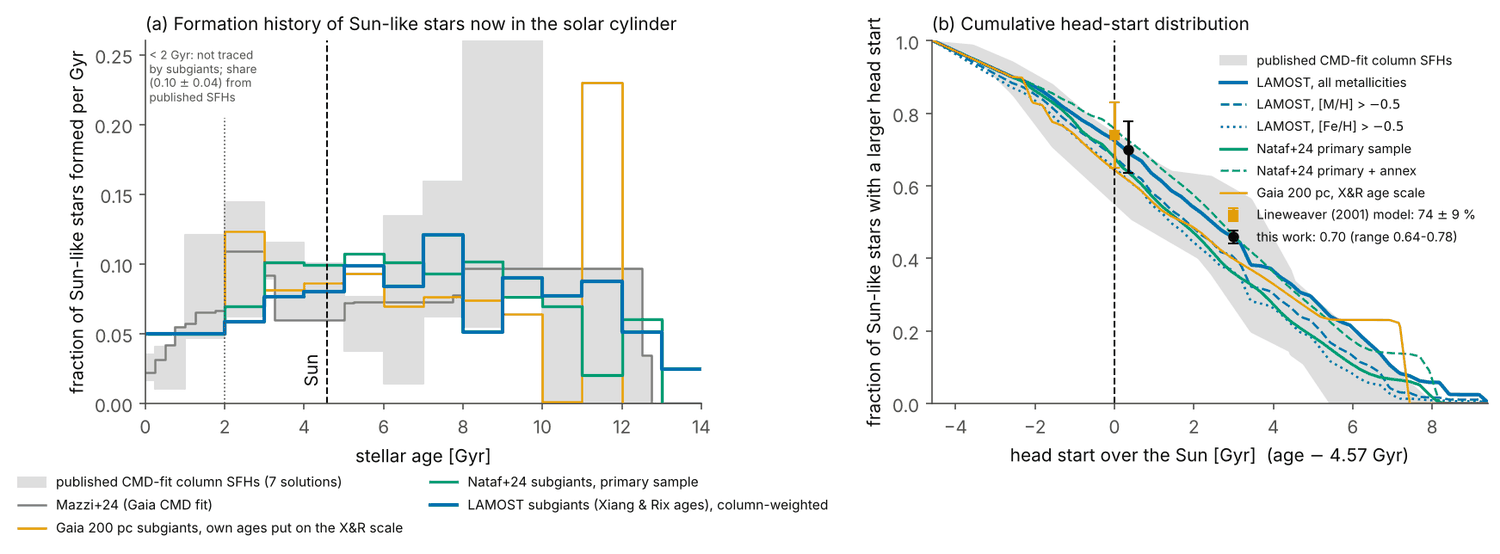
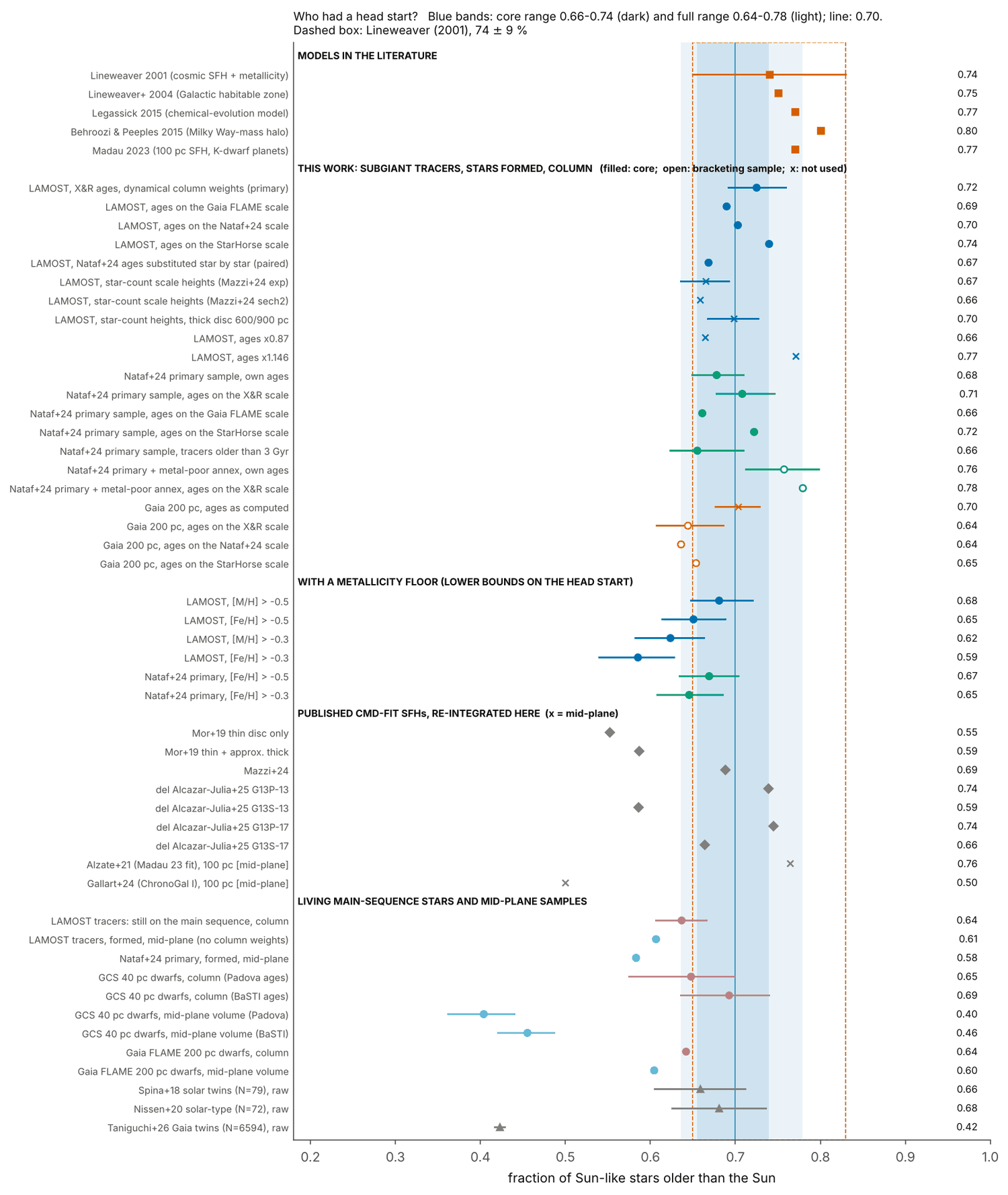
About 70% of the Sun-like (0.8-1.2 Msun) stars now residing in the solar cylinder are older than the Sun, but the first-pass precision did not survive review. The primary LAMOST subgiant sample gives 0.725 (0.692-0.759, statistical plus young-fraction prior); the two well-characterised subgiant samples (LAMOST and the newly added Nataf+24 primary sample) on four published age scales span 0.66-0.74, and two weaker bracketing samples widen the systematic range to 0.64-0.78. That is consistent with Lineweaver's 74 +/- 9% and does not test it more sharply; published star-formation histories give 0.55-0.74. Older stars lead the Sun by a mean of 4.1 Gyr (3.4-4.4 Gyr across estimates) and 16-31% of all Sun-like stars lead by more than 5 Gyr. The Fermi-clock consequence is robust to all of this: if no settlement has occurred and a settled Galaxy would be evident, p < 1.0e-9 to 1.2e-9 (95%) for the fiducial 2.5-2.9e9 planets, or 3.4e-9 to 7.9e-9 once the uncertainty in star count and eta_Earth is marginalised.
Key numbers
| Quantity | Value | Uncertainty | Note |
|---|---|---|---|
| Fraction of Sun-like stars now in the solar cylinder that are older than the Sun (adopted) | 0.70 | systematic range 0.64-0.78; core range 0.66-0.74 (10 estimates from LAMOST and Nataf+24 primary on four published age scales) | Adopted value is the midpoint of the core envelope. Lower edge of the full range: Gaia 200 pc sample rescaled to the Nataf+24 scale (0.636). Upper edge: Nataf+24 primary + metal-poor annex on the X&R scale (0.779). |
| Primary estimate: LAMOST subgiants, Xiang & Rix ages, dynamical column weights | 0.725 | 0.692-0.759 (16-84%, bootstrap plus young-fraction prior only) | 8,525 stars, 100 bootstrap resamples. This interval is statistical; it is not the uncertainty of the result. |
| Nataf+24 primary sample (new in revision) | 0.678 own ages; 0.708 on the X&R scale; 0.661 FLAME scale; 0.722 StarHorse scale; 0.655 with tracers older than 3 Gyr | 0.649-0.709 (own ages); 0.678-0.746 (X&R scale) | 17,107 stars. Agrees with LAMOST to 0.02 once on one age scale. |
| Nataf+24 primary + metal-poor annex (bracketing, upper) | 0.757 own ages; 0.779 on the X&R scale | 0.712-0.798 (own ages) | Annex selection modelled approximately; combined sample is kinematically colder at old ages than the primary (rms v_z 26 vs 32 km/s at 10-12 Gyr), suggesting contamination. |
| Gaia 200 pc subgiants, this study's own ages (bracketing, lower) | 0.703 as computed (biased); 0.644 on the X&R scale (mid-plane 0.543); 0.636 on the Nataf+24 scale; 0.654 on the StarHorse scale | 0.607-0.686 on the X&R scale | No longer called an independent replication. Lower than LAMOST by 0.07-0.08 on each of three common age scales; cause not established. 32% of the sample has RUWE > 1.4. |
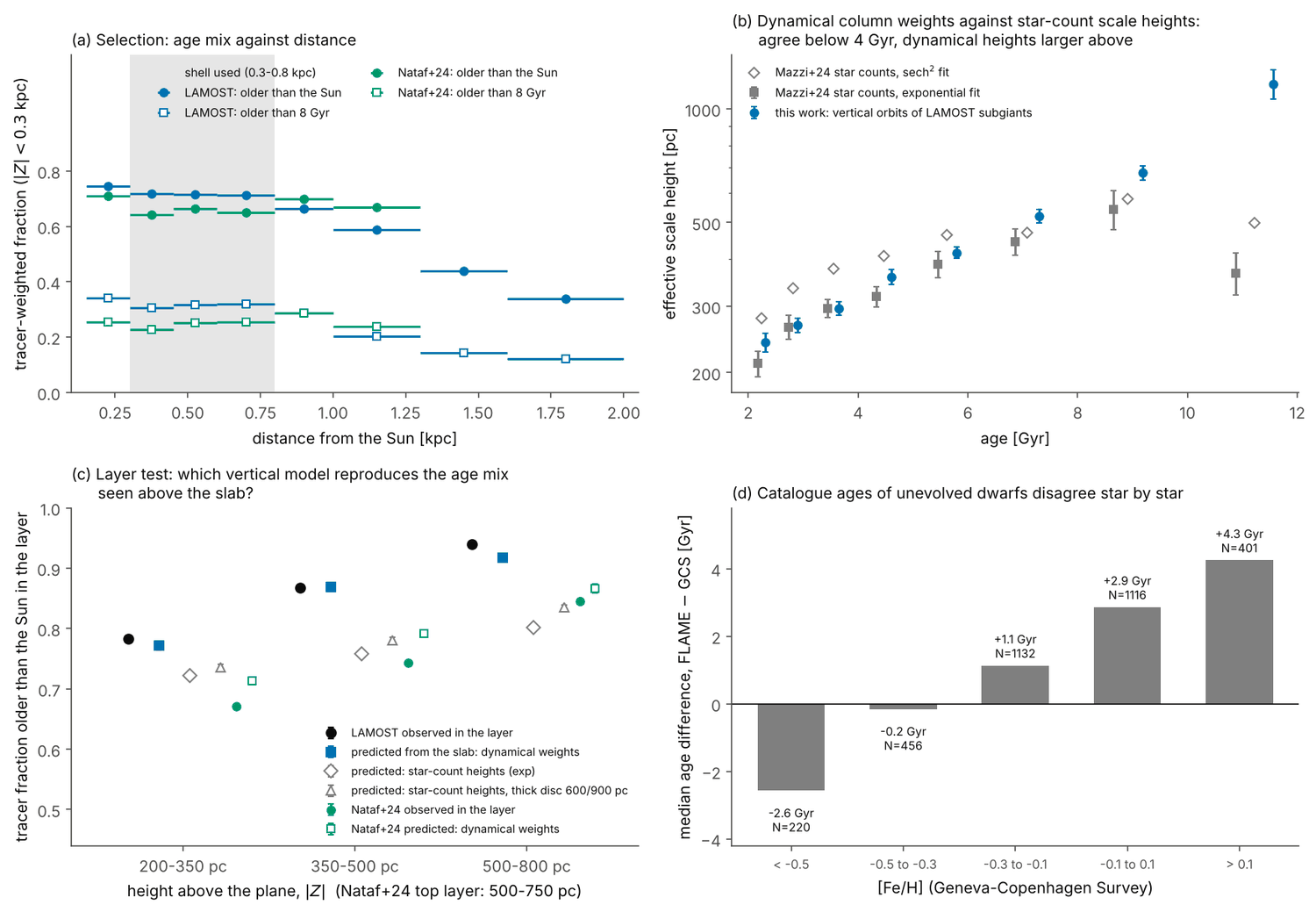
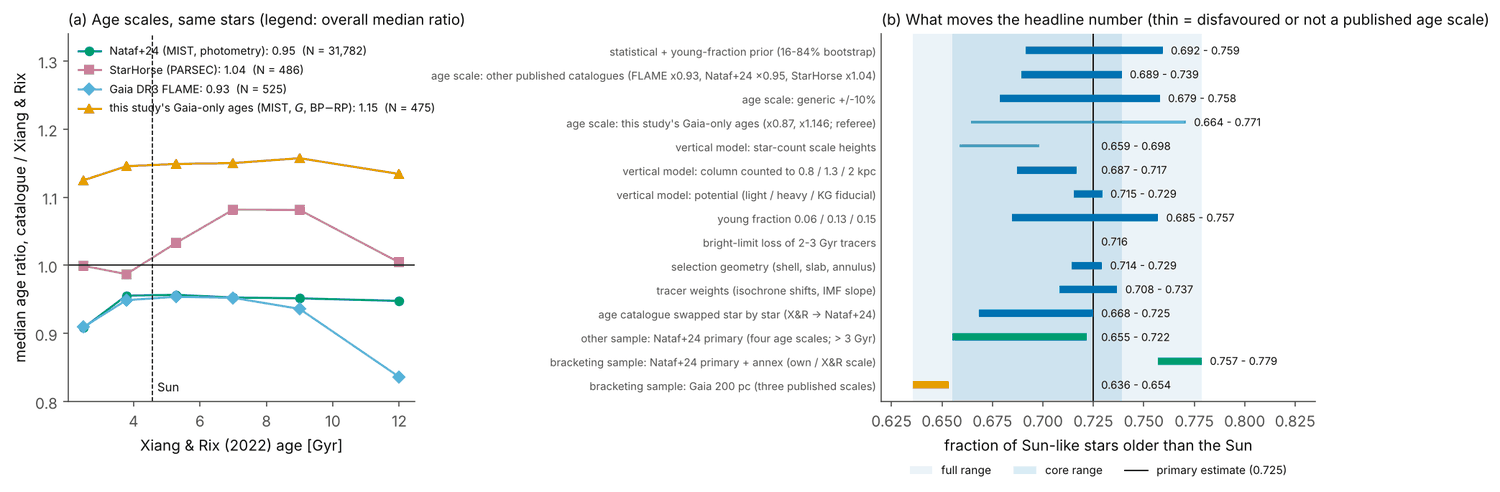
| Age-scale offsets for the same stars (median ratio to Xiang & Rix) | Nataf+24 0.950 (31,782 stars, -0.33 Gyr); StarHorse 1.040 (486, +0.27 Gyr); Gaia FLAME 0.926 (525, -0.55 Gyr); this study's Gaia-only ages 1.146 (475, +0.97 Gyr) | The Gaia-only ages are also 1.167x Nataf+24 and 1.125x StarHorse (+0.79 Gyr, 9,879 stars), and put 22% of their weight in the last age bins. | |
| Star-by-star age swap (LAMOST stars given Nataf+24 ages, same weights) | -0.056 | 1,583 stars in common: 0.758 with X&R ages, 0.701 with Nataf+24 ages. Larger than the constant-ratio rescaling (0.703 vs 0.725) because 7% of the weight crosses the Sun's age downward and 0.5% upward. | |
| Systematics of the primary estimate: age scale | 0.689-0.739 for published scales (x0.93 to x1.04); 0.679-0.758 for +/-10%; 0.664 and 0.771 for x0.87 and x1.146 | x0.87 and x1.146 are the scale of this study's own Gaia-only ages and are not supported by any published catalogue. The x1.146 value differs from the referee's 0.759 because a first-pass bug that dropped stars rescaled beyond 14 Gyr was fixed. | |
| Systematics of the primary estimate: vertical structure | star-count scale heights 0.659-0.698; column counted to 0.8 / 1.3 / 2 kpc 0.687 / 0.708 / 0.717; alternative potentials 0.715-0.729 | Star-count variants are disfavoured by the layer test but lie inside the full range anyway. | |
| Systematics of the primary estimate: other | young fraction 0.06 / 0.13 / 0.15 gives 0.757 / 0.701 / 0.685; bright-limit correction 0.716; selection geometry 0.714-0.729; tracer weights (isochrone shifts, IMF slope) 0.708-0.737 | 0.13 is the young fraction the tracers imply for a flat recent rate. | |
| Layer test, LAMOST: tracer fraction older than the Sun at |Z| 200-350 / 350-500 / 500-800 pc | observed 0.783 / 0.867 / 0.939; dynamical weights predict 0.771 / 0.869 / 0.918; star-count heights (exp) predict 0.722 / 0.758 / 0.801 | about 0.004-0.008 per cell | Orbit-based weights reproduce the observed age mix above the slab to within 0.02; star-count heights miss by 0.06-0.14. For Nataf+24 the dynamical prediction is high by 0.02-0.05 (observed 0.671 / 0.744 / 0.845). |
| Scale heights: dynamical vs Mazzi+24 star counts | agree below 4 Gyr (240/267/296 vs 211/264/296 pc); dynamical 7-25% larger at 4-10 Gyr; 1166 vs 368 pc in the oldest bin | Implied high-alpha share of Sun-like stars: 24% in the column, 10% in the mid-plane. | |
| Mean head start of the stars older than the Sun | 4.13 Gyr | 4.06-4.20 statistical; 3.4-4.4 across core and bracketing estimates; 3.3-5.1 including disfavoured variants | Median 4.03 Gyr (3.2-4.3 across estimates). |
| Fraction of all Sun-like stars older than the Sun by more than 1 / 3 / 5 Gyr | 0.629 / 0.456 / 0.289 (primary) | ranges across estimates 0.54-0.69 / 0.34-0.51 / 0.16-0.31 | Primary statistical intervals 0.602-0.656 / 0.433-0.477 / 0.271-0.306. |
| Mean age minus the Sun's age, all Sun-like stars (Lineweaver's 1.8 +/- 0.9 Gyr statistic) | 2.43 Gyr | 1.5-2.9 across estimates | Consistent with Lineweaver's value. |
| With a metallicity floor (LAMOST) | [M/H] > -0.5: 0.681; [Fe/H] > -0.5: 0.651; [M/H] > -0.3: 0.623; [Fe/H] > -0.3: 0.585 | 0.647-0.720; 0.614-0.688; 0.582-0.663; 0.539-0.628 | Lower bounds on the head start: small planets show no sharp metallicity floor (Buchhave+ 2012, 2014; Kepler-444). Nataf+24 primary: 0.669 and 0.646 for [Fe/H] > -0.5 and > -0.3. |
| Living main-sequence Sun-like stars older than the Sun | 0.636 (LAMOST); 0.608 (Nataf+24 primary) | Stars formed, weighted by the fraction still on the main sequence. | |
| Column minus mid-plane fraction | +0.04 to +0.12 depending on sample and method | LAMOST dynamical +0.12 (mid-plane 0.606); star-count heights +0.05 to +0.09; Nataf+24 +0.06 to +0.09; Gaia subgiants +0.08 to +0.10; FLAME dwarfs +0.04; GCS 40 pc dwarfs +0.24. | |
| Published star-formation histories re-integrated | 0.55-0.74 (seven column solutions; Mazzi+24 0.688) | Mid-plane literature values: 0.50 (Gallart+24, 100 pc) and 0.76 (Alzate+21 as fitted by Madau 2023, who quotes 77%). | |
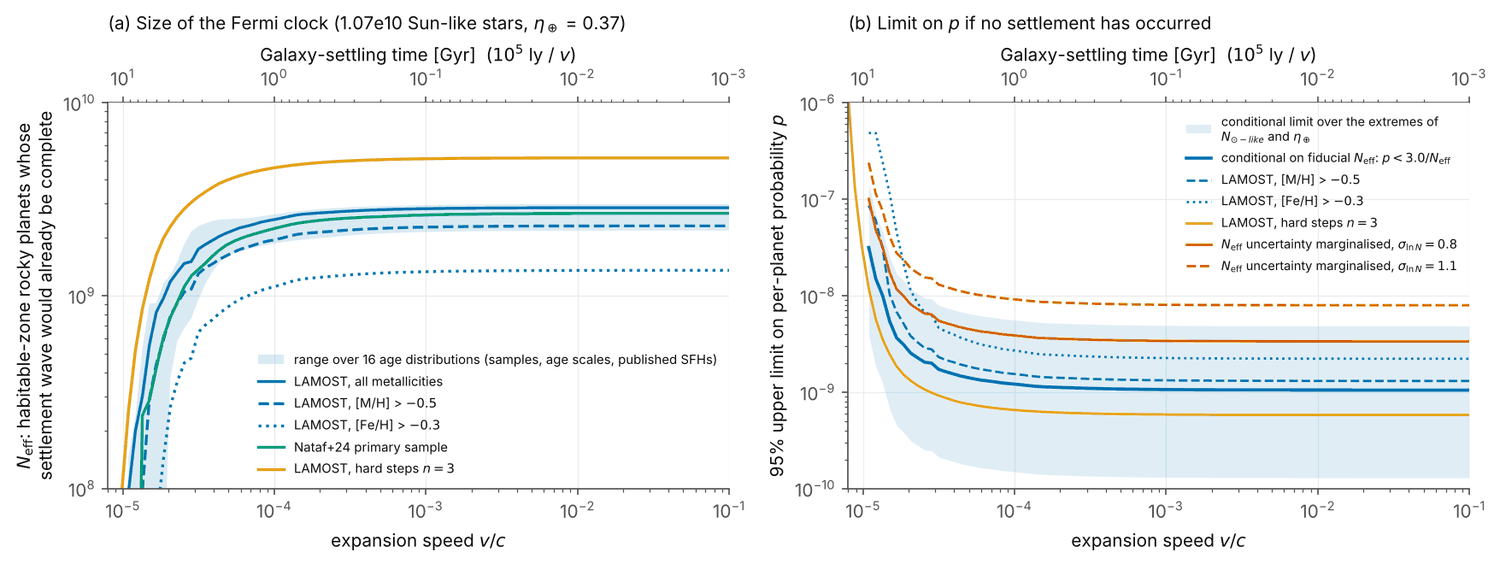
| N_eff: habitable-zone rocky planets with enough head start (fiducial 1.07e10 Sun-like stars, eta_Earth 0.37) | 2.48e9 at 1e-4 c; 2.86e9 at 0.1 c | 1.9e9-2.6e9 and 2.2e9-3.0e9 across 16 age distributions; factor of several from star count and eta_Earth | 1.6e9 at 3e-5 c (56% of maximum); zero below about 1.1e-5 c. |
| 95% upper limit on per-planet probability of a Galaxy-settling civilisation, conditional on fiducial N_eff | 1.05e-9 (0.1 c) to 1.21e-9 (1e-4 c) | 1.0e-9-1.6e-9 across age distributions; 1.3e-9-2.7e-9 with metallicity floors; 1.3e-10-5.6e-9 at the joint extremes of star count and eta_Earth | Premise: no settlement has occurred and a settled Galaxy would be evident; Earth-clock emergence. |
| Same limit with the uncertainty of N_eff marginalised (log-normal, sigma_ln 0.8-1.08, flat prior on p) | 3.4e-9 to 7.9e-9 at 0.1 c; 3.9e-9 to 9.1e-9 at 1e-4 c | Loosening factor 3.2-7.6. Upper end exceeds the referee's 6e-9 because 'factor 2 either way' in star count read as 1 sigma gives sigma_ln 1.08. | |
| Galaxy-wide fraction (illustrative assumptions, not measurements) | 0.71-0.80 with a bulge assumption; 0.76-0.82 using Xiang+25's high-alpha disc mass plus the local low-alpha age mix | Local low-alpha stars alone: 0.65 older than the Sun. | |
| Selection cut-flow | LAMOST 247,104 -> 245,301 (age >= 2 Gyr) -> 45,043 (shell) -> 33,151 (annulus) -> 8,534 (|Z| < 200 pc) -> 8,525 (J_z > 0); Nataf+24 401,819 -> 17,107; Gaia 200 pc 117,677 -> 28,388 | 451 LAMOST stars get zero column weight (no-zero weighting gives 0.729); bright-limit completeness of 2-3 Gyr tracers 0.84 (-0.009); 14% of Gaia candidates lack a radial velocity, flat with age. |
Data used
- Xiang & Rix 2022 LAMOST subgiant catalogue (VizieR J/other/Nat/603.599): 247,104 rows; 8,525 used
- Nataf+ 2024 subgiant catalogue (TotalSample.fits from the authors' repository, ApJ 976, 87): 401,819 rows; Gaia DR3 astrometry and radial velocities looked up by source_id for 236,110; 17,107 used (33,773 with the annex)
- Gaia DR3 gaia_source + astrophysical_parameters within 200 pc (Gaia TAP): parent sample 117,677 rows, 28,388 subgiant candidates used; FLAME Sun-like dwarfs 227,504 rows, 98,306 used
- Geneva-Copenhagen Survey, Casagrande+ 2011 (VizieR J/A+A/530/A138): 16,682 rows; 877 used
- Gaia DR3 FLAME for Hipparcos stars: 53,443 rows; 3,325 Sun-like stars in common with GCS
- StarHorse Gaia RVS ages, Queiroz+ 2023 (VizieR J/A+A/673/A155): 291,807 rows; age-scale comparison only (486 / 1,118 / 9,879 stars in common with X&R / Nataf+24 / the Gaia sample)
- Solar twins: Spina+ 2018 (79), Nissen+ 2020 (72), Taniguchi+ 2026 (6,594)
- MIST v1.2 isochrones
- Published star-formation history tables transcribed from Mor+ 2019, Mazzi+ 2024, del Alcazar-Julia+ 2025 and the Madau 2023 fit to Alzate+ 2021; Gallart+ 2024 single quoted number (0.50)
- Bryson+ 2021 eta_Earth (literature value, not re-derived)
Method
Subgiant tracer estimator: each subgiant in a survey's colour-magnitude selection box stands for I0/G(age,[M/H]) Sun-like stars born at the same time, where G is the IMF-weighted mass interval of a MIST v1.2 isochrone inside the box. Stars are taken from a 0.3-0.8 kpc shell (age mix flat with distance), within 0.5 kpc of the solar radius and |Z| < 200 pc, and each is weighted by the inverse of the fraction of its vertical orbit spent in the slab to convert mid-plane to column. The weighted age histogram is deconvolved for age errors by EM; stars younger than 2 Gyr are added with a share of 0.10 +/- 0.04 from published star-formation histories; intervals come from 100/50/30 bootstrap resamples. Three samples: LAMOST with Xiang & Rix 2022 ages (primary), the Nataf+24 primary sample with Gaia kinematics (added in revision, plus its metal-poor annex modelled approximately), and a Gaia-only 200 pc sample with this study's own ages (cross-check, rescaled onto published scales). Revision additions: star-by-star age comparison between catalogues and a paired age-swap test; a layer test in which slab-star orbits predict the age mix observed at 200-800 pc, compared with star-count scale heights; a systematics table; [M/H] floors; estimates classified as core, bracketing or excluded with reasons. Cross-checks: seven published column star-formation histories re-integrated, GCS and Gaia FLAME dwarfs, solar twins. Fermi clock: N_eff(v) = N_Sun-like x eta_Earth x fraction of stars whose age minus settling time (1e5 ly / v) exceeds the emergence time; 95% limit p < 3.0/N_eff, also marginalised over a log-normal N_eff with a flat prior on p.
Closest prior work and what is new
Closest prior work. Madau 2023 (analytic fit to a Gaia mid-plane star-formation history within 100 pc combined with planet occurrence: 77%); Lineweaver 2001 (74 +/- 9%) and Lineweaver+ 2004 (75%) from models; Legassick 2015 (arXiv:1509.02832: 77% of potentially habitable systems older than the Sun, by 3.13 Gyr on average); Behroozi & Peeples 2015 (80%); Zackrisson+ 2016; Robles+ 2008 (53 +/- 2%). Data products: Xiang & Rix 2022 and Nataf+ 2024 (subgiant ages), Mazzi+ 2024 and Gallart+ 2024 (local star-formation histories; integrating Mazzi+24's published column history gives 0.69 in a few lines), Xiang+ 2025 (selection-corrected model of the same LAMOST subgiants).
What is new. The answer itself is not new: this is a reproduction of the known 'about three quarters' with newer data and an honest systematic range. What I did not find published: (i) the statistic taken from individual subgiant ages in three samples rather than from a model or fitted history; (ii) an explicit orbit-based mid-plane-to-column correction, checked by a layer test that discriminates it from star-count scale heights; (iii) an age-scale budget from stars shared between catalogues, including a star-by-star age swap; (iv) head-start distribution and metallicity-floor variants on both [Fe/H] and [M/H]; (v) the Fermi clock computed from a measured distribution with conditional and marginalised limits. The Fermi limit is standard Hart-Tipler arithmetic.
Confidence that it is new: medium
Limitations
- Age scale: the Sun's age sits where the cumulative age distribution is steep. Published catalogues differ by 4-7% for the same stars, worth -0.036 to +0.014 on the headline and -0.056 in the star-by-star swap. No catalogue is known to be right.
- Three samples give two answers: LAMOST and Nataf+24 primary agree to 0.02 on a common scale, but the Gaia 200 pc sample is lower by 0.07-0.08 and the cause is not established (home-made ages, high binary fraction and smaller volume are candidates).
- Vertical structure: column weights are one-dimensional. The layer test supports them to 800 pc for LAMOST and shows a 0.02-0.05 over-prediction for Nataf+24; above 800 pc they are untested (dropping that part entirely gives 0.687), and the oldest bin's implied 1166 pc height rests on 306 stars.
- Selection functions are not modelled star by star; the method relies on age-independent sampling inside the shell, checked only by the distance and layer tests. The Nataf+24 primary box under-samples metal-poor stars and its annex cannot be modelled exactly, so the two only bracket the truth.
- Stars younger than 2 Gyr are not traced by subgiants; their share (0.10 +/- 0.04) is imported from published star-formation histories. The tracers themselves suggest 0.13 if the recent rate was flat.
- The measurement is for stars now residing in the solar cylinder, not the Galaxy and not stars born at the Sun's radius. The Galaxy-wide figures are assumptions.
- Metallicity floors are applied to stars, not planets; every star younger than 2 Gyr is assumed to pass them, and eta_Earth is assumed independent of age and metallicity.
- The Fermi limit is conditional on an assumed star count (factor 2), eta_Earth (Bryson+21), an emergence time no longer than Earth's, the solar age mix holding Galaxy-wide, and the premise that settlement has not happened and would be evident. The analysis says nothing about emergence times longer than Earth's.
- The adopted value and range are an envelope of estimates, not a formal confidence interval; which estimates count as core, bracketing or excluded is a judgement, stated with reasons in the report.
- After the final full pipeline run I corrected one sentence in make_report.py and re-ran only that step; it reads only the CSVs, so numbers are unchanged. The report prose is about 3,600 words (6,600 with tables), above the 2,000-word target, because of the cut-flow tables and referee response the review required.
- Not used: GALAH and APOGEE ages, Kordopatis+23 ages (service time-outs), and the Gallart+24 star-formation history beyond its one quoted number. The Nataf+24 catalogue is fetched from a Google Drive link given in the authors' GitHub README, which may not be permanent.
What it means for the Fermi question
The head start Fermi's argument needs is real and large: 64-78% of Sun-like stars near the Sun's orbit are older than the Sun, by a median of 3.2-4.3 Gyr, and 16-31% by more than 5 Gyr. Under an Earth-clock emergence model, travel time alone cannot explain the silence for front speeds above about 3e-5 c: the number of planets with enough head start is already 56% of its maximum at 3e-5 c and 87% at 1e-4 c. The resulting 95% limit on the per-planet probability of producing a Galaxy-settling civilisation is about 1e-9 for the fiducial planet count and 3e-9 to 8e-9 with the count's uncertainty marginalised, and holds only if no settlement has occurred and a settled Galaxy would be evident. The census fixes the size of the clock; it does not say which explanation (rarity, short lifetimes, no expansion, undetected presence) is right, and it says nothing about emergence times longer than Earth's. Even the hardest metallicity floor considered ([Fe/H] > -0.3) leaves the limit at 2.7e-9 at 1e-4 c. The uncertainty in the age census (which changes N_eff by under 25%) is small next to the factor-of-several uncertainty from the assumed star count and eta_Earth.
Changes made after the referee report
- Headline changed from '72.5% (69-76%), confirms Lineweaver' to 'about 70%: 0.70 with systematic range 0.64-0.78 (core samples 0.66-0.74), consistent with Lineweaver's 74 +/- 9%'; the 0.692-0.759 interval of the primary sample is labelled statistical plus young-fraction prior.
- Added a second tracer sample from Nataf+ 2024 (401,819-row catalogue, Gaia look-ups for 236,110 stars; new analysis_nataf.py and fetch code): primary sample 0.678 (0.708 on the X&R scale), primary + annex 0.757, with cut-flow, distance-shell test, kinematics and layer test.
- Gaia 200 pc sample demoted from 'independent replication' to cross-check: its ages are shown to be 12-17% older than three published catalogues; results are reported on the X&R, Nataf+24 and StarHorse scales (0.644 / 0.636 / 0.654; mid-plane 0.543) and the 0.07-0.08 disagreement with LAMOST is stated.
- New age_scales.py: star-by-star age comparison between Xiang & Rix, Nataf+24, StarHorse, Gaia FLAME and the Gaia-only ages, and a paired age-swap test on 1,583 LAMOST stars (-0.056).
- New layer test for both catalogue samples, comparing the age mix observed at 200-800 pc with predictions from dynamical weights and from star-count scale heights; star-count height variants (exp, sech2, thick-disc 600/900 pc) and a column-to-0.8 kpc variant added.
- Systematics table added (age scale x0.87/0.90/0.93/0.95/1.04/1.10/1.146, young fraction 0.06/0.13/0.15, star-count heights, column to 0.8/1.3/2 kpc, potentials, bright limit, geometry, tracer weights), plus a table of all 21 estimates classified core / bracketing / excluded with reasons.
- Fig. 3b retitled 'Dynamical column weights against star-count scale heights' with sech2 heights added; text states the 7-25% excess at 4-10 Gyr, the threefold excess in the oldest bin and the 24% high-alpha column share.
- Mean head start now quoted as 4.1 Gyr with ranges (3.4-4.4 across estimates; 3.3-5.1 including disfavoured variants); head-start thresholds given with ranges.
- Mid-plane-to-column correction quoted as +0.04 to +0.12 by sample and method instead of 'about 0.12'.
- Gallart+24 (mid-plane 0.50) added to tables and Fig. 2; Legassick 2015 added to the model comparison; Nataf+ 2024 and Xiang+ 2025 cited; result described as a reproduction of a known number.
- Metallicity floors labelled as [Fe/H]; [M/H] floor variants added (0.681 and 0.623); Buchhave+ 2012/2014 and Kepler-444 cited; floors described as lower bounds.
- Fermi limit stated as conditional on the fiducial N_eff with the premise in the same sentence, and a marginalised limit added (3.4e-9 to 7.9e-9); N_eff range across 16 age distributions and with floors tabulated; Galaxy-wide bracket from Xiang+25's high-alpha disc mass added beside the bulge assumption.
- Implications softened to 'travel time alone cannot explain the silence for front speeds above about 3e-5 c under an Earth-clock emergence model'.
- Every selection cut documented with reason and count for all three samples; zero-weight stars (451), bright-limit loss of 2-3 Gyr tracers (completeness 0.84, -0.009), radial-velocity loss (14%, flat with age) and RUWE > 1.4 fraction (32%) quantified.
- Bug fixed: the age-rescaling option dropped stars pushed beyond 14 Gyr, biasing upward rescalings low (x1.146 now gives 0.771, not 0.759).
- Figures redrawn: five figures (new Fig. 5 for age scales and the systematics budget; layer test in Fig. 3c; marginalised limit in Fig. 4); run_all.py now has 11 steps and was rerun end to end (about 17 minutes) so all tables, figures and the report match the final code.
Referee points not accepted
- Partly rejected: treating star-count scale heights as an equally likely alternative worth -0.03 to -0.06 (referee 2.3). A new layer test shows the orbit-based weights predict the age mix LAMOST observes at 200-800 pc to within 0.02 (0.771/0.869/0.918 predicted vs 0.783/0.867/0.939 observed), while star-count heights miss it by 0.06-0.14. The star-count variants are kept in the tables as disfavoured. A smaller vertical uncertainty is retained: the same test over-predicts Nataf+24's layers by 0.02-0.05, and the column above 800 pc is untested (0.687 if dropped). All three star-count values (0.659-0.698) fall inside the final range anyway.
- Partly rejected: ages x0.87 and x1.146 as plausible age scales (referee 2.1, 2.2). Both factors come from this study's own Gaia-only ages, which are 12-17% older than three published catalogues for the same stars, including Nataf+24, which uses the same MIST models. Published scales span x0.93 to x1.04 of Xiang & Rix. The size of the effect the referee claimed is nonetheless confirmed by another route: swapping in Nataf+24 ages star by star moves the estimate by -0.056.
- Not a rejection, but a difference: the referee proposed a range of 0.64-0.76; I find 0.64-0.78. The lower edge is set by the rescaled Gaia sample as in the referee's report; the upper edge is higher because of the Nataf+24 annex sample (0.757-0.779), which the referee did not have. Likewise my marginalised Fermi limit reaches 7.9e-9 rather than 6e-9, and the x1.146 values are 0.771 and 5.1 Gyr rather than 0.759 and 4.6 Gyr after fixing a first-pass bug that dropped stars rescaled beyond 14 Gyr.
Figures
Code
Every number above is produced by these scripts from public data. The data tables themselves are not hosted here; the scripts download them.
age_scales.py analysis_gaia_sg.py analysis_ms.py analysis_nataf.py analysis_xr.py common.py fermi_clock.py fetch_data.py figures.py make_report.py published_sfh.py run_all.py sgweights.py tracer.py
Referee report
A second, separate analysis re-ran the code, recomputed the main numbers by its own route and tried to break the result. Like the first, it was run by Claude for this project; it is not an outside expert. In its report “the analyst” is the first analysis, which wrote the paper, and file names that are not linked on this page are its own working files. The paper above is the version revised in response.
Verdict: sound with fixes. Results reproduced: partly.
Rerun: exact. I ran a scratch copy of run_all.py --no-fetch (515 s, single thread); all 17 derived CSV tables match the analyst's with zero numerical difference (headline 0.725, floors 0.651/0.585, living MS 0.636, Gaia-only 0.703, Fermi clock table). Fermi arithmetic reproduced by hand (Kroupa fraction 0.0533 -> 1.07e10 stars; N_eff 2.48e9 at 1e-4c, 2.86e9 at 0.1c; p95 1.21e-9 and 1.05e-9; extremes 1.3e-10 and 5.6e-9; v_half 2.5e-5c). Mazzi+24 Table 4 re-integrated by hand: 0.688. Independent routes for the headline come out LOWER than 0.725: (a) same LAMOST stars and 1/G weights but star-count scale heights (Mazzi+24 Table 3) instead of the dynamical J_z weights give 0.666 (exp), 0.660 (sech2), 0.699 with canonical thick-disc heights at old ages, bootstrap sd 0.005; (b) the analyst's Gaia 200 pc sample put on the Xiang & Rix age scale gives 0.644 column / 0.544 mid-plane. So the pipeline reproduces exactly, but the headline value sits at the top of what independent routes support (0.64-0.73).
Strongest objection
The data cannot fix this fraction to better than about +/-0.06, so they do not test Lineweaver's number; they are merely compatible with it. The Sun's age falls where the cumulative age distribution is steep, so the statistic is hostage to the absolute isochrone age scale and to the weight given to the thick disc. The measured disagreement between age scales for the same stars (Xiang & Rix vs StarHorse vs the analyst's MIST ages: 4-15%) moves the answer by 0.035-0.06; replacing dynamical column weights with star-count scale heights moves it by 0.03-0.06; the two subgiant samples disagree by 0.06-0.08 once on one age scale; published column SFHs span 0.55-0.74. An expert would accept 'somewhere in 0.6-0.75' and reject '72.5% (69-76%)' and 'confirms'. The Fermi-relevant conclusion survives: across f = 0.55-0.76 N_eff runs 2.2e9-3.0e9 and the conditional limit 1.4e-9 to 1.0e-9, against a factor-6 uncertainty from star count and eta_Earth; multi-Gyr head starts for a majority of Sun-like stars and insensitivity to expansion speed above about 3e-5 c are secure. The specific headline number, its error bar, the word 'confirms' and the 'independent replication' label do not survive.
Errors found
- major. The 'independent Gaia-only replication'
(0.703) is on a different age scale from the primary result. For the
same stars the analyst's MIST photometric ages are systematically older
than the Xiang & Rix ages, so the apparent agreement 0.703 vs 0.725
is partly coincidence. On a common age scale the two samples disagree by
0.06-0.08, two to three times the quoted 1-sigma range.
- Evidence: Positional cross-match of Xiang & Rix stars within 230 pc to the analyst's gaia_sg_sample.csv: 475 stars with p_sg>0.5, median (Gaia age - X&R age) = +0.97 Gyr, ratio 1.15, rising from +0.38 Gyr at 2-4 Gyr to +1.54 Gyr at 10-14 Gyr. StarHorse - X&R = +0.27 Gyr (486 stars); analyst's own table shows Gaia - StarHorse = +0.70 Gyr; 22.5% of Gaia weight piles up at 13-14 Gyr. Rescaling the Gaia likelihoods to the X&R scale and rerunning the analyst's variant(): 0.644 column, 0.544 mid-plane, 0.620 with [M/H]>-0.5 (x0.93 StarHorse-like scale: 0.671). LAMOST sample on the Gaia scale (ages x1.146): 0.759.
- Fix: Stop calling it an independent replication at 0.703. Report the age-scale offsets, give the Gaia result on the X&R scale (about 0.64), state the 0.06-0.08 disagreement, and preferably redo the replication with published subgiant ages (Nataf et al. 2024, ApJ 976, 87).
- major. The headline range 0.69-0.76 covers only
bootstrap noise and the young-fraction prior. Demonstrable systematics
(age scale, vertical-structure model, young fraction) are larger and
mostly push downward; a defensible range for the subgiant-based column
fraction is about 0.64-0.76.
- Evidence: Analyst's code: ages x0.93 -> 0.690; x0.87 -> 0.664; x1.146 -> 0.759; young fraction 0.13 (the tracers' own flat-rate value, phi_young_if_flat) -> 0.701; column to 1.3 kpc -> 0.708. Referee: star-count scale heights instead of dynamical weights -> 0.66-0.70. Mazzi+24 column SFH -> 0.688. Gaia sample on common scale -> 0.644.
- Fix: Label 0.69-0.76 as statistical plus young prior; add a systematics table; quote the result as about 0.70 with a systematic range 0.64-0.76 (0.55-0.74 across published SFHs).
- major. Figure 3b is titled 'Column weights
reproduce scale heights', but the dynamical effective heights exceed
Mazzi+24 star-count heights by 7-25% for all ages above 4 Gyr and
threefold in the oldest bin. The excess grows with age, so it inflates
the fraction older than the Sun. The vertical weighting is the largest
single step in the analysis.
- Evidence: xr_scale_heights.csv: 359 vs 319, 416 vs 388, 520 vs 445, 677 vs 543, 1166 vs 368 pc. Tracers older than the Sun (age>2 Gyr only): 70.0% unweighted, 67.5% with 1/G, 80.5% with column weights. Dynamical weights imply 24.5% of formed Sun-like stars in the column are high-alpha (10% mid-plane); literature surface-density shares are roughly 12-20%; my age-only star-count heights give 10-17%.
- Fix: Retitle the panel, state the mismatch and the implied high-alpha share, and carry -0.03 to -0.06 into the error budget.
- minor. 451 of 8,525 LAMOST stars (5.3%) receive
exactly zero vertical weight because the 1-D energy implied by J_z is
below the potential at the observed height and the velocity is clipped
to zero. They are colder and younger than average.
- Evidence: diag1/diag2: n wd==0 = 451; 62.1% of them older than the Sun vs 70.0% overall; median J_z 0.75 vs 1.95 kpc km/s. The 'slab' mode, which has no zeros, gives 0.729, so the net effect is small.
- Fix: Document the count and the slab-mode cross-check.
- minor. Bright-limit incompleteness for the youngest
tracers inside the shell: 2-3 Gyr subgiants are under-sampled at the
near side.
- Evidence: Fraction beyond 0.55 kpc is 0.344 for 2-3 Gyr tracers vs 0.286-0.291 for every older bin (median distance 0.498 vs 0.48 kpc). Implies about 16% under-count of 2-3 Gyr tracers, roughly -0.007 on the headline. Older bins have identical distance distributions, which supports magnitude-independent sampling above 3 Gyr.
- Fix: State it, or raise the inner shell edge for the youngest tracers.
- minor. Gallart+24 (ChronoGal I) is omitted from the
key numbers and Figure 2 although the study plan asked for it and the
code comment records its result: 50% of the stellar mass within 100 pc
was in place 4.5 Gyr ago, i.e. a mid-plane fraction of about 0.50. The
only mid-plane literature point shown is Madau's 0.76.
- Evidence: published_sfh.py docstring; confirmed in the saved paper text (arXiv:2402.09399): '50% and 90% of the stellar mass was reached 4.5 and 0.9 Gyr ago'.
- Fix: Add it; mid-plane literature range becomes 0.50-0.76.
- minor. 'Mid-plane samples understate the old
fraction by about 0.12' is specific to the LAMOST dynamical weights.
- Evidence: Same correction: +0.03-0.04 (FLAME), +0.08 (Gaia subgiants), +0.06-0.09 (star-count heights, referee), +0.12 (LAMOST dynamical), +0.25 (GCS 40 pc).
- Fix: Quote 0.04-0.12 depending on sample and method.
- minor. Metallicity floors are applied to [Fe/H]
rather than total metals, so alpha-enhanced thick-disc stars with ample
rock-forming elements are removed; the floor variants over-prune old
stars. Buchhave et al. 2012/2014, which the study plan asked to be
cited, are not cited.
- Evidence: analysis_xr.one uses s.feh; mh is computed but not used for the floor. Kepler-444 (Campante et al. 2015): metal-poor thick-disc star, 11.2 +/- 1.0 Gyr, five sub-Venus-size planets.
- Fix: Add an [M/H] floor variant, cite Buchhave et al., describe floor results as lower bounds.
- minor. The '95% upper limit' p < 3.0/N_eff is
conditional on a known N_eff, while N_eff is uncertain by about a factor
6 either way.
- Evidence: Marginalising a lognormal N_eff with sigma_ln = 0.8-1.0 and a flat prior on p gives a 95% limit of 3.3e-9 to 6.0e-9 instead of 1.0e-9.
- Fix: State the limit as conditional on the fiducial N_eff and give the marginal value alongside.
- minor. Wording 'ever formed at the Sun's Galactic
radius' ignores radial migration.
- Evidence:
- Fix: Write a real report listing every cut with its count; change wording to 'now residing in the solar cylinder'.
- minor. Gaia subgiant sample quality is
under-described: 15% of candidates lack a radial velocity and are
dropped, and 30-36% of the membership-weighted sample has RUWE > 1.4
(heavy binary contamination).
- Evidence: gaia_rescale.py diagnostics: RV fraction 0.86-0.87 in every age bin above 2 Gyr (flat, so harmless); RUWE>1.4 fraction 0.30-0.36.
- Fix: Report both numbers.
Overclaims
- 'A direct census confirms Lineweaver's model' - should be 'is consistent with'; Lineweaver's +/-9% admits 0.65-0.83 and the metallicity-floor variants (0.59-0.65) sit at or below its lower edge
- '72.5% (16-84% range 69-76%)' - statistical plus young-prior only; systematic range is about 0.64-0.76
- 'Independent Gaia-only replication ... 0.703' - on an age scale about 15% older than the primary; about 0.64 on a common scale
- Figure 3b title 'Column weights reproduce scale heights' - they exceed star-count heights by 7-25% above 4 Gyr and threefold in the oldest bin
- 'Mid-plane samples understate the old fraction by about 0.12' - 0.04-0.12 depending on sample and method
- '95% upper limit of about 1e-9' - conditional on the fiducial N_eff; 3e-9 to 6e-9 when the uncertainty in star count and eta_Earth is marginalised
- 'Explanations of the silence must therefore come from rarity, short lifetimes or non-expansion rather than from timing' - only travel time is addressed, under an Earth-clock emergence model
- 'Sun-like stars ever formed at the Sun's Galactic radius' - they are stars now residing in the solar cylinder
- Mean head start '4.13 Gyr +/- 0.07' - systematic range is about 3.3-4.6 Gyr
Novelty check
Novel: partly. The assembled calculation (subgiant tracers with explicit column weighting, metallicity floors, Fermi clock from a measured distribution, uniform comparison across catalogues) is not published in this form as far as I could find. The answer is not new: Madau 2023 already used an empirical Gaia SFH and got 77% (mid-plane); integrating Mazzi+24's published column SFH gives 0.69 in a few lines; Legassick 2015 (not cited) reports 77% of habitable systems older than the Sun by 3.13 Gyr on average from a chemical-evolution model. The p < 3/N limit is standard Hart-Tipler arithmetic. Best described as a careful reproduction of the known 'about three quarters' with newer data, whose useful new element is the explicit mid-plane-to-column correction. Two relevant datasets were missed: Nataf et al. 2024 (Gaia ages for ~400,000 subgiants, a ready replacement for the home-made Gaia ages) and Xiang et al. 2025 (selection-function-modelled high-alpha disc mass, a better basis for a Galaxy-wide statement). All spot-checked citations (Lineweaver 2001, Madau 2023, Robles+ 2008, Behroozi & Peeples 2015, Zackrisson+ 2016, Bryson+ 2021) say what the analyst claims; table transcriptions from Mazzi+24, del Alcazar-Julia+25, Mor+19 and Xiang & Rix match the papers.
- Madau 2023, ApJ 957, 66 (arXiv:2309.11927): 77% of temperate terrestrial planets within 100 pc older than the Solar System, median 6.2 Gyr
- Lineweaver 2001, Icarus 151, 307: 74 +/- 9% older, mean 1.8 +/- 0.9 Gyr older
- Lineweaver, Fenner & Gibson 2004: 75% of stars in the Galactic habitable zone older than the Sun
- Legassick 2015, arXiv:1509.02832: 77% of potentially habitable systems older than the Sun, 3.13 Gyr on average (not cited by the analyst)
- Behroozi & Peeples 2015, MNRAS 454, 1811: Solar System formed after 80% of existing Earth-like planets
- Zackrisson et al. 2016, ApJ 833, 214: mean terrestrial-planet age 7 +/- 1 Gyr for FGK hosts
- Robles et al. 2008: Sun younger than 53 +/- 2% of thin-disc stars
- Mazzi et al. 2024, MNRAS 527, 583: column SFH of the solar cylinder (integrates to 0.69)
- Gallart et al. 2024, A&A 687, A168: 50% of mass within 100 pc formed more than 4.5 Gyr ago (omitted from the analyst's table)
- Nataf et al. 2024, ApJ 976, 87 (arXiv:2407.18307): ages for ~400,000 nearby subgiants (not used)
- Xiang et al. 2025, arXiv:2410.09705: high-alpha disc mass with rigorous selection function (in the analyst's literature folder, not used)
Required changes
- Headline: replace 'A direct census confirms Lineweaver's model: 72.5% (69-76%)' with 'about 70% (0.725 +/- 0.035 statistical in the primary sample; 0.64-0.76 including age-scale and vertical-structure systematics; 0.55-0.74 across published SFHs), consistent with Lineweaver's 74 +/- 9%'.
- Gaia sample: drop the 'independent replication' label; report the age offsets to Xiang & Rix (+0.97 Gyr median, ratio 1.15) and StarHorse (+0.70 Gyr); give the result on the Xiang & Rix scale (about 0.64 column, 0.54 mid-plane); state the 0.06-0.08 disagreement on a common scale; preferably redo with Nataf+24 ages.
- Add a systematics table to the key numbers: ages x0.87/0.93/1.04/1.15 (0.664/0.690/0.734/0.759), young fraction 0.13 (0.701), star-count scale heights instead of dynamical weights (0.66-0.70), column to 1.3 kpc (0.708). Label 0.69-0.76 as statistical plus young prior.
- Figure 3b and scale-height text: retitle; state that dynamical heights exceed star counts by 7-25% above 4 Gyr and threefold in the oldest bin, and that the implied high-alpha column share is 25%.
- Mean head start among older stars: quote 4.1 Gyr with a systematic range of about 3.3-4.6 Gyr.
- Change 'mid-plane samples understate the old fraction by about 0.12' to 'by 0.04-0.12 depending on sample and method'.
- Add Gallart+24 (mid-plane 100 pc, about 0.50) to the key numbers and Figure 2.
- Metallicity floors: state they are on [Fe/H]; add an [M/H] variant (mh is already computed in analysis_xr.load); cite Buchhave et al. 2012 and 2014; describe floor results as lower bounds on the head start.
- Fermi limit: write 'p < 3.0/N_eff = 1.0e-9 to 1.2e-9 for the fiducial N_eff; 3e-9 to 6e-9 if the uncertainty in star count and eta_Earth is marginalised', with the premise (no settlement has occurred and it would be evident) in the same sentence.
- Implications: soften 'must therefore come from rarity, short lifetimes or non-expansion rather than from timing' to 'travel time alone cannot explain the silence for front speeds above about 3e-5 c under an Earth-clock emergence model'.
- Prior work: cite Legassick 2015, Nataf+ 2024 and Xiang+ 2025; describe the result as a reproduction of the known 'about three quarters' with newer data and an explicit column correction.
- Document every selection cut with reason and count: age >= 2 Gyr, shell 0.3-0.8 kpc, |R-R0| < 0.5 kpc, |Z| < 200 pc, J_z > 0 (9 stars), the 451 zero-weight stars, the 15% of Gaia candidates without radial velocity, the RUWE > 1.4 fraction (30-36%), the bright-limit loss of 2-3 Gyr tracers.