Where is everybody? · Working papers
When was Earth last sterilised?
Revised after a second, separate analysis run for this project tried to break it. Neither analysis is an outside expert.
When was Earth last sterilised? The lunar basin record and the time actually available for the origin of life
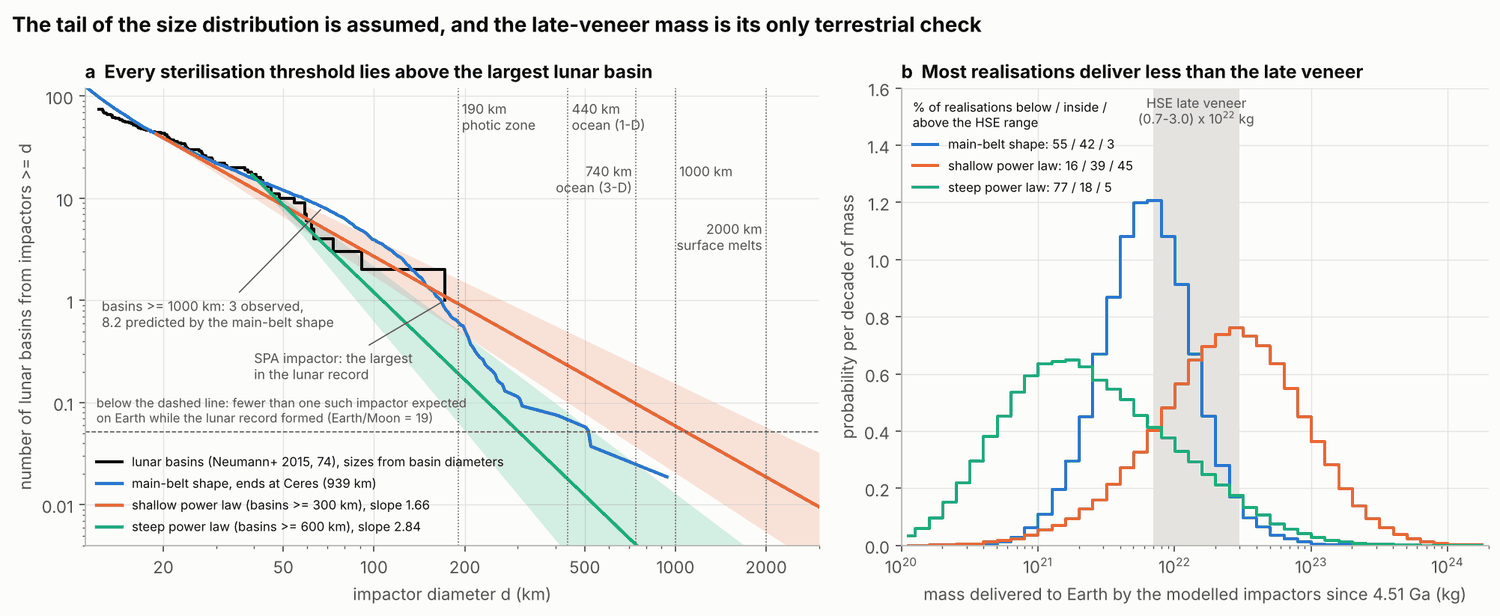
Summary. The dated lunar basin record fixes the time profile of the early bombardment, but every published sterilisation threshold lies above the largest lunar impactor, so the number of sterilising impacts on Earth rests on an assumed size-distribution tail whose only terrestrial check is the late-veneer (HSE) mass. Used as an upper bound only, that mass gives a median date of 4.25 Ga for the last impactor >= 440 km (10% chance younger than 3.87 Ga; 28% chance none followed ocean formation at 4.404 Ga); with both bounds enforced the median is 4.12 Ga and the chance of none is 4%. P(none after 4.2 Ga) is 0.58 or 0.35, and 0.23-0.76 across size distributions and treatments. Only a surface-melting impact (about 2000 km) has physical support for sterilising the subsurface, and its probability after 4.4 Ga is 0.4-0.9%, so the best-supported reading is that the fast:slow abiogenesis Bayes factor is unchanged at 13.0 (LUCA at 4.2 Ga) and 2.9 (accepted 3.48 Ga fossils). If smaller impacts are assumed to sterilise, the factor is multiplied by 1.3-1.9 (LUCA, 440 km), 1.1-1.4 (740 km) or 1.2-2.0 (fossils, 440-190 km); with equal prior on sterilise and survive it is 13.3-14.9 (LUCA) and 3.0-3.9 (fossils). It falls only if the origin itself needs a large impact: 1.0-2.3 for windows up to 200 Myr. Main caveats: the tail is assumed, the two HSE treatments are both defensible, the thresholds below 2000 km are hypotheticals, and the result concerns Earth only.
Question
Kipping's fast-versus-slow abiogenesis Bayes factor (13:1 with a 4.2 Ga LUCA, reproduced in this project's timing study) assumes Earth was continuously habitable from 4.404 Ga. Large impacts may have boiled the photic zone or the ocean after that. When did the last impactor above each published threshold strike Earth, and what happens to the Bayes factor when the window opens at the later of ocean formation and that impact?
Data
| Source | Rows | Use and cuts |
|---|---|---|
| Neumann et al. 2015 (Sci. Adv. 1, e1500852), GRAIL basin table | 74 basins | 43 with main ring >= 300 km, 17 >= 600 km. All confidence classes kept (18 of 43 not rated certain). |
| Orgel et al. 2018, LPSC 49 abstract 1395 | Model ages of 30 basins | Journal table (JGR Planets 123, 748) not obtained. 13 of the 43 basins are undated. |
| Fassett et al. 2012 (JGR 117, E00H06), Table 1 | N(20) for 30 basins | Robustness run only. |
| JPL Small-Body Database | 10,172 asteroids >= 10 km; 8,331 main-belt | Main-belt size distribution; 3 bodies >= 440 km, largest 939 km. |
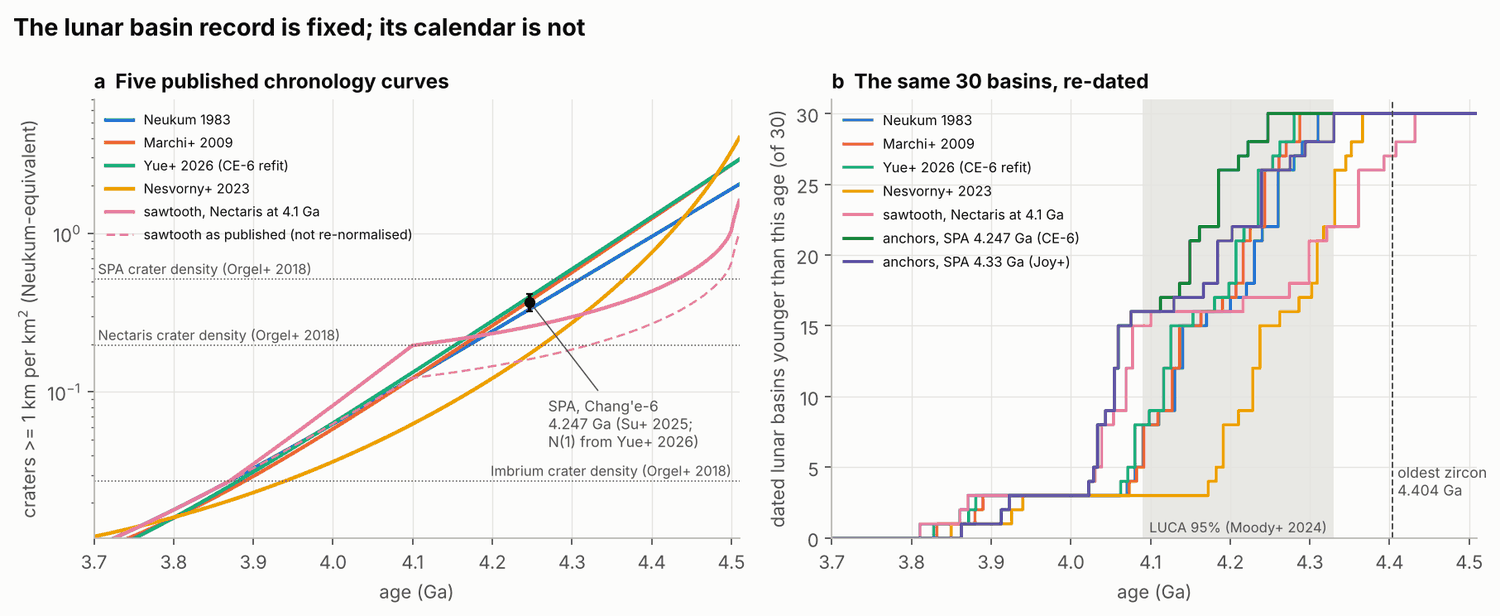
Seven chronologies: Neukum 1983; Marchi et al. 2009; Yue et al. 2026 (Chang'e-5/6 refit); Nesvorny et al. 2023 (accretion tail); Morbidelli et al. 2012 sawtooth, re-normalised so that Nectaris falls at 4.1 Ga as in that paper; and two anchor-only chronologies through Imbrium (3.922 Ga), Nectaris (3.95-4.20 Ga, sampled) and South Pole-Aitken (SPA) at 4.247 Ga (Chang'e-6; Su et al. 2025) or 4.33 Ga (Joy et al. 2025). No terminal-cataclysm chronology is included beyond that Nectaris range, so "accretion tail versus cataclysm" is only partly tested (Fig. 1).
Thresholds (impactor diameter): about 190 km for boiling the photic zone (energy-scaled from Sleep et al. 1989; not checked at source); 440 km for ocean vaporisation in 1-D models (Sleep et al. 1989; Zahnle et al. 2020); 500 and 1000 km (Marchi et al. 2014); 740 km, the 3-D lower limit, and 2000-2700 km to melt the whole surface (Citron & Stewart 2022). Abramov & Mojzsis 2009 find no subsurface sterilisation short of that. Terrestrial checks: late-accreted mass (0.7-3.0) x 10^22 kg from highly siderophile elements (HSE; Walker 2009 via Marchi et al. 2014) and Archean spherule layers (Johnson et al. 2016).
Method
- Each dated basin's crater density is re-dated under each chronology; undated basins take the density of a random dated basin at least as dense as Nectaris.
- Earth/Moon impact ratio from two-body gravitational focusing: median 19.2 (16.7-26.5).
- Impactor size d = 0.0442 D^1.062 km (six published pairs; shared 20% systematic). SPA's impactor is 172 km.
- Three size distributions extend the record upward (Fig. 2): the main-belt shape; a shallow power law fitted to basins >= 300 km (slope 1.63 +/- 0.25, KS p = 0.35); a steep one fitted to basins >= 600 km (2.73 +/- 0.66, p = 0.72 on those 17 basins). The main-belt shape fits basins >= 300 km (p = 0.35) but fails on basins >= 600 km (p = 0.007) and predicts 8.2 basins >= 1000 km against 3 observed (Poisson p = 0.04), as Minton et al. 2015 found. Its tail rests on three bodies >= 440 km; that error is propagated by a Bayesian bootstrap of the bodies >= 100 km.
- Monte Carlo: 20,000 draws for each of 21 models, fixed seed, sampling the sizes of all Earth impactors >= 150 km since 4.51 Ga. Flux before SPA and after the youngest basin follows the chronology curve.
- HSE treatment. The impactors of all 74 catalogued basins, scaled to Earth, carry 2.6 x 10^20 kg, 4% of the HSE lower bound, so the veneer must sit in bodies larger than SPA's impactor. Two treatments are run on the same realisations. Upper only discards realisations above 3 x 10^22 kg; it is right if most of the veneer came in one or a few giants outside the modelled population that struck before about 4.4 Ga (Bottke et al. 2010; Brasser et al. 2016; Genda et al. 2017). Both bounds also requires at least 0.7 x 10^22 kg from the modelled population. Realisations fall below / inside / above the range in 55 / 42 / 3% (main-belt), 16 / 39 / 45% (shallow) and 77 / 18 / 5% (steep) of draws. "All models" weights each model by its pass fraction.
- Bayes factor. With t_h = min(4.404 Ga, last sterilising impact), evidence date t_ev and m later hard steps, the timing study's success-conditioned ratio is averaged over t_h. Cases: (A) impacts >= D sterilise; (B) life survives; equal prior on A and B; (C) life originates only within W after such an impact.
Results
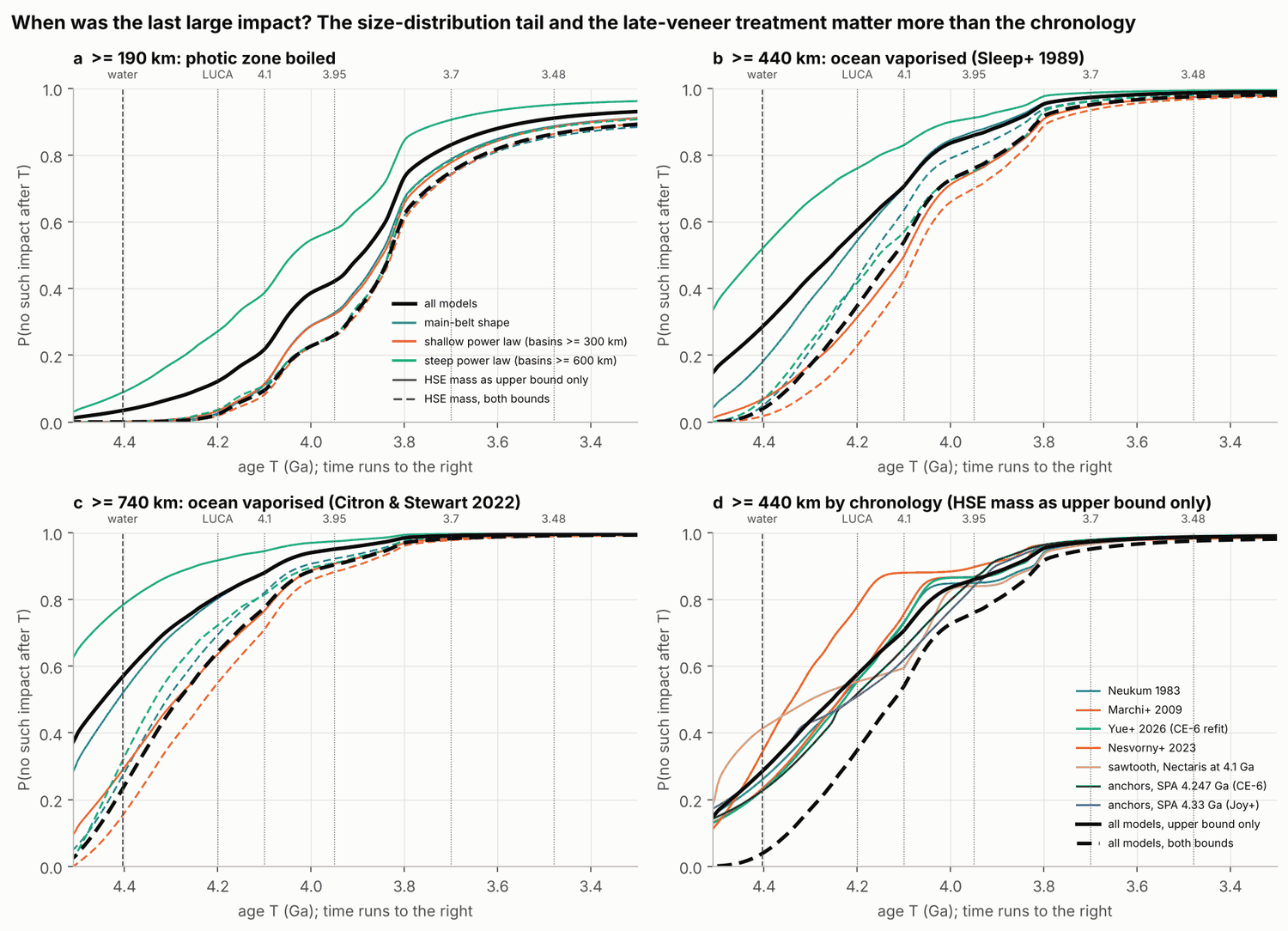
Probability that no impactor of the stated size struck after age T (all models; upper only / both bounds; Fig. 3):
| Impactor | 4.4 Ga | 4.2 Ga | 4.0 Ga | 3.8 Ga | Median date (Ga) |
|---|---|---|---|---|---|
| >= 190 km | 0.04 / 0.00 | 0.12 / 0.02 | 0.39 / 0.23 | 0.73 / 0.62 | 3.89 / 3.83 |
| >= 440 km | 0.29 / 0.04 | 0.58 / 0.35 | 0.84 / 0.73 | 0.95 / 0.92 | 4.25 / 4.12 |
| >= 740 km | 0.58 / 0.24 | 0.81 / 0.64 | 0.94 / 0.89 | 0.98 / 0.97 | 4.45 / 4.28 |
| >= 1000 km | 0.86 / 0.70 | 0.95 / 0.88 | 0.98 / 0.97 | 1.00 / 0.99 | none in most cases |
| >= 2000 km | 0.996 / 0.991 | 0.999 / 0.997 | 1.00 / 1.00 | 1.00 / 1.00 | none |
| Model group | P(no >= 440 km after 4.2 Ga) | Median date of last >= 440 km (Ga) |
|---|---|---|
| All models | 0.58 / 0.35 | 4.25 / 4.12 |
| Neukum 1983 | 0.56 / 0.24 | 4.24 / 4.10 |
| Marchi+ 2009 | 0.57 / 0.33 | 4.24 / 4.13 |
| Yue+ 2026 | 0.56 / 0.30 | 4.23 / 4.12 |
| Nesvorny+ 2023 | 0.78 / 0.67 | 4.34 / 4.26 |
| Sawtooth, Nectaris 4.1 Ga | 0.55 / 0.20 | 4.30 / 4.03 |
| Anchors, SPA 4.247 Ga | 0.52 / 0.32 | 4.21 / 4.10 |
| Anchors, SPA 4.33 Ga | 0.51 / 0.24 | 4.21 / 4.05 |
| Main-belt shape | 0.54 / 0.43 | 4.22 / 4.17 |
| Shallow power law | 0.31 / 0.23 | 4.10 / 4.08 |
| Steep power law | 0.76 / 0.42 | 4.42 / 4.15 |
The tail and the HSE treatment matter more than the chronology. The steep law marks the side bounded by the lunar mega-basin deficit (0.76); the HSE lower bound marks the other (0.2-0.4). Ocean-vaporising impacts (>= 440 km) had ended with 92-95% probability by 3.8 Ga. The >= 190 km late tail depends on the post-Orientale extrapolation: there is a 10% chance that the last such impact is younger than 3.5 Ga (upper) or 3.2 Ga (both), but 3.8 Ga if no basin-forming flux followed the youngest basin. The model expects 1.6 lunar basins >= 300 km after that basin where none exist (p = 0.20), yet it under-predicts spherule layers threefold, so this flux is uncertain by a factor of about 3 either way.
Checks. Marchi et al. 2014 (median 4.32 Ga
for the last > 500 km impact; 3-7 such impactors; 1-4 above 1000 km):
upper only gives 4.30 Ga with 5.6 impactors >= 500 km and 0.5 >=
1000 km; both bounds give 4.15 Ga with 10.9 and 1.1. The upper-only
agreement is not an independent confirmation, because those realisations
mostly miss the HSE lower bound. The difference is whether the veneer
arrived in a few bodies above 1000 km (Marchi; upper only) or in many
500-1000 km bodies (both bounds; also the main-belt-only model of
Abramov et al. 2026). Lunar record: the Moon has nothing larger
than SPA; the model expects 0.24 (upper) or 0.38 (both) lunar impactors
>= 250 km since SPA, so this does not discriminate.
Spherules: 2.6-2.9 Earth impactors >= 20 km expected at
3.2-3.5 Ga against 8 layers. Independent re-computation
(code/independent_check.py, no shared code, Neukum x
main-belt): P(no >= 440 km after 4.2 Ga) = 0.56-0.64 against 0.54
(upper) and 0.31-0.39 against 0.31 (both); the spread reflects counting
three real bodies at 440 km or four at 400 km.
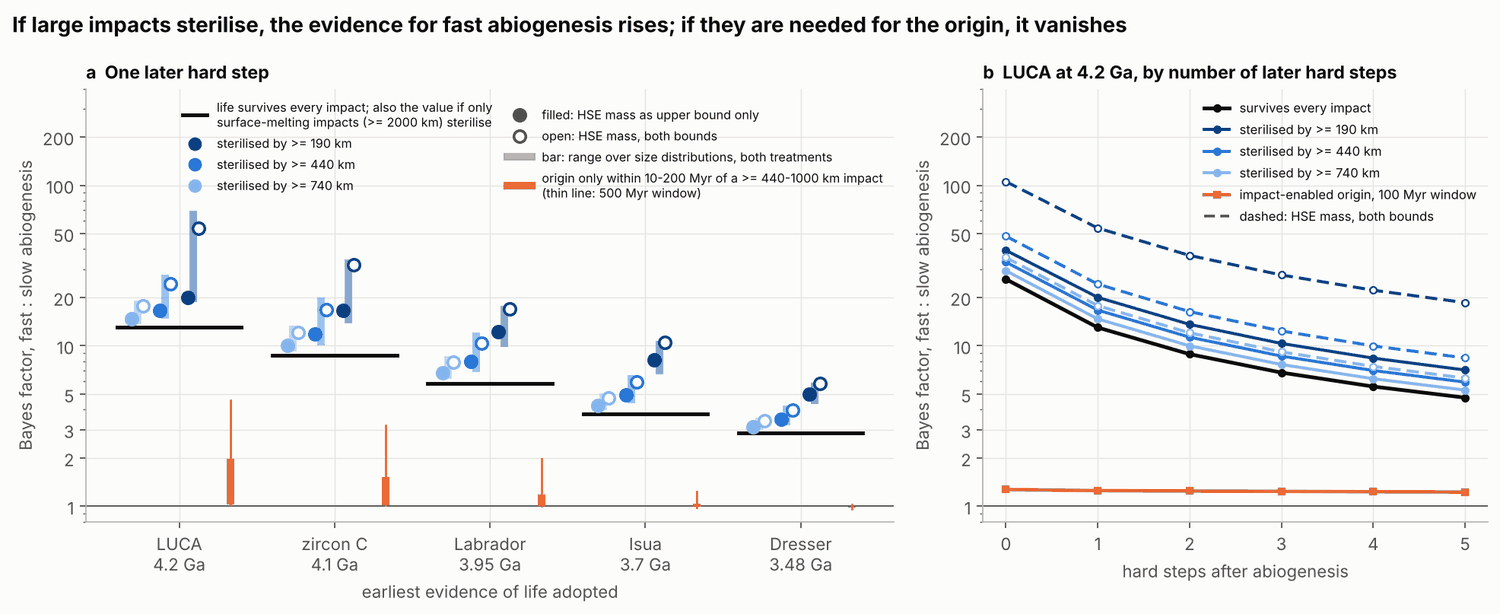
Bayes factor, fast : slow, one later hard step (all models; upper only / both bounds; Fig. 4):
| Earliest evidence | Survive, or only >= 2000 km sterilises | >= 740 km sterilises | >= 440 km | >= 190 km | 50:50 at 440 km | Impact-enabled, W <= 200 Myr |
|---|---|---|---|---|---|---|
| LUCA 4.2 Ga | 13.0 | 14.7 / 17.8 | 16.7 / 24.2 | 20.0 / 54 | 14.2 / 14.9 | 1.0-2.3 |
| Zircon carbon 4.1 Ga (contested) | 8.7 | 10.1 / 12.1 | 11.8 / 16.8 | 16.6 / 32 | 9.8 / 10.6 | 1.0-1.8 |
| Labrador 3.95 Ga (contested) | 5.8 | 6.8 / 7.9 | 8.0 / 10.4 | 12.2 / 16.9 | 6.7 / 7.3 | 1.0-1.3 |
| Isua 3.7 Ga (contested) | 3.8 | 4.2 / 4.8 | 4.9 / 5.9 | 8.2 / 10.5 | 4.3 / 4.6 | 1.0-1.1 |
| Dresser 3.48 Ga (accepted) | 2.9 | 3.1 / 3.4 | 3.5 / 4.0 | 5.0 / 5.8 | 3.2 / 3.3 | 1.0 |
The 190-740 km columns are conditional hypotheticals. For LUCA at 440 km the ranges are 14.0-18.2 (upper) and 17.8-31.2 (both) across chronologies. Multipliers barely depend on the number of hard steps: for m = 0-5 the LUCA values are 26.0 / 13.0 / 8.9 / 6.8 / 5.6 / 4.8 (survive) and 33 / 16.7 / 11.3 / 8.6 / 7.0 / 5.9 or 48 / 24.2 / 16.3 / 12.4 / 10.0 / 8.4 (440 km). For a 500 Myr impact-enabled window the LUCA factor is 1.8-5.6. Integrating over the LUCA age error gives 16.4 / 22.6 against 13.25.
LUCA and the last impact. After a 4.2 Ga LUCA at least one impactor struck with probability 88% / 98% (>= 190 km; 5.5 / 8.2 expected), 42% / 65% (>= 440 km), 19% / 36% (>= 740 km) and 5% / 12% (>= 1000 km). The LUCA date therefore disfavours "photic-zone boiling sterilises" by 7-11 to 1 (upper) or 37-150 to 1 (both), and "ocean vaporisation at 440 km sterilises" by about 2 to 1 or 3-5 to 1. This is why the equal-prior value stays at 13.3-14.9 whatever the treatment.
Answer. Sterilisation can only shorten the window, so it raises the factor or leaves it unchanged. With the physically supported threshold it is unchanged. The size of any increase is set by the assumed tail, not by the basin record.
Robustness checks
Eighteen bombardment variants (smooth basin ages; Fassett densities; undated basins dropped or redrawn; Earth/Moon ratio 17 or 23; impactor sizes x 0.8 or x 1.25; no flux before SPA; none or x 3 after the youngest basin; steeper or flatter pre-SPA flux; power laws ending at 1000 or up to 6000 km; no main-belt bootstrap; two alternative sawtooth normalisations):
| Quantity | Upper only | Both bounds |
|---|---|---|
| P(no >= 440 km after 4.2 Ga) | 0.50-0.65 | 0.29-0.42; 0.05 with no flux before SPA |
| Median last >= 440 km (Ga) | 4.20-4.31 | 4.08-4.16; 3.91 with no flux before SPA |
| P(no >= 190 km after 3.8 Ga) | 0.47-0.98 | 0.29-0.98 |
| B(LUCA, 440 km) | 15.5-17.4 | 21.7-25.8; 46 with no flux before SPA |
| B(Dresser, 190 km) | 4.6-5.5 | 5.1-7.0 |
| 50:50 B(LUCA, 440 km) | 13.8-14.3 | 13.6-15.0 |
These ranges are not the uncertainty on the headline; the tail and HSE treatment are. Other HSE treatments at 440 km, P(none after 4.2 Ga): no constraint 0.49; upper bound x 5 only 0.50; lower bound with upper x 5: 0.28; lower bound halved 0.42. Subsets, listed separately: main-belt only 0.54 / 0.43 with B(LUCA, 440) = 18.9 / 24.1; main-belt normalised at 600 km basins 0.51 / 0.40 and 18.5 / 23.0; without main-belt 0.60 / 0.29 and 15.6 / 24.5. Sawtooth alone: 0.55 / 0.20 pinned, 0.64 / 0.24 as published with Orgel densities (Nectaris 4.32 Ga), 0.55 / 0.19 rescaled uniformly. Chang'e-6, like for like, B(LUCA, 440): Neukum to Yue +5% / -1%; SPA anchor 4.33 to 4.247 Ga +15% / +26%. Bayes side: window from 4.50 Ga gives 13.5 / 23.4 against 9.0; pointwise convention 17.4 / 25.6. Sampled and analytic survival agree within 0.007; Monte Carlo standard error is at most 0.005.
Limitations
- The basin record supplies timing; the number of threshold-size impactors is an assumption about an unobserved tail, with a time-invariant size distribution and equal prior on three families.
- The two HSE treatments differ by 0.13 Gyr in the median and sevenfold in the chance of no ocean-vaporising impact after oceans formed. Upper only assumes the veneer giants struck before about 4.4 Ga; the Earth/Moon HSE ratio favours a few giants, but late lunar retention (Morbidelli et al. 2018; Zhu et al. 2019) weakens that argument.
- With both bounds the result is sensitive to the unrecorded flux before SPA.
- Thresholds are energy criteria, not biological facts; the 190 km value was not checked at source.
- Orgel et al.'s journal table was not obtained; 13 of 43 basins are undated.
- No cataclysm chronology beyond Nectaris 3.95-4.20 Ga; the fast-decay curve used by Abramov et al. 2026 is not implemented and would end large impacts earlier.
- HSE retention may be incomplete for large differentiated impactors (Marchi et al. 2018).
- The Bayes factor inherits the timing study's assumptions, and the mixture counts three near-identical chronologies separately.
Closest prior work and what is new
Marchi et al. 2014 (Extended Data Fig. 6) gave an HSE-calibrated Monte Carlo distribution for the date of the last > 500 km impact. Abramov, Medvegy, Kremer & Mojzsis 2026 (Nat. Commun. 17, 9790; EGU26-11758) ran a 3-D thermal model with main-belt impactors and found global sterilisation events until about 4.4 Ga and an optimal window near 4.4-4.3 Ga, with no rate inference; they treat ocean-vaporising impacts as sterilising, so the 2000 km reading is not unanimous. Snyder-Beattie et al. 2021 (Sec. 6.3) compared habitability from 4.3 or 3.9 Ga as fixed alternatives; Lineweaver & Davis 2002 used a "frustrated" interval of 0.5 +/- 0.4 Gyr; Spiegel & Turner 2012 noted the start could be marginalised but fixed it; Kipping 2020 and 2025 fix it at 4.404 Ga; Pearce et al. 2018 bracket 4.5 or 3.9 Ga. Minton et al. 2015 showed that a main-belt size distribution over-produces lunar mega-basins. Sleep et al. 1989, Abramov & Mojzsis 2009 and Citron & Stewart 2022 set the thresholds; Benner et al. 2020, Zahnle et al. 2020 and Wogan et al. 2023 argue for impact-enabled chemistry.
New here: (i) an extension of Marchi et al.'s date distribution to thresholds of 190-2000 km, seven chronologies including the Chang'e-6 dates, a basin-based calibration and one-sided versus two-sided use of the HSE mass; (ii) that distribution marginalised inside the selection-conditioned Bayes factor; (iii) survive, sterilise and impact-enabled branches in one framework, with the odds that a 4.2 Ga LUCA pre-dates the last impact. The direction of the effect follows from Kipping's formula; the size is new. I did not find (ii) or (iii) in the literature; the search was not exhaustive.
Implications for the Fermi Paradox
Late sterilisation does not rescue slow abiogenesis on Earth. For the integrator: keep the timing study's factor (13.0 for LUCA, 2.9 for accepted fossils) as the best-supported value. If a sterilisation scenario is wanted, multiply by 1.0-1.9 (LUCA, >= 440 km; 1.0-1.4 for >= 740 km) or 1.0-2.0 (fossils, 440-190 km); the equal-prior value is 13-15 and 3.0-3.9. All of this lies inside the spread of about 3 to 30 the timing study found. Carry "impact-enabled origin" as a separate branch in which the timing evidence is void (factor 1.0-2.3 for windows up to 200 Myr, up to about 5 for 500 Myr). For Earth, impact sterilisation is not a plausible early filter; the study says nothing about bombardment elsewhere.
Figures and code
code/run_all.py (about 12 minutes on one busy core;
numpy, scipy, pandas, matplotlib, pdftotext) re-downloads the sources
and regenerates every table in data/, the four figures and
the independent check.
Response to referee
- Two-sided HSE run in main table and headline. Done; both treatments run on common realisations and appear in every table and figure. My values: median 4.12-4.25 Ga, P(none after 4.2 Ga) 0.35-0.58, P(none after oceans) 4-28%.
- Multipliers. Replaced by 1.0-1.9 (LUCA, 440 km), 1.0-1.4 (740 km), 1.0-2.0 (fossils); equal-prior values 13.3-14.9 and 3.0-3.9 added.
- Robustness range. No longer presented as the uncertainty. Range across tail and HSE treatment is 0.23-0.76 (referee: 0.25-0.77). Eighteen variants now; main-belt-only rows listed separately.
- Main-belt fit. KS p = 0.007 reported, Minton et al. 2015 cited, sentence corrected. Rather than declare the Poisson error, I propagated it by bootstrap; the effect is small (0.54 against 0.56).
- Marchi comparison. Reworded as requested; both treatments tabulated.
- Sawtooth. Fixed, with Nectaris pinned at 4.1 Ga and the young end left at the published calibration. I did not adopt a uniform rescale as the main version because it puts Imbrium at 3.79 Ga; it is a robustness row with the same result. Ranges updated; the missing cataclysm chronology is stated.
- "Essentially certainly by 3.8 Ga". Now 92-95%.
- Filter claim. Restricted to Earth.
- 2000 km threshold. Added as a column and as the best-supported reading (0.4-0.9% after 4.4 Ga; factor unchanged). I note that Abramov et al. 2026 treat ocean-vaporising impacts as sterilising, so this is not unanimous.
- Impact-enabled range. Quoted separately for W <= 200 Myr (1.0-2.3 with both treatments) and 500 Myr (1.8-5.6).
- Chang'e-6. Like-for-like pairs reported. The effect vanishes for the refit pair under two-sided conditioning but grows for the anchor pair (+26%), so "disappears" is only half right.
- >= 190 km tail. Quoted as a range; 1.6 expected post-Orientale lunar basins reported; B(Dresser, 190 km) 4.6-5.8, up to 7.0 with threefold flux.
- Prior work. Snyder-Beattie et al. 2021, Abramov et al. 2026 (abstract and the September 2026 paper) and Minton et al. 2015 added; novelty item (i) reworded.
- 190 km label and framing. Column labelled as energy-scaled and unchecked; the summary now says the basin record supplies timing and the tail is assumed.
New in revision and not requested: sensitivity to pre-SPA flux under two-sided conditioning; an independent re-computation; a lunar check on impactors larger than SPA's.
Key numbers
| Quantity | Value | Uncertainty | Note |
|---|---|---|---|
| Median date of the last Earth impactor >= 440 km (classic 1-D ocean-vaporising threshold) | 4.25 Ga (HSE mass as upper bound only); 4.12 Ga (both HSE bounds) | across seven chronologies 4.21-4.34 Ga (upper only) and 4.03-4.26 Ga (both bounds); 10% chance younger than 3.87 / 3.81 Ga | Equal-prior mixture of 21 models (7 chronologies x 3 size distributions), 20,000 draws each. The two treatments are both defensible; the result is a range, not a point. |
| P(no impactor >= 440 km after ocean formation at 4.404 Ga) | 0.28 (upper only); 0.04 (both bounds) | Monte Carlo standard error <= 0.005 | Expected number of impactors >= 440 km since 4.51 Ga: 7.1 or 13.6. |
| P(no impactor >= 440 km after 4.4 / 4.3 / 4.2 / 4.1 / 4.0 / 3.9 / 3.8 Ga) | upper only: 0.29 / 0.44 / 0.58 / 0.71 / 0.84 / 0.88 / 0.95; both bounds: 0.04 / 0.17 / 0.35 / 0.54 / 0.73 / 0.80 / 0.92 | at 4.2 Ga: 0.23-0.76 across the three size distributions and two treatments; 0.51-0.78 (upper) and 0.20-0.67 (both) across chronologies | Tail and HSE treatment dominate; fifteen-plus bombardment variants move the mixture only by 0.50-0.65 (upper) and 0.29-0.42 (both), except 'no flux before SPA' with both bounds: 0.05. |
| P(no impactor >= 190 km after 4.2 / 3.8 Ga) (photic zone boiled; threshold energy-scaled, not checked at source) | upper only: 0.12 / 0.73; both bounds: 0.02 / 0.62 | at 3.8 Ga: 0.29-0.98 depending on the post-Orientale flux (x3 to zero); median date 3.89 / 3.83 Ga; 10% chance younger than 3.5 / 3.2 Ga (3.8 Ga with no post-Orientale flux) | Model expects 1.6 lunar basins >= 300 km after the youngest basin where none exist (Poisson p = 0.20); spherule layers point the other way. |
| P(no impactor >= 740 km after 4.404 / 4.2 Ga) (Citron & Stewart 2022 lower limit) | upper only: 0.57 / 0.81; both bounds: 0.23 / 0.64 | median date 4.45 / 4.28 Ga | For >= 1000 km: 0.86 / 0.95 (upper) and 0.70 / 0.88 (both) after 4.4 / 4.2 Ga. |
| P(impactor >= 2000 km after 4.4 Ga) (surface melting; the only threshold with physical support for full sterilisation) | 0.4% (upper only); 0.9% (both bounds) | 3-6% if the HSE upper bound is raised fivefold or removed | Best-supported reading: Bayes factor unchanged at 13.0 (LUCA) and 2.87 (accepted fossils). |
| Bayes factor fast:slow, LUCA 4.2 Ga, one later hard step, if impactors >= D sterilise | 440 km: 16.7 (upper) / 24.2 (both); 740 km: 14.7 / 17.8; 190 km: 20.0 / 54; 1000 km: 13.4 / 14.1; 2000 km: 13.0 / 13.0 | 440 km: 14.0-18.2 (upper) and 17.8-31.2 (both) across chronologies; 14.8-21.9 and 21.6-27.7 across size distributions | Baseline with no sterilisation 13.0. Multipliers: 1.3-1.9 (440 km), 1.1-1.4 (740 km). Conditional hypotheticals. |
| Bayes factor fast:slow, accepted fossils 3.48 Ga, one later hard step | 2.87 (survive); 440 km: 3.5 / 4.0; 190 km: 5.0 / 5.8; 740 km: 3.1 / 3.4 | 190 km: 4.6-5.5 (upper) and 5.1-7.0 (both) across bombardment variants | Multipliers 1.2-1.4 (440 km) and 1.7-2.0 (190 km). |
| Bayes factor with equal prior on 'sterilises' and 'life survives' (one hard step) | LUCA: 13.3-14.9; accepted fossils: 3.0-3.9 | over thresholds 190-740 km, both HSE treatments; 13.6-15.0 (LUCA, 440 km) across all bombardment variants | Stable because a 4.2 Ga LUCA makes the sterilising hypotheses unlikely in exactly the cases where they would raise B most. |
| Probability that at least one impactor struck after a 4.2 Ga LUCA | >= 190 km: 88% (upper) / 98% (both); >= 440 km: 42% / 65%; >= 740 km: 19% / 36%; >= 1000 km: 5% / 12% | expected number >= 190 km after 4.2 Ga: 5.5 / 8.2 | The LUCA date disfavours 'photic-zone boiling sterilises' by 7-11 to 1 (upper) or 37-150 to 1 (both), and '>= 440 km sterilises' by about 2 to 1 or 3-5 to 1. |
| Bayes factor if life can originate only within a window W after an impact >= 440-1000 km | LUCA: 1.0-2.3 for W = 10-200 Myr; 1.8-5.6 for W = 500 Myr. Accepted fossils: 0.96-1.1 | range over thresholds, 0-5 hard steps, size distributions and both HSE treatments; all-model, one-step values 1.0-2.0 and 2.0-4.6 | Timing evidence is void in this branch. |
| Realised late-accreted mass versus the HSE range (0.7-3.0)e22 kg | fraction below / inside / above: main-belt shape 55 / 42 / 3%; shallow power law 16 / 39 / 45%; steep power law 77 / 18 / 5% | medians 0.63, 2.5 and 0.22 e22 kg | Impactors of all 74 catalogued basins scaled to Earth carry only 2.6e20 kg, 4% of the HSE lower bound: the veneer must sit in bodies larger than the South Pole-Aitken impactor. |
| Comparison with Marchi et al. 2014 (last impactor > 500 km: median 4.32 Ga, 3-7 impactors) | upper only: median 4.30 Ga, 5.6 impactors >= 500 km, 0.5 >= 1000 km; both bounds: 4.15 Ga, 10.9 and 1.1 | P(last > 500 km impact younger than 4.0 Ga): 14% / 23% (Marchi: about 10%) | Agreement in the upper-only case is not an independent confirmation; it holds only if the veneer came in a few giants. |
| Main-belt size distribution versus lunar mega-basins | KS p = 0.35 (basins >= 300 km), p = 0.007 (basins >= 600 km); 8.2 basins >= 1000 km predicted, 3 observed (Poisson p = 0.04) | main-belt tail rests on 3 bodies >= 440 km; now propagated by Bayesian bootstrap | Consistent with Minton et al. 2015. Power-law slopes (impactor size): 1.63 +/- 0.25 (>= 300 km), 2.73 +/- 0.66 (>= 600 km). |
| Chang'e-6 re-dating, like for like, B(LUCA, 440 km) | Neukum to Yue refit: +5% (upper), -1% (both); SPA anchor 4.33 to 4.247 Ga: +15% (upper), +26% (both) | Dresser values change by less than 5% | Effect is small and not robust in sign for the refit pair. |
| Spherule-layer check: expected Earth impactors >= 20 km at 3.2-3.5 Ga | 2.6 (upper), 2.9 (both); observed 8 layers | 2.1-3.4 across chronologies | Model under-predicts about threefold; post-Orientale flux uncertain by a factor of about 3 either way. |
Changes made after the referee report
- Added two-sided HSE conditioning (mass within (0.7-3.0)e22 kg) as a second main treatment, evaluated on the same realisations as the upper-bound-only case, and carried both through every table, figure and headline number; four further HSE treatments are robustness rows.
- Headline dates and multipliers are now ranges across the two treatments (median last >= 440 km impact 4.12-4.25 Ga; P(none after oceans) 4-28%; multipliers 1.3-1.9 for LUCA at 440 km).
- Added the 2000 km surface-melting threshold and state that the best-supported reading leaves the Bayes factor unchanged; 190-740 km columns are labelled conditional hypotheticals.
- Replaced the '0.50-0.65 across 16 variants' uncertainty by the 0.23-0.76 range across size distributions and HSE treatments; robustness variants are counted correctly and main-belt-only rows are listed separately.
- Reported the main-belt KS failure on basins >= 600 km (p = 0.007), cited Minton et al. 2015, corrected the 'all three fit' sentence, and propagated the small-number error of the main-belt tail by Bayesian bootstrap.
- Re-normalised the sawtooth chronology so Nectaris is at 4.1 Ga; the as-published and uniformly rescaled versions are robustness rows; chronology ranges updated.
- Reworded the Marchi et al. 2014 comparison: not an independent confirmation.
- Replaced the confounded Chang'e-6 '+12%' by like-for-like pairs under both treatments.
- Impact-enabled range now quoted separately for windows up to 200 Myr and 500 Myr.
- The >= 190 km late tail and B(Dresser, 190 km) are quoted as ranges; the 1.6 expected post-Orientale lunar basins are reported.
- Softened 'essentially certainly by 3.8 Ga' to 92-95% and restricted the filter statement to Earth.
- Added Snyder-Beattie et al. 2021, Abramov et al. 2026 and Minton et al. 2015 to prior work; first novelty item described as an extension of Marchi et al. 2014 Extended Data Fig. 6.
- Added code/independent_check.py (shares no code with the model) and a lunar consistency check (impactors larger than the SPA impactor expected on the Moon).
- Main grid raised to 20,000 draws per model; BLAS pinned to one thread; all tables and figures regenerated from fresh downloads with the final code.
Referee points not accepted
- Chang'e-6 effect 'disappears under two-sided HSE conditioning': only partly. The Neukum-to-Yue refit pair does vanish (-1%), but the SPA-anchor pair grows from +15% to +26%. Both pairs are reported.
- Sawtooth fix by uniform rescaling (the referee's version): not adopted as the main implementation because it moves Imbrium to 3.79 Ga against its 3.92 Ga radiometric age. I pin Nectaris at 4.1 Ga and keep the young end at the published calibration; the uniform version is a robustness row and gives the same conclusions (P = 0.55 in both).
- 'About 2000 km is the physically supported threshold': adopted as the best-supported reading, but stated as not unanimous, because Abramov et al. 2026 (Nat. Commun.) treat ocean-vaporising impacts as global sterilisation events.
- Range '0.25-0.77': my rerun gives 0.23-0.76 across size distributions and the two treatments, and wider extremes (0.05 to 0.78) for single variants and chronologies; the latter are disclosed rather than folded into one number.
- The suggestion that the Poisson error on three main-belt bodies moves the main-belt P between 0.34 and 0.72: once propagated by bootstrap inside the Monte Carlo, the effect on the main-belt result is small (0.54 against 0.56 without bootstrap), because the HSE conditioning and the other error terms already dominate.
Code
Every number above is produced by these scripts from public data. The data tables themselves are not hosted here; the scripts download them.
analysis.py bayes.py chronology.py config.py fetch_data.py figures.py independent_check.py model.py run_all.py
Referee report
A second, separate analysis re-ran the code, recomputed the main numbers by its own route and tried to break the result. Like the first, it was run by Claude for this project; it is not an outside expert. In its report “the analyst” is the first analysis, which wrote the paper, and file names that are not linked on this page are its own working files. The paper above is the version revised in response.
Verdict: sound with fixes. Results reproduced: yes.
RERUN. I copied code/ to a separate working folder and ran run_all.py with fresh downloads (all four sources re-fetched; 304 s, one core). results.json, p_none_table.csv, bf_table.csv, robustness.csv, last_impact_quantiles.csv, hse_check.csv, spherule_check.csv and model_grid.csv are byte-identical to the analyst's files. Every headline number I checked in the report matches those tables (dates, P(none) rows, Bayes-factor grid, 50:50 values 13.6-14.3, LUCA odds 7-10:1 and 30-90:1, date-marginal 16.6 vs 13.25, robustness rows).
INDEPENDENT ROUTE 1 (bombardment; scripts/indep.py, does not import the analyst's code). Deterministic expectation for Neukum ages and the main-belt shape:
- Lunar basins >= 300 km younger than 4.2 Ga: 19.4 (16.5 dated, 1.3 undated share, 1.6 post-Orientale extrapolation).
- Times Earth/Moon ratio 19.2, times N_MB(>=440 km)/N_MB(>=18.9 km) = 3.63/2290, gives 0.59 expected impacts, so P(none >= 440 km after 4.2 Ga) = 0.55.
- The analyst's values are 0.51 for Neukum x main-belt and 0.55 for the Neukum group. At 4.1 / 4.0 / 3.8 Ga I get 0.75 / 0.87 / 0.96 against the mixture's 0.71 / 0.83 / 0.95.
- Joins are clean: 74 basins, 30 dated, no duplicate or dropped keys, all 30 dated basins are >= 300 km.
INDEPENDENT ROUTE 2 (Bayes factor). My own integration over the published survival_curves.csv gives, for one hard step:
- LUCA: 17.0 / 19.9 / 15.0 for >= 440 / 190 / 740 km (analyst 16.9 / 19.7 / 15.0).
- Dresser: 3.5 and 5.0 (same).
- Closed-form "survives" row: 13.0 / 8.72 / 5.84 / 3.77 / 2.87 (same). The algebra is correct: for one hard step B is about 5.3 / (2 x mean window given the window is open), so the result is simply how much the 204 Myr window shrinks.
CITATIONS CHECKED AT SOURCE.
- Yue et al. 2026: eq. 1 coefficients, SPA N(1) = 0.369 at 4.247 Ga and Fra Mauro 3.922 Ga confirmed in the PMC full text.
- Marchi et al. 2014: median 4.32 Ga for the last > 500 km impact, about 10% at 4.0 Ga or later, 3-7 impactors > 500 km, 1-4 > 1000 km, "average of five", per-area factors 1.24 and 1.90, all confirmed in the PDF.
- Citron & Stewart 2022: 350-450 km prior estimates, 740 km lower limit, 2000-2700 km for surface melting, confirmed.
- Orgel LPSC table: all 30 rows match the PDF text.
- Morbidelli et al. 2012: N1/N20 of about 1400 and Nectaris assumed at 4.1 Ga, confirmed.
- Su et al. 2025 and Joy et al. 2025 exist as cited.
- Not verifiable: the 190 km photic-zone figure in Sleep et al. 1989 (paywalled; the analyst declares this).
STRESS TESTS I ADDED (twosided/ref_tests*.py; the analyst's model with one extra clause, mass >= hse_min). Results are in the errors list.
Strongest objection
The lunar basin record cannot say how many ocean-vaporising impactors hit Earth; that number comes from an assumed tail, and the one terrestrial constraint on the tail is applied one-sidedly.
Every threshold lies above the largest lunar impactor, so the count of impactors of 440 km and larger is set by the extrapolated size distribution. The HSE late-veneer mass is the only data that bear on that tail. The model fails its lower bound in 55-82% of realisations, yet only the upper bound is enforced. That keeps exactly the mass-deficient realisations with few large impacts.
Enforcing both bounds inside the analyst's own model changes the bombardment headline materially:
- Median last impact of 440 km or larger: 4.13 Ga instead of 4.25 Ga.
- Chance that none followed ocean formation: 4% instead of 28%.
- P(none after 4.2 Ga): 0.36 instead of 0.58.
- B(LUCA, 440 km sterilises): 25 instead of 16.9.
An expert would add two points. The main-belt shape is rejected by the mega-basin counts (KS p = 0.007; Minton et al. 2015), which pulls the other way. And the published physics (Abramov & Mojzsis 2009; Citron & Stewart 2022) says nothing short of a 2000 km impactor sterilises the subsurface; the analyst's own table gives a probability of about 0.4% for such an impact after 4.4 Ga.
Does the conclusion survive? The direction and the Fermi-level message do:
- Sterilisation can only shorten the window, so it can only raise the fast:slow factor.
- The equal-prior sterilise/survive value stays at 13-15 under every variant I ran.
- With the physically supported threshold (about 2000 km) the factor is simply unchanged at 13.0.
- The impact-enabled branch still collapses it to about 1-2.
What does not survive is the precision of the bombardment numbers. "Median 4.25 Ga", "28% none after oceans" and "multiplier 1.3-1.5" should be given as about 4.1-4.3 Ga, 4-28% and 1.3-1.9.
Errors found
- major. The late-veneer (HSE) mass is used only as
an upper bound, and the headline dates and multipliers depend on that
choice by more than the quoted robustness range. The model
under-delivers the veneer in most realisations: only 45% (main-belt),
39% (shallow) and 18% (steep) of draws fall inside (0.7-3.0)e22 kg. The
filter therefore removes heavy-tail realisations and keeps
mass-deficient ones, which are the ones with few large impactors and an
early last impact.
- Evidence: Analyst's hse_check.csv gives the fractions above; sawtooth x main-belt exceeds the lower bound in 3% of draws. My rerun with the lower bound enforced (21 models x 2000-3000 draws, twosided/ref_tests2.log), against the analyst's baseline:
- P(no >= 440 km after 4.4 / 4.3 / 4.2 / 4.1 / 4.0 / 3.9 / 3.8 Ga): 0.04 / 0.17 / 0.36 / 0.56 / 0.73 / 0.80 / 0.92, against 0.28 / 0.43 / 0.58 / 0.71 / 0.83 / 0.88 / 0.95.
- Median last >= 440 km: 4.13 Ga against 4.25. Median last >= 190 km: 3.83 against 3.89.
- P(no >= 190 km after 4.2 Ga): 0.02 against 0.13.
- B(LUCA, one hard step): 25.0 / 18.3 / 52 for 440 / 740 / 190 km, against 16.9 / 15.0 / 19.7.
- B(Dresser): 4.0 / 5.8 for 440 / 190 km, against 3.5 / 5.0.
- 50:50 sterilise/survive: 13.3-15.1, essentially unchanged. Variants:
lower bound halved gives 0.42 and 4.16 Ga; power laws to 6000 km give
0.39 and 4.15 Ga; upper bound x5 with the lower bound gives 0.31 and
4.10 Ga. Counter-evidence the analyst can use: Marchi et al. 2014 meet
the HSE budget with a few > 1000 km bodies and get 4.32 Ga for >
500 km. So the answer depends on whether the veneer arrived in a few
giants (baseline holds) or in many 500-1000 km bodies (later dates). The
three SFD families barely represent the giants.
- Fix: Add the two-sided HSE run as a main-table row, not a footnote. State the last >= 440 km impact as median 4.1-4.3 Ga and P(none after ocean formation) as 4-28%. Give the sterilisation multiplier as 1.3-1.9 (LUCA, 440 km) and 1.2-1.4 (Dresser, 440 km). Stop presenting '0.50-0.65 across 16 robustness variants' as the uncertainty on P(none after 4.2 Ga); the defensible range is about 0.25-0.77. Say explicitly that the one-sided treatment is right only if the veneer came in one or a few giant early bodies outside the modelled population (Bottke 2010; Brasser 2016; Genda 2017).
- major. The framing 'from the lunar basin record'
overstates what the basin data constrain. Every threshold (190-1000 km)
lies above the largest lunar impactor (SPA, 172 km). The basin record
fixes only the time profile and the number of roughly 19 km impactors;
the number of threshold-size impactors is set entirely by the assumed
tail. The main-belt shape, given one-third prior, is rejected by the
analyst's own test on the large basins, and this is not reported in the
text.
- Evidence: sfd_fits.csv: main-belt shape against basins >= 600 km has KS p = 0.0073. The report text quotes only 'KS p = 0.35, 0.35, 0.72', and the 0.72 belongs to the steep law tested on >= 600 km basins only, not on >= 300 km as the sentence says. The main-belt shape predicts 8.2 basins >= 1000 km against 3 observed (Poisson p about 0.04). Minton, Richardson & Fassett 2015 (Icarus 247, 172) is the known result that a main-belt SFD over-produces mega-basins; it is not cited. N_MB(>= 440 km) rests on 3 bodies; its roughly 55% Poisson uncertainty is not propagated and alone moves the main-belt P(none after 4.2 Ga) between about 0.34 and 0.72.
- Fix: Report the KS p = 0.007 and cite Minton et al. 2015. Correct the 'all three fit' sentence. State in the headline that the tail is an assumption bracketed on one side by the lunar mega-basin deficit (steep law, P = 0.77) and on the other by the HSE lower bound (P about 0.25-0.4). Either propagate the small-number error on the main-belt tail or say it is not propagated.
- minor. The 'Morbidelli+ 2012 sawtooth' row is not
the published sawtooth timeline for basins. With Orgel's higher crater
densities and the x1400 conversion, Nectaris lands at 4.32 Ga and SPA at
4.49 Ga, whereas the paper builds the curve with Nectaris at 4.1 Ga and
SPA-floor retention at 4.33-4.39 Ga. As implemented, the cataclysm-type
model is the earliest chronology (median 4.38 Ga), which is backwards
relative to its intent. No true terminal-cataclysm chronology is in the
set; the anchor chronologies cover it only partly (Nectaris 3.95-4.20
Ga).
- Evidence: twosided/ref_tests3.py. As implemented: Nectaris 4.320, SPA 4.487. Renormalised so Nectaris is 4.10 Ga: P(no >= 440 km after 4.2 Ga) = 0.54 instead of 0.64, median last 4.27 instead of 4.39 Ga, P(no >= 190 km after 3.8 Ga) = 0.44 instead of 0.66. B(LUCA, 440 km) stays 14.1; B(Dresser, 190 km) goes 5.1 to 5.6.
- Fix: Renormalise the sawtooth to its own Nectaris anchor, or relabel the row 'sawtooth curve with Orgel densities'. Correct the chronology ranges: the 4.38 Ga upper end of '4.20-4.38 Ga' comes from this row. Say that the study plan's 'accretion tail versus cataclysm' comparison is only partly tested.
- minor. The late tail of the >= 190 km
distribution rests on an extrapolation that the lunar record mildly
contradicts. The model expects about 1.5 lunar basins >= 300 km after
Orientale; none exist (Poisson p about 0.2). This tail drives '10%
chance younger than 3.53 Ga' and part of the Dresser / 190 km Bayes
factor.
- Evidence: My deterministic count gives 1.5 expected lunar basins after 3.8 Ga. The analyst's own variant 'no basin-forming flux after the youngest basin' moves P(no >= 190 km after 3.8 Ga) from 0.73 to 0.98 and B(Dresser, 190 km) from 5.0 to 4.6. The spherule check points the other way (model low by about 3x at 3.2-3.5 Ga).
- Fix: Quote the >= 190 km late quantile as a range (10% younger than about 3.5-3.8 Ga) and B(Dresser, 190 km) as 4.5-5.8. Say that the post-Orientale flux is unconstrained to a factor of about 3 either way.
- minor. The impact-enabled range '1.0-1.9' silently
excludes the W = 500 Myr rows that are in the published
bf_impact_enabled.csv.
- Evidence: For all models, one hard step, LUCA: W = 0.5 Gyr gives B = 3.0 (440 km), 2.5 (740 km), 2.0 (1000 km). The maximum over the file is 4.2.
- Fix: Either drop the W = 0.5 rows from the CSV or quote '1.0-1.9 for W <= 200 Myr, up to 3-4 for W = 500 Myr'.
- minor. 'Sixteen robustness variants' ranges are
computed over fifteen; the main-belt-only variant falls outside every
quoted range.
- Evidence: robustness.csv row 'main-belt family normalised at 600 km basins': P = 0.494, B(LUCA, 440 km) = 19.6, B(Dresser, 190 km) = 6.0, against quoted 0.50-0.65, 15.8-17.7, 4.5-5.5.
- Fix: Say 'fifteen mixture variants' and list the main-belt-only variant separately against its own baseline (0.53, 19.9, 5.6).
- minor. 'The Chang'e-6 re-dating raises B by about
12% (18.5 against 16.5)' is confounded by grouping. The 'other five'
include the Nesvorny and sawtooth chronologies, which give the lowest B
for unrelated reasons.
- Evidence: Like for like: Neukum to Yue refit is 17.7 to 18.7 (+6%); anchor SPA 4.33 to 4.247 Ga is 15.6 to 18.1 (+16%). Under two-sided HSE conditioning the Neukum/Yue difference vanishes (31.7 against 31.6).
- Fix: Replace with the like-for-like pairs and state that the effect is 5-15% and not robust to the HSE treatment.
- minor. The 190 km photic-zone threshold is not
verified at source (declared by the analyst). I could not verify it
either; Citron & Stewart confirm only the criterion (top 200 m), not
the diameter.
- Evidence: Sleep et al. 1989 is paywalled. Energy scaling from 440 km gives 184 km, which is consistent.
- Fix: Keep the caveat. Label the column '~190 km (energy-scaled from Sleep et al. 1989; not checked at source)'.
Overclaims
- Headline: 'the last ocean-vaporising impact has median date 4.25 Ga ... 28% chance none after the oceans formed'. This holds only with the HSE mass used as an upper bound; with both bounds it is 4.13 Ga and 4%.
- 'a multiplier of 1.2-1.7 that barely depends on the number of later hard steps'. The hard-step independence is correct, but the multiplier is 1.3-1.9 (LUCA, 440 km) and up to 2.0 (fossils, 190 km) once the HSE lower bound is enforced.
- 'Sixteen bombardment-side variants ... move P(no >= 440 km impact after 4.2 Ga) between 0.50 and 0.65'. Presented as robustness, but the size-distribution tail and HSE treatment move it over about 0.25-0.77.
- 'Independent calibration (basin record here, HSE there)' for the agreement with Marchi et al. 2014. The agreement is partly coincidental: the model misses the HSE lower bound in most draws, and conditioning on it doubles the number of >= 500 km impactors relative to Marchi.
- 'ocean-vaporising impacts were over by about 4.2 Ga in the median case and essentially certainly by 3.8 Ga'. The analyst's own P(none after 3.8 Ga) is 0.95, and 0.92 two-sided.
- 'Impact sterilisation itself is not a plausible early filter for Earth-like planets'. This generalises from one planet's bombardment history to all Earth-like planets.
- 'the Chang'e-6 re-dating raises B by about 12%'. Confounded by the grouping of chronologies; like for like it is 6-16% and vanishes under two-sided HSE conditioning.
- 'All three fit the basins >= 300 km'. The main-belt shape fails on basins >= 600 km (KS p = 0.007 in the analyst's own table).
- The title-level framing 'from the actual record' / 'built from the dated basin catalogue'. The basin record supplies the timing; the number of threshold-size impactors is an assumption about an unobserved tail.
Novelty check
Novel: partly. The components have clear precedents; the combination appears new. Marchi et al. 2014 (Extended Data Fig. 6) already give a Monte Carlo distribution for the date of the last > 500 km impact, calibrated on HSE, and the analyst's baseline essentially reproduces it (4.29 against 4.32 Ga) from a different calibration. Lineweaver & Davis 2002 and Snyder-Beattie et al. 2021 already asked how a later habitability start changes the abiogenesis inference, with fixed dates. I found no paper that marginalises a bombardment-derived distribution for the window opening inside a selection-conditioned fast:slow Bayes factor, or that sets out the survive / sterilise / impact-enabled branches in one framework. Kipping 2025 does not treat impacts (checked in the full text). The analyst's 'medium' confidence is fair. Two additions to the prior-work section are needed: Snyder-Beattie et al. 2021 Sec. 6.3 and the Abramov, Medvegy & Mojzsis 2026 abstract. The qualitative result (a shorter window raises the fast:slow ratio) follows directly from Kipping's formula; the new content is the size of the effect and the LUCA-versus-threshold odds.
- Marchi et al. 2014, Nature 511, 578: Monte Carlo date distribution of the last > 500 km impact (median 4.32 Ga; about 10% at 4.0 Ga or later), HSE-calibrated; no abiogenesis inference
- Lineweaver & Davis 2002, Astrobiology 2, 293: 'frustrated' interval of 0.5 +/- 0.4 Gyr from the 4.44-3.7 Ga literature range for the last sterilising impact, in a rate estimate not conditioned on our existence
- Snyder-Beattie, Sandberg, Drexler & Bonsall 2021, Astrobiology 21, 265: Sec. 6.3 compares habitability starting at 4.3 Ga (oceans) with 3.9 Ga (end of the Late Heavy Bombardment) as fixed alternatives in a hard-steps Bayesian model. Not cited by the analyst
- Spiegel & Turner 2012, PNAS 109, 395: note that t_min could be given a prior and marginalised; they use fixed values
- Kipping 2020 (PNAS 117, 11995) and Kipping 2025 (Astrobiology; arXiv:2504.05993): window fixed at 4.404 Ga; no treatment of impacts
- Pearce et al. 2018, Astrobiology 18, 343: habitability boundary bracketed at about 4.5 or 3.9 Ga
- Abramov, Medvegy & Mojzsis 2026, EGU26-11758 (abstract): 3-D thermal model of impact sterilisation and habitats over 4.5-3.5 Ga, optimal window about 4.4-4.3 Ga; no rate inference. Not cited by the analyst
- Benner et al. 2020 (arXiv:1908.11327) and Citron & Stewart 2022 (PSJ 3, 116): impact-enabled origin and revised sterilisation thresholds
- Minton, Richardson & Fassett 2015, Icarus 247, 172: a main-belt SFD over-produces lunar mega-basins; bears directly on the tail extrapolation. Not cited by the analyst
Required changes
- Add the two-sided HSE run (realised mass within (0.7-3.0)e22 kg) to the main results table and the headline. Give the last >= 440 km impact as median 4.1-4.3 Ga (4.25 Ga upper-bound-only, 4.13 Ga two-sided), P(none after 4.2 Ga) as 0.36-0.58, and P(none after ocean formation) as 4-28%.
- Replace 'multiplier of 1.2-1.7' and the integrator guidance 'multiply by 1.0-1.5 (LUCA) or 1.0-1.7 (accepted fossils)' with 1.0-1.9 (LUCA, >= 440 km; 1.0-1.4 for >= 740 km) and 1.0-2.0 (accepted fossils, 440-190 km). Add that the equal-prior sterilise/survive value is stable at 13-15 (LUCA) and 3.0-3.9 (fossils).
- Remove '0.50-0.65 across 16 robustness variants' as the uncertainty on P(no >= 440 km after 4.2 Ga). State the range as about 0.25-0.77, driven by the size-distribution tail and the HSE treatment. Say 'fifteen variants' and list the main-belt-only variant separately.
- In Method step 4, report that the main-belt shape fails the KS test on basins >= 600 km (p = 0.007) and cite Minton et al. 2015. Correct the sentence 'All three fit the basins >= 300 km (KS p = 0.35, 0.35, 0.72)': the third value is for the steep law on >= 600 km basins only. State that the Poisson error on the three main-belt bodies >= 440 km is not propagated.
- Reword the Marchi et al. 2014 comparison. It is not a clean independent confirmation: the baseline matches Marchi's date for > 500 km (4.29 against 4.32 Ga) while failing the HSE lower bound in most draws. With the lower bound enforced the model gives about 10 impactors >= 500 km (Marchi: about 5) and a median near 4.16 Ga. Explain that the difference is whether the veneer arrives in a few > 1000 km bodies or many 500-1000 km bodies.
- Fix or relabel the sawtooth chronology (Nectaris at 4.32 Ga as implemented, 4.1 Ga in Morbidelli et al. 2012). Renormalised values: P(no >= 440 km after 4.2 Ga) = 0.54, median 4.27 Ga. Update the 'across chronologies' ranges, whose 4.38 Ga upper end comes from this row. State that no terminal-cataclysm chronology is included beyond the anchor chronologies' Nectaris range of 3.95-4.20 Ga.
- Soften 'essentially certainly by 3.8 Ga' to 'with about 92-95% probability by 3.8 Ga'.
- Delete or restrict 'Impact sterilisation itself is not a plausible early filter for Earth-like planets'. The study constrains Earth's bombardment only; say 'for Earth'.
- State in the headline and the Answer paragraph that with the physically supported sterilisation threshold (about 2000 km, Citron & Stewart 2022; no subsurface sterilisation, Abramov & Mojzsis 2009) the model gives a probability of about 0.4% after 4.4 Ga, so the best-supported reading is 'factor unchanged at 13.0 (LUCA) / 2.9 (fossils)'. The 190-740 km columns are conditional hypotheticals.
- Quote the impact-enabled range as '1.0-1.9 for windows up to 200 Myr; up to 3-4 for a 500 Myr window', or remove the W = 0.5 Gyr rows from bf_impact_enabled.csv.
- Replace 'the Chang'e-6 re-dating raises B by about 12% (18.5 against 16.5)' with the like-for-like pairs (Neukum to Yue +6%; SPA anchor 4.33 to 4.247 Ga +16%) and note that the effect disappears under two-sided HSE conditioning.
- Quote the >= 190 km late tail as a range (10% chance younger than about 3.5-3.8 Ga) and B(Dresser, 190 km) as 4.5-5.8. Note that the model expects about 1.5 lunar basins >= 300 km after Orientale where none exist.
- Add Snyder-Beattie et al. 2021 (Sec. 6.3), Abramov, Medvegy & Mojzsis 2026 (EGU26-11758) and Minton et al. 2015 to the prior-work section. Describe the first novelty item as an extension of Marchi et al. 2014 Extended Data Fig. 6 to other thresholds, chronologies and a basin-based calibration, not as a first.