Where is everybody? · Working papers
How long does a rocky planet stay habitable?
Revised after a second, separate analysis run for this project tried to break it. Neither analysis is an outside expert.
How long do rocky planets stay habitable? An empirical handle on the planetary lifetime cap behind the "are we early" argument (revised)
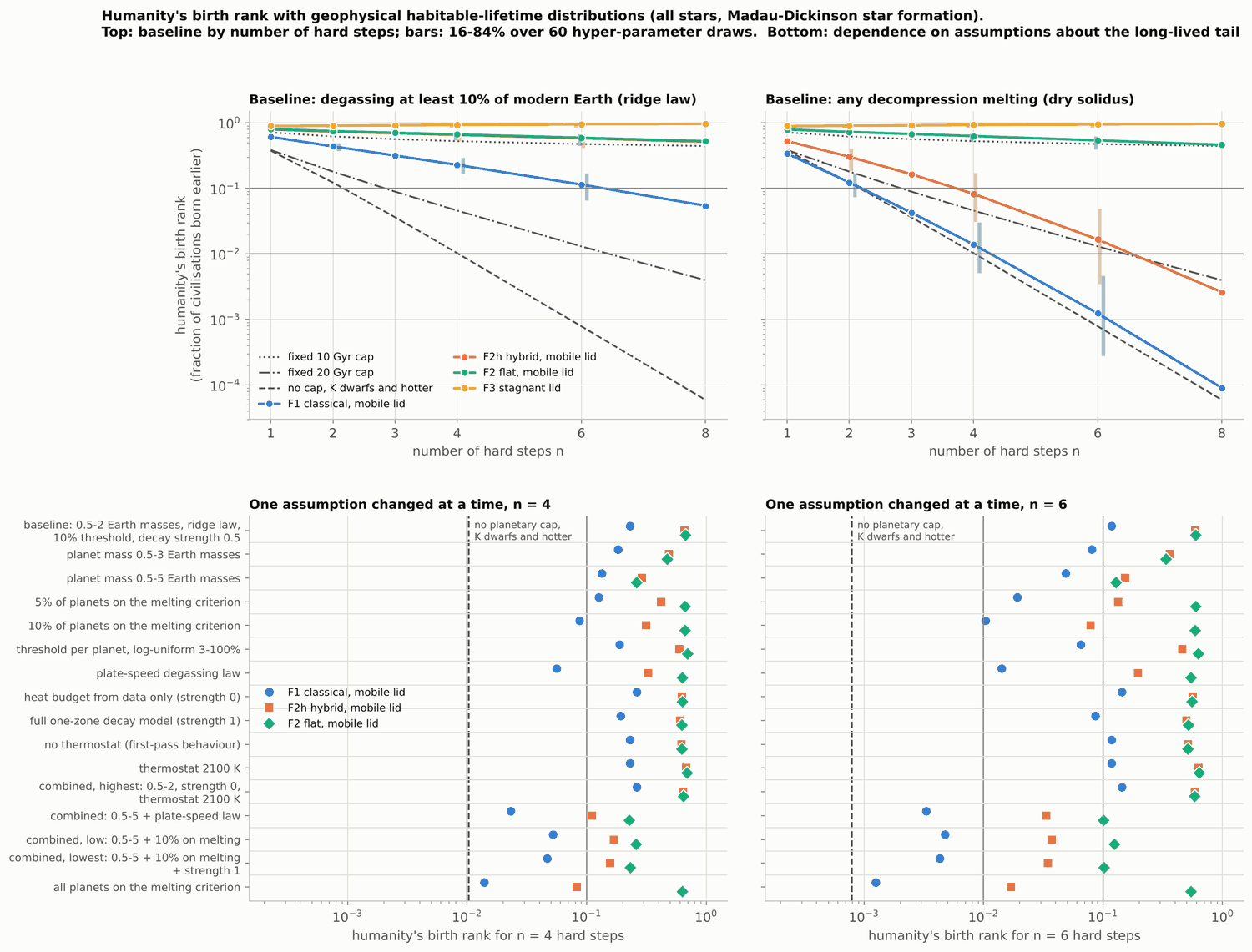
Summary. With habitability ended when CO2 degassing falls below 10% of modern Earth's (ridge-type degassing law), rocky planets of 0.5-2 Earth masses formed with the Sun stay geologically habitable for a median of 11.1 Gyr (16-84% over calibration uncertainty: 10.5-12.5) under classical mantle scaling, 7.3 Gyr (6.7-8.1) under a hybrid scaling, 6.8 Gyr (6.3-7.3) under flat scaling and 4.1 Gyr (3.6-4.5) for stagnant lids. A plate-speed degassing law gives 16.5 Gyr (15.2-18.2) for the classical case, and ending habitability only when dry decompression melting stops gives 20.8 Gyr (16.7-28.5). In the hard-steps birth-rank integral the baseline rank of humanity for 4 hard steps is 0.23 (0.17-0.30) classical and 0.65 (0.53-0.71) hybrid; for 6 steps 0.11 (0.07-0.17) and 0.58 (0.42-0.67). The first-pass headline, that the geophysical cap dissolves humanity's earliness for up to 4 hard steps, does not survive review. Across defensible assumptions about the long-lived tail (masses up to 5 Earth masses, 5-10% of planets ending only when melting stops, the plate-speed law) the mobile-lid rank spans 0.02-0.70 for 4 steps and 0.003-0.63 for 6; with the melting rule for every planet and classical scaling it is 0.014 and 0.0012, the same as with no planetary cap (0.010 and 0.0008). Main caveats: (1) the threshold is published but the mobile-lid degassing laws are my constructions; (2) the outcome is decided by the heat-flow scaling and the end-of-habitability rule, neither of which exoplanet data can test; (3) the stellar data do not establish that older stars carry more r-process heat sources per unit rock (raw slope +0.006 +/- 0.010 dex/Gyr, sign dependent on reference element and sample); (4) uranium is unmeasured in every star and the decay model that turns europium into initial thorium is supported at only 0.43 +/- 0.27 of its nominal strength. The ranges are envelopes over scenarios, not probability intervals.
Question
The claim that humanity is early rests on rocky planets around long-lived stars staying habitable for tens of Gyr. The sister study (mdwarf_early) showed the birth rank is controlled by a single free parameter, the maximum habitable lifetime of a planet: 0.52 for a 10 Gyr cap, 0.046 for 20 Gyr, 0.010 with no cap (4 hard steps). Can that cap be replaced by a distribution derived from measured stellar heat-source abundances and mantle thermal evolution, and does the earliness survive?
Data
All tables are downloaded by code/fetch_data.py from
VizieR TAP into raw/.
| Sample | Source | Used for | Selection cuts | N |
|---|---|---|---|---|
| Solar twins | Botelho+ 2019 (Th), Spina+ 2018 (Eu, ages), Bedell+ 2018 (Mg, Si) | Th and Eu per rock | stars excluded by Botelho+ removed; Th: published values only | 53 (Th), 74 (Eu) |
| HARPS-GTO | Delgado Mena+ 2017, 2019 | Eu per rock | Teff 5300-6400 K, log g > 3.8, Eu error <= 0.15 dex, age error <= 2 Gyr, [Fe/H] > -1 | 215 of 570 |
| F and G dwarfs | Battistini & Bensby 2016, Bensby+ 2014 | Eu per rock | same, no per-star Eu error (0.08 dex assumed) | 208 of 378 |
| GALAH DR3, DR4 | Buder+ 2021, 2025 | K per rock | K, Mg, Si unflagged, S/N >= 60, Teff 5500-6100 K, log g 3.8-4.6, [Fe/H] > -1; DR3 age error <= 30%; DR4 age 0.5-13.5 Gyr | 14,075; 51,645 |
| Geneva tracks | Mowlavi+ 2012 | stellar habitable-zone exit | 0.5-1.0 Msun, Z = 0.014 | 6 masses |
The cuts keep Sun-like dwarfs with usable ages; "rock" is the mean of Mg and Si. GALAH europium was rejected: it is detected in 1,535 of 75,989 Sun-like dwarfs in DR3 (2.0%) and 1,059 of 197,897 in DR4 (0.54%), with median [Eu/Fe] of +0.32 and +0.38, so it is detection-limited. Mishenina+ 2022 thorium (129 dwarfs, no ages) was used as a check only (scatter about its [Fe/H] trend 0.11 dex, an upper bound).
Method
- Abundances. For each sample I fit zero point at the solar age, linear age trend and intrinsic scatter (maximum likelihood with per-star errors, bootstrap uncertainties) of [Eu/rock], and of Th corrected for decay inside the star. Raw slopes are also given for Mg and Si separately.
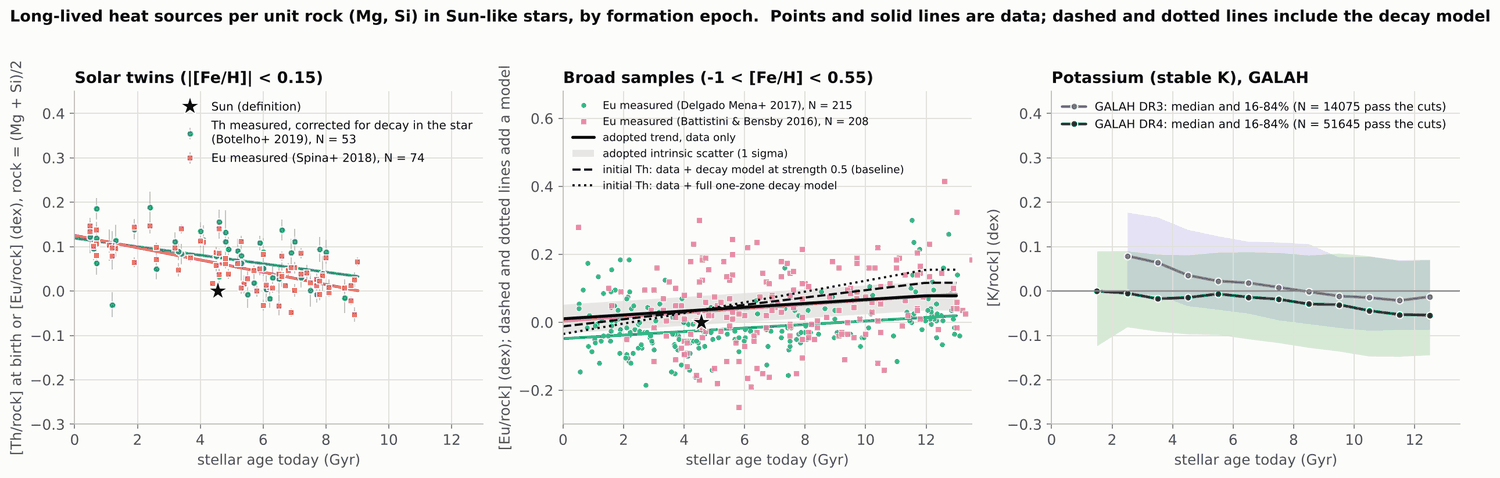
- Heat budget. Th and U are taken to follow Eu; a one-zone free-decay model (uniform production) gives the extra Th, U and 40K present in the gas when older stars formed. Its strength is a parameter: 0 = data only, 1 = full model. Baseline 0.5, because the one test available, [Th/Eu] at birth against age in solar twins, has slope +0.0042 +/- 0.0027 dex/Gyr where the model predicts +0.0100 (strength 0.43 +/- 0.27).
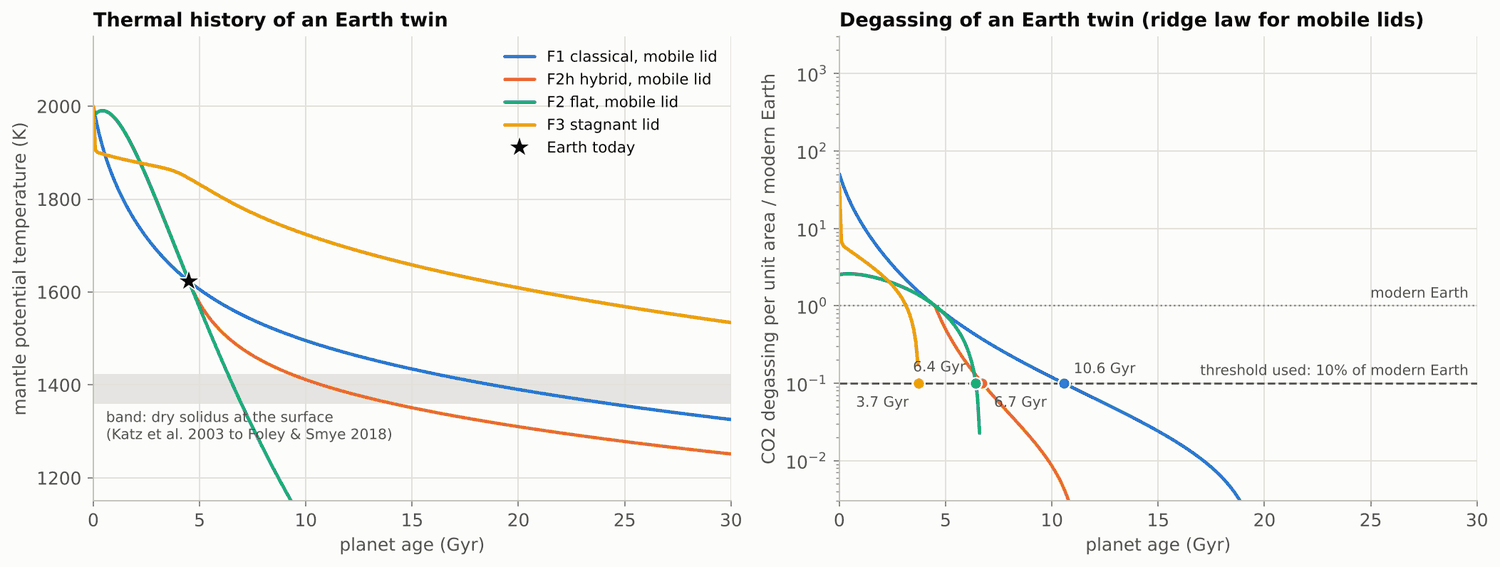
- Thermal evolution. C dT/dt = H(t) - Q(T) for four formulations, calibrated on Earth: F1 classical (heat flow rising steeply with temperature; under-predicts Earth's present heat loss, 20.9 TW against 38 TW), F2 flat (heat flow independent of temperature; fits Earth today), F2h hybrid (flat above today's temperature, classical below; my combination), F3 stagnant lid (Foley & Smye 2018, simplified). New in the revision: mobile-lid mantles are limited to 2200 K (dry liquidus at zero pressure is 2053 K), the excess heat assumed lost by magmatism.
- End of habitability. Three rules: (a) degassing per unit area below 10% of modern Earth's with a ridge law (spreading rate times melt-zone depth), the baseline; (b) the same threshold with degassing proportional to plate speed (arc-dominated limit, the coupling of Oosterloo et al. 2021); (c) dry decompression melting stops. The 10% threshold is published (Tajika 2003, 2007, quoted by Kadoya & Tajika 2014; used for stagnant lids by Foley & Smye 2018 and Unterborn et al. 2022). Both mobile-lid degassing laws are my constructions. The critical rate depends on insolation: in Kadoya & Tajika's figure 5 (read by eye) it is near 0.1 only close to the inner edge and rises to about 1 and above in the outer zone; planets below it may cycle between frozen and thawed states rather than freeze for good. Rule (c) is more permissive but not the most permissive conceivable (hydrous and arc melting persist to lower temperatures).
- Population. Monte Carlo over heat budget (data), potassium depletion (0.25 dex prior), mass (log-uniform 0.5-2 Earth masses), viscosity (0.5 dex), initial temperature (100 K), at four formation epochs (stellar ages today 0, 4.57, 8.5, 12 Gyr); 5,000 planets per epoch. Sixty hyper-draws vary abundance zero point, slope and scatter, decay strength U(0,1), thermostat U(2100, 2300 K), activation energy, solidus, continental heat-source fraction, Earth's heat loss and viscosity scatter. Mass range, threshold, degassing law and rule are not drawn; they are run as 32 explicit scenarios.
- Birth rank. The lifetime distribution per epoch replaces the fixed cap in the hard-steps integral of the sister study (weight L^n, window = min(stellar limit, geological lifetime), all stars, Madau-Dickinson star formation). Rank = fraction of all civilisations born before today.
Results
1. Abundances: no established age trend per unit rock
Raw least-squares age slopes (dex/Gyr, data only; older stars to the right, so positive means older stars are richer):
| Sample | N | [X/rock] | [X/Mg] | [X/Si] | [X/Fe] |
|---|---|---|---|---|---|
| Eu, solar twins | 74 | -0.0138 +/- 0.0016 | -0.0168 +/- 0.0016 | -0.0108 +/- 0.0015 | -0.0024 +/- 0.0017 |
| Eu, HARPS-GTO | 215 | +0.0053 +/- 0.0013 | +0.0001 +/- 0.0013 | +0.0104 +/- 0.0013 | +0.0249 +/- 0.0016 |
| Eu, HARPS-GTO thin disc | 163 | -0.0011 +/- 0.0021 | -0.0062 +/- 0.0022 | +0.0040 +/- 0.0021 | +0.0092 +/- 0.0022 |
| Eu, HARPS-GTO thick disc, high alpha | 52 | +0.0139 +/- 0.0088 | +0.0094 +/- 0.0089 | +0.0184 +/- 0.0089 | +0.0416 +/- 0.0104 |
| Eu, Battistini & Bensby | 208 | +0.0060 +/- 0.0021 | +0.0025 +/- 0.0021 | +0.0095 +/- 0.0023 | +0.0258 +/- 0.0027 |
| Th at birth, solar twins | 53 | -0.0097 +/- 0.0028 | -0.0118 +/- 0.0029 | -0.0075 +/- 0.0028 | - |
The well-known rise of [Eu/Fe] with age is real, but per unit rock it vanishes against Mg, survives against Si, reverses in solar twins and in the thin disc alone, and at fixed [Fe/H] the age coefficient is negative in all four samples (-0.003 to -0.015 dex/Gyr). Whether older stars carry more r-process elements per unit rock is not established. I adopt +0.0057 +/- 0.0097 dex/Gyr (mean of the broad samples; uncertainty reaching the twins' slope) and zero point +0.036 +/- 0.044 dex.
Scatter: only the solar twins measure it, 0.031 +/- 0.003 dex (Eu) and 0.040 +/- 0.005 dex (Th), with errors of 0.013 and 0.027 dex. In the broad samples the rms about the trend (0.075 and 0.104 dex) is comparable to the quoted errors (0.072; 0.085 assumed), so the deconvolved values (0.041, 0.057) depend on the error model (0.058 and 0.090 if errors are overestimated by 40%); the rms is the upper bound. Adopted 0.042 +/- 0.011 dex. Observed 10-90% ranges of [Eu/Mg] are -0.02 to +0.11 (twins), -0.09 to +0.09 (HARPS-GTO) and -0.12 to +0.13 (Battistini & Bensby), several times narrower than the +/-0.3 dex explored by Nimmo et al. (2020). Potassium per rock (GALAH) declines with age by 0.005-0.009 dex/Gyr.
2. Heat budget by formation epoch: the rise with age is model, not data
| Stellar age today | r-process per rock, data only | Initial Th, strength 0.5 | Initial Th, strength 1 | Total initial heat, data only | Strength 0.5 (baseline) | Strength 1 |
|---|---|---|---|---|---|---|
| 0 Gyr | 1.02 | 0.97 | 0.92 | 1.07 (0.85-1.46) | 0.90 (0.72-1.21) | 0.75 (0.61-1.01) |
| 4.57 Gyr | 1.09 | 1.09 | 1.09 | 1.07 (0.87-1.44) | 1.07 (0.87-1.44) | 1.07 (0.87-1.44) |
| 8.5 Gyr | 1.14 | 1.20 | 1.25 | 1.08 (0.88-1.42) | 1.36 (1.10-1.80) | 1.72 (1.39-2.30) |
| 12 Gyr | 1.20 | 1.31 | 1.43 | 1.09 (0.90-1.41) | 1.93 (1.58-2.53) | 3.61 (2.96-4.73) |
Values relative to Earth, median (16-84% across planets). The spread is dominated by the potassium-depletion prior; with the measured r-process scatter alone the solar-epoch range is 1.01-1.13.
3. Habitable lifetimes
| Formulation | Earth twin: ridge / plate-speed / melting (Gyr) | Population median, ridge law (16-84% hyper) | 5-95% across planets | Plate-speed law | Melting rule |
|---|---|---|---|---|---|
| F1 classical | 10.6 / 17.1 / 19.9 | 11.1 (10.5-12.5) | 7.2-15.6 | 16.5 (15.2-18.2) | 20.8 (16.7-28.5) |
| F2h hybrid | 6.7 / 9.8 / 11.4 | 7.3 (6.7-8.1) | 5.0-10.2 | 9.7 (8.7-10.9) | 12.2 (10.4-16.6) |
| F2 flat | 6.4 / 6.7 / 6.7 | 6.8 (6.3-7.3) | 4.5-10.1 | 7.0 (6.5-7.6) | 7.0 (6.5-7.6) |
| F3 stagnant lid | 3.7 / - / 3.8 | 4.1 (3.6-4.5) | 2.8-5.5 | - | 4.2 (3.7-4.6) |
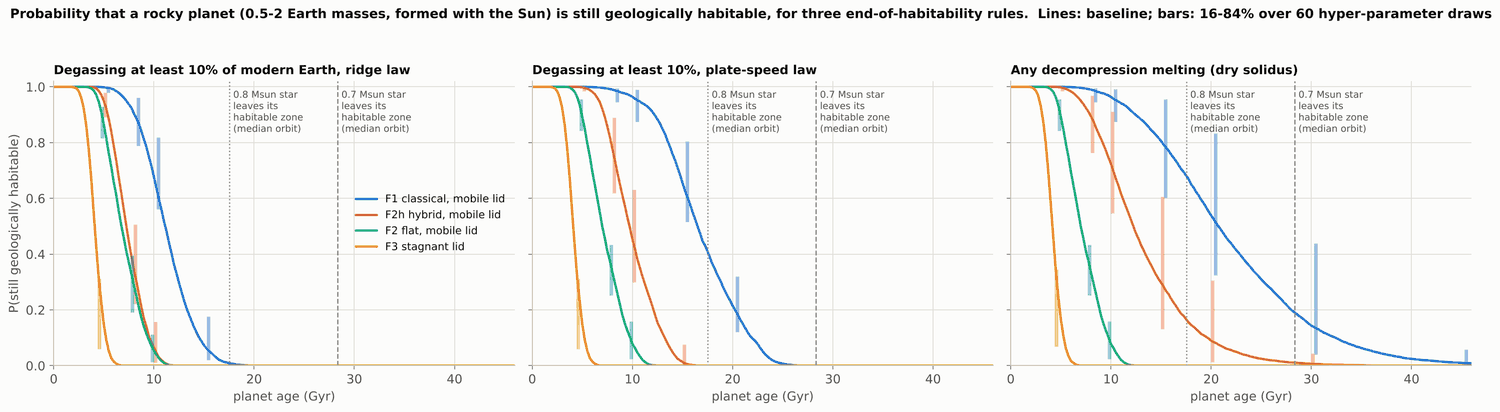
Fraction of planets still habitable (formed with the Sun, 0.5-2 Earth masses):
| Formulation, rule | 8 Gyr | 10 Gyr | 15 Gyr | 20 Gyr | 30 Gyr |
|---|---|---|---|---|---|
| F1, ridge law | 0.90 | 0.68 | 0.073 | 0.0002 | 0 |
| F1, plate-speed law | 0.99 | 0.96 | 0.66 | 0.21 | 0 |
| F1, melting | 0.99 | 0.96 | 0.81 | 0.54 | 0.14 |
| F2h, ridge law | 0.35 | 0.064 | 0 | 0 | 0 |
| F2h, plate-speed law | 0.78 | 0.45 | 0.014 | 0 | 0 |
| F2h, melting | 0.89 | 0.72 | 0.30 | 0.089 | 0.007 |
| F2, ridge law | 0.29 | 0.054 | 0 | 0 | 0 |
| F3 | 0 | 0 | 0 | 0 | 0 |
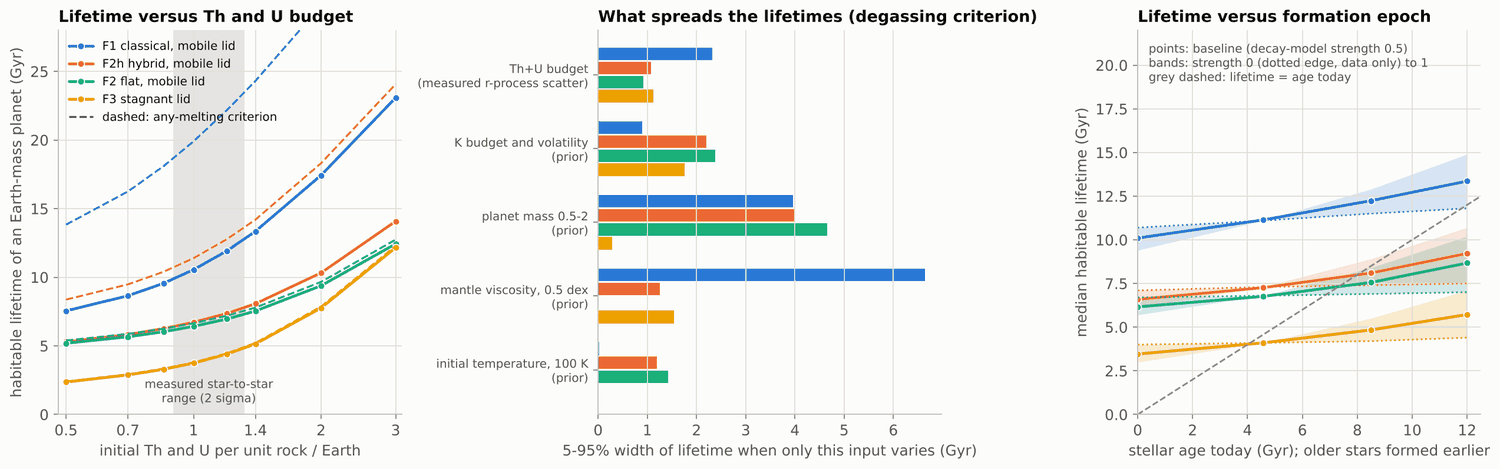
The fraction alive at 20 Gyr is therefore not a robust number: for classical scaling it is 0.0002 (ridge), 0.0015 and 0.021 with masses to 3 and 5 Earth masses, 0.21 (0.12-0.32) with the plate-speed law and 0.54 (0.32-0.83) under the melting rule. Median lifetime rises with formation epoch from 10.1 to 13.4 Gyr (F1) and 6.6 to 9.2 Gyr (F2h) between the youngest and 12-Gyr-old stars in the baseline, but only from 10.7 to 11.8 and 7.1 to 7.5 Gyr with data alone. For comparison the star itself leaves the habitable zone after a median 7.8, 11.3, 17.5, 28.3 and 47.8 Gyr at 1.0, 0.9, 0.8, 0.7 and 0.6 Msun.
What spreads the lifetimes (5-95% width when one input varies; F1 / F2h): measured r-process scatter 2.3 / 1.1 Gyr; potassium prior 0.9 / 2.2; mass 4.0 / 4.0; viscosity 6.6 / 1.3; all together 8.1 / 5.1 Gyr. The measured star-to-star scatter is never the leading contributor to the spread. The zero point is a separate matter: +/-0.044 dex shifts the median by 0.75 Gyr (F1) and 0.4 Gyr (F2h).
4. Birth rank
| Formulation, rule | n = 2 | n = 4 (16-84% hyper) | n = 6 (16-84% hyper) |
|---|---|---|---|
| F1, ridge law | 0.44 | 0.23 (0.17-0.30) | 0.11 (0.065-0.17) |
| F1, plate-speed law | 0.22 | 0.055 (0.041-0.080) | 0.014 (0.009-0.024) |
| F1, melting | 0.12 | 0.014 (0.005-0.030) | 0.0012 (0.0003-0.0046) |
| F2h, ridge law | 0.73 | 0.65 (0.53-0.71) | 0.58 (0.42-0.67) |
| F2h, plate-speed law | 0.52 | 0.32 (0.23-0.43) | 0.19 (0.12-0.30) |
| F2h, melting | 0.30 | 0.082 (0.031-0.17) | 0.017 (0.003-0.049) |
| F2, ridge law | 0.75 | 0.66 (0.55-0.71) | 0.59 (0.45-0.67) |
| F2, melting | 0.73 | 0.63 (0.52-0.68) | 0.54 (0.40-0.63) |
| F3 | 0.90 | 0.93 (0.83-0.96) | 0.95 (0.83-0.97) |
| Reference: fixed cap 10 Gyr / 20 Gyr / none | 0.62 / 0.18 / 0.12 | 0.52 / 0.046 / 0.010 | 0.47 / 0.013 / 0.0008 |
Scenarios, one assumption changed at a time unless marked (rank for n = 4 / n = 6; 2,000 planets per epoch, Monte Carlo error about 0.01):
| Scenario | F1 | F2h | F2 |
|---|---|---|---|
| Baseline | 0.23 / 0.12 | 0.66 / 0.59 | 0.67 / 0.60 |
| Masses 0.5-3 Earth masses | 0.18 / 0.081 | 0.49 / 0.36 | 0.47 / 0.34 |
| Masses 0.5-5 Earth masses | 0.13 / 0.049 | 0.29 / 0.15 | 0.26 / 0.13 |
| 5% of planets on the melting rule | 0.13 / 0.019 | 0.42 / 0.13 | 0.67 / 0.60 |
| 10% of planets on the melting rule | 0.087 / 0.010 | 0.31 / 0.079 | 0.67 / 0.59 |
| Threshold per planet log-uniform 3-100% | 0.19 / 0.065 | 0.60 / 0.46 | 0.70 / 0.63 |
| Threshold 3% for all | 0.073 / 0.020 | 0.40 / 0.26 | 0.64 / 0.56 |
| Threshold 100% for all (outer zone) | 0.89 / 0.90 | 0.88 / 0.89 | 0.88 / 0.89 |
| Plate-speed degassing law | 0.056 / 0.014 | 0.33 / 0.20 | 0.63 / 0.55 |
| Decay strength 0 (data only) | 0.26 / 0.14 | 0.63 / 0.56 | 0.63 / 0.56 |
| Decay strength 1 (full model) | 0.19 / 0.086 | 0.61 / 0.50 | 0.63 / 0.52 |
| No thermostat | 0.23 / 0.12 | 0.62 / 0.52 | 0.63 / 0.51 |
| First-pass configuration (strength 1, no thermostat) | 0.19 / 0.086 | 0.47 / 0.30 | 0.47 / 0.29 |
| Combined: masses 0.5-5 + plate-speed law | 0.023 / 0.0033 | 0.11 / 0.034 | 0.23 / 0.10 |
| Combined: masses 0.5-5 + 10% on melting | 0.052 / 0.0048 | 0.17 / 0.037 | 0.26 / 0.13 |
| Referee's combination (0.5-5, thermostat 2300 K, strength 0) | 0.15 / 0.060 | 0.31 / 0.17 | 0.27 / 0.14 |
| Zero point +0.1 dex / -0.044 dex | 0.13 / 0.053; 0.28 / 0.16 | 0.53 / 0.42; 0.70 / 0.65 | 0.56 / 0.46; 0.70 / 0.65 |
| All planets on the melting rule | 0.014 / 0.0013 | 0.083 / 0.017 | 0.63 / 0.55 |
Envelope over the tail and rule scenarios (excluding the uniform 100% threshold): n = 2: 0.15-0.77; n = 4: 0.023-0.70; n = 6: 0.0033-0.63. Heat-budget scenarios alone (zero point, slope, decay strength, scatter) move the rank only within 0.13-0.28 (F1) and 0.53-0.70 (F2h) for n = 4. The rank is thus set by whether a long-lived sub-population exists, not by the abundance data. Within a given population the tail is not extreme (the longest-lived 5% carry 17-20% of the n = 4 weight under the ridge law, 35-40% under the melting rule).
Conditional shares of hyper-draws with rank >= 0.1 (n = 4 / n = 6), given formulation and rule: F1 ridge 0.98 / 0.57; F1 plate-speed 0.03 / 0.00; F1 melting 0.02 / 0.00; F2h ridge 1.00 / 1.00; F2h plate-speed 1.00 / 0.88; F2h melting 0.30 / 0.12; F2 and F3 1.00 / 1.00. These are not probabilities that earliness dissolves: the formulation, rule, mass range and threshold carry no prior.
Robustness checks
- Thermostat. In the baseline 43% of flat-scaling planets of the oldest epoch reach 2200 K. Without it the median peak is 2169 K and 6% exceed 2500 K; in the first-pass configuration the median peak was 2557 K and 60% exceeded 2500 K, which is unphysical. With the thermostat that configuration gives F2h 0.61 / 0.50 instead of 0.47 / 0.30. Limits of 2100 and 2300 K move F2h by +/-0.02 to 0.03. In 5 of 60 hyper-draws Earth's own calibrated initial temperature exceeded the limit and the limit was raised to it.
- Rock reference. Raw broad-sample slope +0.0012 (Mg), +0.0057 (mean), +0.0099 (Si) dex/Gyr; zero point 0.026-0.047 dex; scatter 0.037-0.045 dex. Rank with zero slope 0.25 (F1, n = 4), with the twins' slope 0.28.
- Thermal parameters. Activation energy 200-400 kJ/mol, solidus 1359-1423 K, viscosity scatter 0-1 dex, no continental sequestration: F1 0.15-0.29, F2h 0.41-0.68 (n = 4).
- Stellar limit. Using the habitable-zone exit instead of the main-sequence lifetime in the rank integral changes ranks by less than 0.001.
- Tectonic mix and star formation. 50% or 83% stagnant lids raise F1 to 0.25 and 0.31 (n = 4). Other star-formation histories change ranks by at most 0.09, except a tenfold future star formation, which gives 0.04-0.13 for every formulation.
- Verification (
code/verify.py, 20 checks, all pass): adaptive LSODA against the fixed-step integrator (Earth-twin lifetimes agree to 0.003 Gyr; hot thermostat case to 0.02 Gyr), weighted against replicated mixtures, first-pass regression (0.469 and 0.295 against 0.468 and 0.294), fixed-cap ranks of the sister study.
Limitations
- The decisive inputs are geophysical choices without observational tests: the heat-flow scaling (classical fails Earth's present heat loss; flat needs a thermostat; hybrid is mine) and the rule that ends habitability.
- The mobile-lid degassing laws are mine; the threshold depends on insolation and limit cycles may keep planets intermittently habitable below it.
- Scenario ranges are envelopes over my choices, not probability intervals.
- Uranium is unmeasured in all stars; thorium only in 53 solar twins; 40K/K is entirely model; the decay model is tested at 1.6 sigma only.
- The age trend per rock is not established, and broad-sample scatter is an upper bound.
- One-dimensional parameterised convection: no regime transitions, no carbon depletion, no water cycle, no tidal or core heating; scalings to 5 Earth masses are extrapolations.
- Kadoya & Tajika's figure was read by eye.
Closest prior work and what is new
Unterborn et al. (2022) and Foley & Smye (2018) computed stagnant-lid degassing lifetimes as a function of heat budget, the former with europium-based stellar budgets; Kite, Manga & Gaidos (2009) found that volcanism on plate-tectonic super-Earths can last the main-sequence life of the star while stagnant lids "die young"; Oosterloo et al. (2021) coupled a plate-tectonic carbon cycle to plate speed and found it still regulating climate at 10 Gyr, where their runs end. My classical Earth twin agrees with theirs over that span (1495 K and 12% of modern degassing at 10 Gyr; their mantle temperatures 1500-1680 K), and their coupling corresponds to my plate-speed law; my flat and hybrid ridge-law lifetimes of 6-7 Gyr are shorter than their picture. O'Neill et al. (2016) argue planets pass from hot stagnant lid through episodic and plate-tectonic regimes to a cold stagnant lid after about 10 Gyr; I do not model such transitions. Nimmo et al. (2020) and Frank, Meyer & Mojzsis (2014) treated radiogenic budgets from europium spread and chemical evolution; Botelho et al. (2019) measured thorium in solar twins. Hanson et al. (2021) left the planetary lifetime as a free parameter.
The abundance part of this study is a reproduction and re-normalisation per unit rock of published measurements, not a new measurement. New are: lifetime distributions per formation epoch, for several formulations and rules, placed in the birth-rank integral; the finding that the rank depends on the existence of a long-lived tail rather than on the measured heat-source spread; and the [Th/Eu]-at-birth calibration of the decay model. arXiv searches for hard-steps or grabby-aliens papers using plate tectonics or mantle evolution returned nothing; confidence that the rank application is new is medium.
Implications for the Fermi Paradox
The planetary lifetime cap is the lever of the earliness argument, and this study shows it cannot presently be fixed from data. If planets lose habitability when degassing falls to a tenth of Earth's under a ridge-type law, humanity is not early (rank 0.2-0.7) and the grabby-aliens inference loses its main empirical premise. If even 5-10% of planets, or super-Earths up to 5 Earth masses, or planets whose degassing follows plate speed, remain habitable for 20-40 Gyr around K and M dwarfs, earliness returns nearly in full (0.01-0.1 for 4 steps, 0.001-0.02 for 6). The argument therefore needs, and lacks, evidence for that tail. The measured variation of radioactive heat sources among stars (0.03-0.04 dex) is too small to matter here, and the data do not show that early-formed planets were better endowed.
Files
Code: code/run_all.py (entry point; about 16 minutes
single-threaded), fetch_data.py,
abundances.py, thermal.py,
population.py, rank.py,
stellar.py, analysis.py,
figures.py, verify.py. Data:
data/*.csv and data/results_summary.json (all
from the final run). Figures: fig1_heat_sources_vs_age.png,
fig2_earth_twin_histories.png,
fig3_survival_curves.png,
fig4_what_controls_lifetime.png,
fig5_birth_rank.png. Disclosure: the first pass left a
__pycache__ folder in mdwarf_early/code/ by
importing that study's module; the revision uses a local snapshot and
touched nothing outside this study's directory.
Response to referee
- Headline overclaim. Accepted. "Dissolved for up to 4 steps and marginal at 6" and the 94/70/54% shares are deleted; headline and implications now give the range (0.02-0.70 for 4 steps, 0.003-0.63 for 6) and say the first-pass claim does not survive.
- Mass priors and melting-rule mixes. Done: masses 0.5-3 and 0.5-5 Earth masses and 5% and 10% mixes are in the scenario table, with combinations. The text says the rank is set by the long-lived tail. Qualification: it is the existence of an added long-lived sub-population that matters; clipping the top 5% of a given population changes the rank by about 0.01.
- "Th factor (measured)". Relabelled; data-only and model columns are separate.
- Raw slopes by reference element. Tabulated; the answer to "do older stars carry more r-process per rock" is "not established". The model now uses the raw slope.
- [Th/Eu] at birth. Reported (+0.0042 +/- 0.0027 against +0.0100); half-strength model is the baseline, strengths 0 and 1 are scenarios. I did not make data-only the baseline because free decay is real physics and the test excludes neither 0 nor 1.
- Thermostat. Implemented (2200 K; 2100-2300 K varied); peak temperatures reported. The referee was right that first-pass flat-scaling mantles were unphysically hot; correcting it raises the F2h rank.
- "Dissolve probability". Replaced by conditional shares; never called a probability.
- Degassing law, insolation, limit cycles, wording, Oosterloo et al. All added. Two partial disagreements: the published insolation dependence mostly raises the threshold (shorter lifetimes) rather than lowering it; and Oosterloo et al. conflict with my flat and hybrid ridge-law results but not with the classical case within their 10 Gyr.
- P(20 Gyr). Qualified by rule, law and mass range.
- Scatter. 0.03-0.04 dex stated as measured for solar twins only; rms quoted as the upper bound for broad samples; "never the leading term" restricted to scatter; zero-point sensitivity added.
- Rock reference. Slope changes now included.
- Novelty. Abundance part declared a reproduction; rank application declared the new element.
- Small fixes. GALAH Eu denominator corrected (2.02% and 0.54%); Fig. 1 legend counts are stars passing cuts; axis labels separate data from model; O'Neill et al. (2016) attribution corrected after reading the paper; stellar-limit inconsistency tested (effect below 0.001). The referee's data-only thorium factor of 0.96 at age 0 is an arithmetic slip (the stated slope gives 1.02).
Key numbers
| Quantity | Value | Uncertainty | Note |
|---|---|---|---|
| Median geological habitable lifetime, 0.5-2 Earth masses, formed with the Sun, ridge-law degassing >= 10% of modern Earth: F1 classical / F2h hybrid / F2 flat / F3 stagnant lid | 11.1 / 7.3 / 6.8 / 4.1 Gyr | 16-84% over 60 hyper-parameter draws: 10.5-12.5 / 6.7-8.1 / 6.3-7.3 / 3.6-4.5 Gyr; 5-95% across planets 7.2-15.6 / 5.0-10.2 / 4.5-10.1 / 2.8-5.5 Gyr | Threshold is published (Tajika; Kadoya & Tajika 2014); the mobile-lid degassing law is my construction |
| Same, other end-of-habitability rules (F1 / F2h / F2): plate-speed degassing law; any dry decompression melting | 16.5 / 9.7 / 7.0 Gyr; 20.8 / 12.2 / 7.0 Gyr | 16-84%: 15.2-18.2 / 8.7-10.9 / 6.5-7.6; 16.7-28.5 / 10.4-16.6 / 6.5-7.6 Gyr | The rule matters as much as the heat-flow scaling |
| Baseline birth rank, 4 hard steps (F1 / F2h / F2 / F3), ridge law | 0.23 / 0.65 / 0.66 / 0.93 | 16-84%: 0.17-0.30 / 0.53-0.71 / 0.55-0.71 / 0.83-0.96 | All stars, Madau-Dickinson star formation; 5000 planets per epoch |
| Baseline birth rank, 6 hard steps (F1 / F2h / F2 / F3), ridge law | 0.11 / 0.58 / 0.59 / 0.95 | 16-84%: 0.065-0.17 / 0.42-0.67 / 0.45-0.67 / 0.83-0.97 | |
| Envelope of mobile-lid birth rank over tail and criterion scenarios (uniform 100% threshold excluded) | n=4: 0.023-0.70; n=6: 0.0033-0.63 | scenario envelope, not a probability interval; F1 0.023-0.26 / 0.0033-0.14, F2h 0.11-0.66 / 0.034-0.59, F2 0.23-0.70 / 0.10-0.63 | Minimum: masses 0.5-5 Earth masses with plate-speed law, classical scaling |
| Birth rank if every planet stays habitable until dry melting stops (baseline population): F1 / F2h / F2 | n=4: 0.014 / 0.082 / 0.63; n=6: 0.0012 / 0.017 / 0.54 | 16-84%: F1 0.005-0.030 (n=4), 0.0003-0.0046 (n=6); F2h 0.031-0.17, 0.003-0.049 | Compare no planetary cap (K dwarfs and hotter): 0.010 and 0.0008; fixed 10 Gyr cap 0.52 and 0.47; fixed 20 Gyr cap 0.046 and 0.013 |
| Rank with a 10% minority of planets on the melting rule (others baseline): F1 / F2h | n=4: 0.087 / 0.31; n=6: 0.010 / 0.079 | Monte Carlo error about 0.01 (2000 planets per epoch) | With 5%: 0.13 / 0.42 and 0.019 / 0.13 |
| Rank with planet masses to 5 Earth masses (ridge law): F1 / F2h / F2 | n=4: 0.13 / 0.29 / 0.26; n=6: 0.049 / 0.15 / 0.13 | about 0.01 | To 3 Earth masses: 0.18 / 0.49 / 0.47 and 0.081 / 0.36 / 0.34 |
| Fraction of planets still habitable at 20 Gyr, F1 classical, solar epoch: ridge law / plate-speed law / melting rule | 0.0002 / 0.21 / 0.54 | 16-84%: 0-0.002 / 0.12-0.32 / 0.32-0.83; ridge law with masses to 5 Earth masses 0.021, and 0.098 for the oldest epoch | F2h: 0 / 0 / 0.089; F2 and F3: 0 |
| Raw age slope of [Eu/rock], broad samples (adopted) | +0.0057 dex/Gyr | +/- 0.0097 (half the difference to the solar-twin slope) | By reference element: [Eu/Mg] +0.0001 +/- 0.0013 (HARPS-GTO), +0.0025 +/- 0.0021 (Battistini & Bensby); [Eu/Si] +0.0104, +0.0095; solar twins -0.0138 +/- 0.0015; HARPS thin disc -0.0011 +/- 0.0021. Older stars carrying more r-process per rock: not established |
| Intrinsic star-to-star scatter of r-process per rock | 0.031 +/- 0.003 dex (Eu, 74 solar twins); 0.040 +/- 0.005 dex (Th, 53 solar twins) | broad samples: only upper bounds, rms 0.075 and 0.104 dex with quoted errors 0.072 and 0.085 (assumed) | Adopted 0.042 +/- 0.011 dex; gives 5-95% lifetime width of 0.9-2.3 Gyr out of 5.1-8.1 Gyr total |
| Zero point of r-process per rock at the solar age relative to the Sun | +0.036 dex | +/- 0.044 between samples | A +/-0.044 dex shift moves median lifetime by 0.75 Gyr (F1) and 0.4 Gyr (F2h); +0.1 dex moves F1 rank (n=4) from 0.23 to 0.13 |
| Strength of the one-zone free-decay model from [Th/Eu] at birth versus age (53 solar twins) | 0.43 | +/- 0.27 (observed slope +0.0042 +/- 0.0027 dex/Gyr against +0.0100 predicted) | Baseline uses 0.5; strengths 0 and 1 both run |
| Total initial radiogenic heat per unit rock of planets around 12-Gyr-old stars relative to Earth | 1.09 (data only) / 1.93 (strength 0.5) / 3.61 (full model) | 16-84% across planets 0.90-1.41 / 1.58-2.53 / 2.96-4.73 | The increase with stellar age is model, not measurement; mostly 40K and 235U |
| Share of hyper-draws with rank >= 0.1, conditional on formulation and rule (n=4 / n=6) | F1 ridge 0.98 / 0.57; F1 plate-speed 0.03 / 0.00; F1 melting 0.02 / 0.00; F2h ridge 1.00 / 1.00; F2h plate-speed 1.00 / 0.88; F2h melting 0.30 / 0.12; F2 and F3 1.00 / 1.00 | 60 draws; binomial error up to 0.06 | Conditional shares, not probabilities: mass range, threshold, law and rule are not drawn |
| Thermostat (2200 K) for flat scalings: planets of the oldest epoch reaching it; peak temperature without it | 43% reach it; without it median peak 2169 K, 6% above 2500 K (strength 0.5); first-pass configuration: median 2557 K, 60% above 2500 K | thermostat 2100-2300 K moves F2h rank by +/-0.02 (n=4) and +/-0.03 (n=6) | First-pass configuration F2h rank 0.47 / 0.30 becomes 0.61 / 0.50 with the thermostat |
| Median habitable-zone exit of the star (0.6 / 0.7 / 0.8 / 0.9 / 1.0 Msun) | 47.8 / 28.3 / 17.5 / 11.3 / 7.8 Gyr | orbit-dependent; 10-90% over initial habitable-zone orbits e.g. 5.5-21.5 Gyr at 0.8 Msun | Geneva tracks (Mowlavi et al. 2012) with Kopparapu et al. 2014 limits; unchanged from first pass |
Changes made after the referee report
- Headline and implications rewritten: the claim 'dissolved for up to 4 steps and marginal at 6' and the 94/70/54% shares are deleted; replaced by a range statement (mobile-lid rank 0.023-0.70 for 4 steps, 0.0033-0.63 for 6) and the statement that the geophysical cap can remove or leave earliness depending on untested assumptions.
- Rank table extended with scenarios run through the full pipeline: planet masses 0.5-3 and 0.5-5 Earth masses, 5% and 10% of planets on the melting rule, per-planet thresholds 3-100%, thresholds 3% and 100%, a new plate-speed degassing law, and combined cases including the referee's (new analysis.scenario_stage; data/scenarios.csv, data/rank_ranges.csv). Added tail diagnostics (data/rank_tail_dependence.csv).
- Heat-budget table relabelled: 'measured' removed; separate columns for r-process per rock from data only and for initial Th and total heat with the decay model at strength 0, 0.5 and 1.
- Raw age slopes quoted by reference element ([Eu/Mg], [Eu/Si], mean of both, [Eu/Fe]), by sample and by thin and thick disc (data/abundance_raw_slopes.csv); the question 'do older stars carry more r-process per rock' is now answered 'not established'. Population model now uses the raw slope (+0.0057 +/- 0.0097 dex/Gyr) with the model factor applied separately.
- [Th/Eu]-at-birth test reported (+0.0042 +/- 0.0027 against +0.0100 dex/Gyr predicted; strength 0.43 +/- 0.27); new decay-strength parameter with baseline 0.5, strengths 0 and 1 as scenarios, U(0,1) in hyper-draws.
- Thermostat added for mobile-lid formulations (mantle potential temperature limited to 2200 K, 2100-2300 K in hyper-draws, switchable off); peak temperatures and the share of planets reaching the limit reported (data/peak_temperature_baseline.csv).
- 'Dissolve probability' table replaced by conditional shares per formulation and rule (data/conditional_shares.csv); the word probability is no longer used for them.
- Method text now states that the mobile-lid degassing laws are my constructions and only the threshold is published; added insolation dependence of the threshold, limit cycles, 'more permissive (dry solidus)' wording, and a comparison with Oosterloo et al. 2021.
- P(20 Gyr) qualified: given for the ridge law, the plate-speed law, the melting rule, and for masses to 3 and 5 Earth masses.
- Scatter claims restricted: 0.03-0.04 dex is measured only for solar twins; for the broad samples the rms is quoted as an upper bound with an error-rescaling test (data/abundance_scatter_robustness.csv); 'never the leading term' now refers to scatter only; zero-point sensitivity added (variance table and scenarios).
- Rock-reference robustness table now includes the change in slope (Mg, Si, mean) with and without the decay model.
- Novelty statement rewritten: the abundance part is a reproduction; the rank application is the new element; Oosterloo et al. 2021 added to prior work.
- Small fixes: GALAH Eu detection fraction now uses all Sun-like dwarfs passing the star-level cuts (2.02% and 0.54%, via new count queries); Fig. 1 legend N are stars passing the cuts; Fig. 1 axis labels distinguish data from model; O'Neill et al. 2016 attribution corrected after reading the paper; the main-sequence-lifetime versus habitable-zone-exit inconsistency in the rank integral tested (rank changes by less than 0.001); Fig. 3 gains a plate-speed panel and Fig. 5 a scenario ladder.
- New code/verify.py (stage 9 of run_all.py; data/verification.csv): adaptive LSODA against the fixed-step integrator, thermostat check, weighted against replicated mixtures, first-pass regression (0.469 and 0.295 against 0.468 and 0.294), fixed-cap ranks of the sister study; all 20 checks pass.
- Performance changes so the larger scenario set runs in about 16 minutes single-threaded: one heat-loss evaluation per step for both degassing laws, cached model calibrations.
- Full pipeline rerun from run_all.py; data, figures and results_summary.json are from the final code. Stale first-pass files variants.csv and dissolve_probabilities.csv removed.
Referee points not accepted
- 'The rank is controlled by the longest-lived few percent of planets': accepted in substance, rejected as worded. Within a given population the top 5% of lifetimes carry 17-20% of the weight for 4 steps and 26-30% for 6 under the degassing rule, and clipping them to the 95th percentile changes the F1 rank only from 0.228 to 0.238 (n=4) and 0.114 to 0.126 (n=6). What moves the rank is the existence of an added longer-lived sub-population (larger masses, a minority on the melting rule), which the report now states.
- Referee's data-only thorium factor of 0.96 for the youngest stars: an arithmetic slip. The adopted zero point (+0.036 dex) and raw slope (+0.0057 dex/Gyr) give 1.02 at age 0; 0.97 and 0.92 arise only with the decay model at strength 0.5 and 1.
- 'The threshold is lower for inner habitable-zone planets, so lifetimes are longer': only partly accepted. Kadoya & Tajika (2014, fig. 5, read by eye) show the critical degassing rate near its minimum of about 0.1 only close to the inner edge and rising to about 1 and above over most of the zone, so the insolation dependence mostly shortens lifetimes. A 3% threshold is kept as a bracket (F1 rank 0.073 for 4 steps), and a 100% threshold as the opposite bracket (0.89).
- 'Oosterloo et al. 2021 disagree with the mobile-lid lifetimes': accepted for the flat and hybrid scalings with the ridge law, rejected for the classical scaling. Their runs end at 10 Gyr with degassing still regulating climate; my classical Earth twin has 1495 K and 12% of modern degassing at 10 Gyr (their range 1500-1680 K) and 68% of classical planets are still above threshold then. Their plate-speed coupling is now run as a separate law.
- Adopting the data-only heat budget (decay strength 0) as the baseline: not done. Free decay of 40K, 235U and 232Th in the interstellar medium is real physics, and the only available test gives 0.43 +/- 0.27, which excludes neither 0 nor 1 at 2 sigma. Baseline is 0.5 with 0 and 1 shown throughout.
Figures
Code
Every number above is produced by these scripts from public data. The data tables themselves are not hosted here; the scripts download them.
abundances.py analysis.py common.py fetch_data.py figures.py mdwarf_earliness_snapshot.py plotstyle.py population.py rank.py run_all.py stellar.py thermal.py verify.py
Referee report
A second, separate analysis re-ran the code, recomputed the main numbers by its own route and tried to break the result. Like the first, it was run by Claude for this project; it is not an outside expert. In its report “the analyst” is the first analysis, which wrote the paper, and file names that are not linked on this page are its own working files. The paper above is the version revised in response.
Verdict: sound with fixes. Results reproduced: yes.
WHAT I RAN. (1) Copied code/ to a separate working folder and ran run_all.py in full (408 s, single thread). All 30 CSV outputs are numerically identical to the analyst's data/ files (max abs difference 0 in every file, including hyper_draws.csv and dissolve_probabilities.csv). Three raw tables re-downloaded from VizieR TAP (Botelho table3, Spina table4, Delgado Mena 2019 table2) are byte-identical to the analyst's raw files.
INDEPENDENT ROUTES (my own scripts):
- indep_thermal.py: Earth-twin thermal history written from scratch with scipy LSODA instead of the analyst's fixed-step Heun integrator. Results: F1 Q0 = 20.94 TW, lifetime 10.55 Gyr (degassing) and 19.91 Gyr (melting); F2 T_init = 1978.5 K, 6.42 and 6.65 Gyr; F2h 6.73 and 11.40 Gyr. Analyst: 10.55/19.905, 6.42/6.65, 6.725/11.395. Agreement to 0.01 Gyr. Heat budget constants check out (19.69 TW today, 93.8 TW at formation).
- indep_rank.py: birth rank recomputed with my own integral (astropy cosmology for z(t), survival-function form E[min(x,L)^n] = int n a^(n-1) S(a) da from the tabulated survival curves, own mass binning). Results for n = 2/4/6: F1 degassing 0.404/0.190/0.085; F2h degassing 0.661/0.468/0.294; F2 degassing 0.675/0.471/0.288; F1 melting 0.1175/0.0127/0.0011. Analyst: 0.404/0.190/0.085, 0.661/0.468/0.294, 0.674/0.471/0.288, 0.117/0.0126/0.0011. The rank arithmetic is correct. Future star formation in the adopted Madau-Dickinson continuation is 11% of past.
- indep_abund.py: Th in solar twins re-derived from the raw tables with my own join and ordinary least squares: N = 53, no duplicates, zero point +0.0755 +/- 0.0067, slope -0.0097 +/- 0.0028 dex/Gyr, intrinsic scatter (moment estimate) 0.039 dex. Analyst: +0.075, -0.0095 +/- 0.0028, 0.040. My fits of [Th/Fe], [Th/Eu], [Th/Si] at birth against age agree with Botelho et al. 2019 Table 4 within fitting-method differences. Table 3 of Botelho lists observed [Th/H], so the decay correction is applied once, correctly.
- Citation spot checks against the paper texts: Nimmo et al. 2020 do quote a 10-90% [Eu/Mg] range of -0.3 to +0.3; Unterborn et al. 2022 do give about 1.8 Gyr for a 1 Earth-mass stagnant lid and use the 10% threshold; Foley and Smye 2018 do adopt 10% and 100% of 6e12 mol/yr after Kadoya and Tajika 2014; Botelho's five excluded stars and 53-star sample match. Kopparapu 2014 coefficients match my memory of that table (not re-fetched).
WHAT DID NOT SURVIVE STRESS TESTS (scripts peakT.py, tail_tests.py, tcap.py, dataonly.py, eu_ref.py, combined.py; 2000 planets per node, analyst's own code with one input changed):
- Planet-mass upper limit raised from 2 to 5 Earth masses (log-uniform): degassing-criterion ranks for n = 4 / 6 fall from F1 0.19/0.088 to 0.115/0.038, F2h 0.46/0.29 to 0.165/0.051, F2 0.47/0.28 to 0.15/0.044. With 0.5-3: F1 0.154/0.061, F2h 0.31/0.14.
- 10% of planets judged by the melting criterion, 90% by degassing: F1 0.080/0.010, F2h 0.28/0.083 (5% minority: F1 0.113/0.018, F2h 0.35/0.13).
- Mantle potential temperature in F2 and F2h at the 12-Gyr formation node: median peak 2585 K, 60% of planets above 2500 K, 12% above 3000 K, 0.4% at the 4000 K clip. Capping T at 2300 K (2100 K) changes F2h degassing ranks for n = 4 / 6 from 0.46/0.29 to 0.58/0.45 (0.64/0.55) and F2 from 0.47/0.28 to 0.59/0.47 (0.66/0.57). F1 is unaffected.
- Heat budget from data only (raw Eu/rock slope +0.0055 dex/Gyr, no model decay factors): F1 0.26/0.145, F2h 0.61/0.51; median lifetime by epoch flattens to 10.7/11.1/11.5/11.8 Gyr (F1) from 9.4/11.1/13.0/14.8.
- Combined (0.5-5 Earth masses, T cap 2300 K, data-only heat): F1 0.154/0.061, F2h 0.30/0.16, F2 0.27/0.135; with a 10% melting-criterion minority F1 0.057/0.005, F2h 0.17/0.039.
- Raw age slopes of europium per rock (no model factor): HARPS-GTO [Eu/Mg] +0.0001 +/- 0.0013, [Eu/Si] +0.0104 +/- 0.0013; Battistini and Bensby [Eu/Mg] +0.0025 +/- 0.0021, [Eu/Si] +0.0095 +/- 0.0023; solar twins [Eu/Mg] -0.0168, [Eu/Si] -0.0108; HARPS thin disc only [Eu/Mg] -0.0062 +/- 0.0022.
Strongest objection
The earliness rank is a tail statistic and the study's tail is assumed, not derived. With n hard steps each planet counts as L^n, so the denominator is set by the longest-lived few percent of planets. In this study that tail is fixed by three choices that the abundance data do not touch: a hard upper mass limit of 2 Earth masses, one end-of-habitability rule applied identically to every planet, and zero-dimensional heat-flow laws with constant exponent and dry rheology extrapolated 5-15 Gyr past the only calibration point (Earth today). A geodynamicist would add that nobody can predict from such models when plate tectonics or the carbon cycle stops: the degassing threshold is insolation-dependent and was published for stagnant lids, the mobile-lid degassing law here is the analyst's own ridge-only construction, and a published coupled plate-tectonic carbon-cycle model (Oosterloo et al. 2021) finds climate regulation persisting to 10 Gyr and beyond.
Does the conclusion survive? In part. What survives: geophysics plausibly caps rocky-planet habitability somewhere between about 5 and 25 Gyr rather than at the 20-50 Gyr stellar limit of K dwarfs, and any such cap raises humanity's rank by one to three orders of magnitude relative to the no-cap K-dwarf case (0.010 and 0.0008 for 4 and 6 steps); the calculation is correct and reproducible; and the analyst's own sentence that geophysics alone does not settle the question is right. What does not survive: 'dissolved for up to 4 steps and marginal at 6' and the 94/70/54% shares. Allowing rocky planets up to 5 Earth masses gives ranks of 0.11-0.17 (4 steps) and 0.04-0.05 (6 steps) under the degassing criterion; letting 10% of planets be habitable down to the dry solidus gives 0.08-0.28 and 0.01-0.08 for F1 and F2h; both together give 0.05-0.17 and 0.005-0.04. Correcting the two errors that run the other way (thermal overshoot in the flat-scaling models, model-derived decay factors) raises the ranks to 0.26-0.66 and 0.15-0.57 in the 0.5-2 Earth-mass prior. The honest summary is a range of roughly 0.05-0.6 for 4 steps and 0.005-0.5 for 6 steps under degassing-type criteria, and 0.01 and 0.001 if residual volcanism suffices with classical scaling. Geophysics weakens the earliness argument substantially; it does not dissolve it at a stated probability.
Errors found
- major. The birth rank is controlled by the
longest-lived few percent of planets (weight L^n), and that tail is set
by modelling choices, not data: a hard cap of 2 Earth masses, one
habitability criterion applied to every planet, and a single heat-flow
law per run. The headline ranks (19-47% for 4 steps, 8.5-29% for 6) and
the statement that earliness is dissolved for up to 4 steps and marginal
at 6 are therefore not robust.
- Evidence: Analyst's code, one input changed (referee/scripts/tail_tests.py, combined.py). Mass 0.5-5: n=4/6 ranks F1 0.115/0.038, F2h 0.165/0.051, F2 0.15/0.044 (baseline 0.19/0.088, 0.46/0.29, 0.47/0.28). 10% melting-criterion minority: F1 0.080/0.010, F2h 0.28/0.083. The analyst's own variants already show the effect (viscosity scatter 1 dex: F1 0.13/0.044).
- Fix: Report the ranks as a range over tail assumptions, not a single value per formulation. At minimum add 0.5-3 and 0.5-5 Earth-mass priors and a mixed-criterion population (5-10% of planets on the melting criterion) to the main rank table, and reword the conclusion to: under a degassing-threshold criterion the rank for 4 steps is about 0.1-0.6 and for 6 steps about 0.04-0.5; a 10% minority of planets with residual-volcanism habitability lowers these to 0.05-0.3 and 0.005-0.08 for F1 and F2h.
- major. The age trend of thorium per unit rock is
presented as measured but is mostly model. The reported +0.0154 and
+0.0159 dex/Gyr are slopes of Eu/rock PLUS the one-zone free-decay
factor for Th (abundances.py line 256, logf_th_from_eu = eu_rock +
ism_factor), which alone contributes +0.0100 dex/Gyr. The table column
headed 'Th factor (measured)' (0.92/1.09/1.25/1.42) and the sentence
'The Th column is data' are therefore wrong. The data-only trend is weak
and its sign depends on the reference element and sample.
- Evidence: referee/scripts/indep_abund.py and eu_ref.py: raw [Eu/rock] slope HARPS-GTO +0.0053 +/- 0.0013, Battistini and Bensby +0.0060 +/- 0.0021; [Eu/Mg] +0.0001 +/- 0.0013 and +0.0025 +/- 0.0021; [Eu/Si] +0.0104 and +0.0095; solar twins raw -0.0138; direct Th -0.0097 +/- 0.0028; HARPS thin disc [Eu/Mg] -0.0062 +/- 0.0022. Nimmo et al. 2020 (text in lit/2011.04791.txt) cite Delgado Mena et al. 2019 for Eu/Mg DEcreasing with age at about 0.1 dex per 10 Gyr. data/abundance_rock_reference_check.csv shows the adopted slope moving from 0.0112 (Mg) to 0.0199 (Si); the report mentions only the 0.01 dex zero-point shift.
- Fix: Relabel the column 'Th factor (Eu measured, Th/Eu at birth from decay model)' and give the data-only values next to it (about 0.96/1.09/1.14/1.19 using the raw slope +0.0055). State the raw slopes by reference element. Report in the text the analyst's own test of the decay model, which is in the data file but not in the report: observed [Th/Eu] at birth versus age +0.0042 +/- 0.0027 dex/Gyr against a predicted +0.0100 (Botelho et al. quote +0.0042 +/- 0.0016), so the one-zone model over-predicts the gradient by about a factor of two. Change the answer to the study plan's question 'do older stars carry more r-process per rock' to: not established (flat against Mg, rising against Si, falling in solar twins and in the thin disc).
- major. The flat-scaling formulations F2 and F2h
have no thermostat, so planets given the large inferred early heating of
old formation epochs run to unphysical mantle temperatures (well above
the peridotite liquidus) and then take a long time to cool. This
inflates the long-lifetime tail for old-epoch planets and biases the F2
and F2h ranks low; the formation-epoch dependence quoted for F2 and F2h
(5.7/6.8/8.4/11.4 and 6.1/7.3/9.0/11.7 Gyr) is partly this artefact.
- Evidence: referee/scripts/peakT.py: F2 and F2h at the 12-Gyr node reach a median peak of 2585 K, 60% above 2500 K, 12% above 3000 K, 0.4% at the 4000 K clip in thermal.integrate. referee/scripts/tcap.py: with T capped at 2300 K (2100 K) the degassing ranks for n=4/6 become F2h 0.58/0.45 (0.64/0.55) and F2 0.59/0.47 (0.66/0.57) instead of 0.46/0.29 and 0.47/0.28; median lifetimes barely move (11.8 to 11.0-10.4 Gyr at the oldest node), which again shows the rank is set by the tail.
- Fix: Add a physically motivated upper limit (for example potential temperature capped near 2100-2300 K, or a magma-ocean or heat-pipe heat-loss term above the liquidus) to F2 and F2h, rerun, and quote the corrected ranks. Disclose the peak temperatures reached.
- major. The 'share of model draws with rank above
10%' (0.94/0.70/0.54) is offered in the headline and in the Fermi
implications as the answer to 'with what probability'. It is not a
probability: it equal-weights three formulations and two criteria by
fiat, and the 40 hyper-draws vary only activation energy, solidus,
continental fraction, Earth heat loss, viscosity scatter and the
abundance fit parameters. They do not vary the inputs that move the rank
most (degassing threshold 3-100%, mass range, decay-model strength,
criterion mix).
- Evidence: data/hyper_draws.csv per-cell shares with rank >= 10%: n=4: F1 degassing 1.0, F1 melting 0.0, F2h melting 0.2, others 1.0; n=6: F1 degassing 0.30, F2h melting 0.02, F1 melting 0.0, others 0.98. The 0.54 for n=6 is the mean of numbers that are each near 0 or 1, so it measures the weights, not knowledge. The analyst's own variants.csv: threshold 3% gives F1 0.062/0.016, threshold 100% gives 0.93/0.94.
- Fix: Remove the shares from the headline and from the stated implications, or present them only as a table of conditional shares with the per-cell values, stating that the dominant uncertainties are outside the draws. Do not use the word probability for them.
- major. The 'published degassing criterion' is
published as a threshold (about 10% of modern degassing at Earth's
insolation) and was applied in the literature to stagnant-lid planets.
For mobile-lid planets the degassing rate itself comes from the
analyst's own ridge-only law (heat flux squared over temperature
contrast squared, times melt-zone depth, with fixed mantle carbon),
which ignores arc and metamorphic degassing of subducted carbon. A
published coupled plate-tectonic carbon-cycle model reaches a different
conclusion and is not cited. The 'any melting' criterion uses the dry
solidus, so it is not the most permissive option.
- Evidence: thermal.py MobileLid.degassing_rel. Oosterloo et al. 2021 abstract: atmospheric CO2 pressure decreases 'up to an order of magnitude over 10 Gyr' and 'Carbon cycling mediated by plate tectonics is efficient in regulating planetary climates' over a wide range of radiogenic abundances and masses. Kite et al. 2009 abstract (lit/0809.2305.txt): 'volcanism is likely to proceed on massive planets with plate tectonics over the main-sequence lifetime of the parent star'. Kadoya and Tajika 2014 (lit/kadoya2014.txt): the about one-tenth value is attributed to Tajika 2003, 2007 for the present Earth; the critical rate is 'against a given incident flux condition'; snowball-mode planets 'repeatedly change between snowball and non-snowball states'.
- Fix: Say plainly that the mobile-lid degassing law is the analyst's construction. Cite and discuss Oosterloo et al. 2021 (A&A 649, A15; arXiv:2103.09505) and the Kite et al. 2009 abstract. Note that the Kadoya and Tajika threshold depends on insolation (lower for inner habitable-zone planets) and that sub-threshold planets cycle between frozen and thawed states. Replace 'most permissive' by 'more permissive (dry solidus)'.
- minor. 'P(still habitable at 20 Gyr) is at most
0.0002' holds only for planets formed with the Sun in the 0.5-2
Earth-mass prior. It is quoted without that qualifier in the headline
and in the Fermi implications ('below 0.001').
- Evidence: data/survival_baseline.csv: F1 degassing P(20 Gyr) = 0.0072 at the 8.5-Gyr node and 0.041 at the 12-Gyr node; F2h and F2 0.001 at 12 Gyr. With 0.5-5 Earth masses the solar-epoch F1 value is 0.0165 (referee/scripts/combined.py).
- Fix: Add the qualifier and give the other epochs and the wider mass range.
- minor. The intrinsic scatter of the two broad Eu
samples (0.041 +/- 0.007 and 0.058 +/- 0.010 dex) is obtained by
subtracting quoted errors and is not robust. For Battistini and Bensby a
uniform 0.08 dex error is assumed by the analyst; for HARPS-GTO the
quoted errors (rms 0.084) exceed the residual rms (0.074). The bootstrap
errors do not include this.
- Evidence: referee/scripts/indep_abund.py: HARPS-GTO moment estimate 0.000 with quoted errors, 0.032 if errors are scaled by 0.8, 0.054 by 0.6; Battistini and Bensby 0.058, 0.078, 0.090. Analyst's bivariate fit gives 0.005 +/- 0.012 for Battistini and Bensby. abundances.py line 124 sets e_eu_h = 0.08.
- Fix: Quote the solar-twin values (0.03-0.04 dex, where errors are small) as the measurement, and for the broad samples quote the rms about the trend (0.075 and 0.10 dex) as an upper bound with the deconvolved value as error-model dependent. Soften 'several times smaller than the range often quoted' to the direct comparison: observed 10-90% [Eu/Mg] range -0.12 to +0.19 against Nimmo et al.'s -0.3 to +0.3.
- minor. 'The measured heat source is never the
leading term' is true for the star-to-star scatter but not for the zero
point and epoch trend of the heat budget, which move the rank as much as
other inputs.
- Evidence: variants.csv: Th and U +0.1 dex for every planet changes n=4 rank F1 0.19 to 0.11 and F2h 0.47 to 0.34; the sample-to-sample zero-point spread is 0.044 dex and solar twins sit +0.075 dex above the Sun. Removing the model decay factors changes F2h n=6 from 0.29 to 0.56.
- Fix: Restrict the claim to scatter and add the zero-point sensitivity next to it.
- minor. GALAH europium detection fractions (2.1% and
0.5%) are fractions of a pre-filtered download (stars with either Eu or
K unflagged, fetch_data.py lines 39 and 47), not of all Sun-like dwarfs.
Figure 1 legend gives N = 14038 and 50309 for GALAH potassium while the
text and table give 13,529 and 50,697.
- Evidence: fetch_data.py GALAH3/GALAH4 WHERE clauses; fig1_heat_sources_vs_age.png legend.
- Fix: State the denominator correctly (the true fraction among all Sun-like dwarfs is lower, which strengthens the point) and reconcile the two sets of N.
- minor. The rank integral limits the window by the
star's main-sequence lifetime (10 Gyr at 1 solar mass), while section 3
of the same report finds habitable-zone exit at 7.8 Gyr (1.0) and 11.3
Gyr (0.9 solar masses). Inherited from the sister study and small in
effect (only stars above about 0.85 solar masses), but inconsistent.
- Evidence: rank.py line 43 (tau = E.ms_lifetime_gyr); data/stellar_hz_lifetimes.csv.
- Fix: State the inconsistency, or use the habitable-zone exit time for stars above 0.8 solar masses.
- minor. One citation could not be verified: the
statement that O'Neill et al. 2016 found mobile-lid volcanism lasting 10
Gyr or more. That paper is about a transient window for plate tectonics;
I did not find the text among the analyst's downloads and did not
confirm the claim.
- Evidence: No copy among the downloaded papers; Kite et al. 2009 text does support the statement for that paper (low-mass planets approach the solidus by 7-8 Gyr, massive ones later).
- Fix: Quote the specific result and figure from O'Neill et al. 2016 or drop the attribution.
Overclaims
- 'so earliness is dissolved for up to 4 steps and marginal at 6' (headline): holds only inside the 0.5-2 Earth-mass prior with one criterion for all planets; with 0.5-5 Earth masses the ranks are 0.11-0.17 and 0.04-0.05.
- 'the share of model draws with rank above 10% is 94%, 70% and 54%' and 'geophysics dissolves the puzzle ... in about 94%, 70% and 54% of model draws' (headline and implications): arbitrary equal weights over cells that are each near 0 or 1, with the dominant uncertainties not varied; not a probability.
- 'The Th column is data' and 'Th part is measured (0.92 / 1.09 / 1.25 / 1.42)': about two thirds of the age trend is the one-zone decay model; the data-only values are about 0.96 / 1.09 / 1.14 / 1.19 and the sign of the raw trend depends on whether Mg or Si is the reference.
- 'Trend of r-process per unit rock with stellar age, +0.0154 and +0.0159 dex/Gyr': the measured Eu/rock trend is +0.005 to +0.006 dex/Gyr (zero against Mg, +0.010 against Si); the rest is model.
- 'P(still habitable at 20 Gyr) is at most 0.0002' and 'below 0.001': true only for the solar formation epoch and masses up to 2 Earth masses; 0.04 for the oldest epoch and 0.017 for 0.5-5 Earth masses under F1.
- 'with any published heat-flow scaling and the published degassing criterion, rocky planets ... stop sustaining a carbon cycle after about 4-15 Gyr' (implications): the mobile-lid degassing law is the analyst's own, F2h is the analyst's own combination, and Oosterloo et al. 2021 find otherwise.
- 'Under the most permissive criterion (any mantle melting)': it uses the dry solidus; hydrous melting and arc degassing are more permissive.
- 'The measured heat source is never the leading term' and 'better abundance data would barely tighten the answer': true for scatter, not for the zero point (+0.1 dex moves the 4-step rank from 0.19 to 0.11) or the epoch trend.
- 'the measured star-to-star scatter (0.03-0.06 dex) is several times smaller than the range often quoted': the like-for-like comparison is an observed 10-90% [Eu/Mg] range of -0.12 to +0.19 against the quoted -0.3 to +0.3, about half; the 0.04-0.06 values for the broad samples depend on assumed measurement errors.
- 'That removes most of the pressure to invoke expanding civilisations' (implications): should read that it removes one to three orders of magnitude of the earliness under a degassing-type criterion and none under a residual-volcanism criterion with classical scaling.
- 'Earlier-forming planets last longer' with medians 9.5 / 11.2 / 13.0 / 14.9 Gyr (F1): with the data-only heat budget the medians are 10.7 / 11.1 / 11.5 / 11.8 Gyr; the epoch dependence is almost entirely the inferred 235U and 40K factors.
Novelty check
Novel: partly. I found no prior paper that puts a geophysically derived lifetime distribution into the hard-steps birth-rank integral; arXiv API queries combining hard steps or grabby aliens with plate tectonics, planet lifetime or habitable lifetime return only Hanson et al. 2021 (which varies an assumed maximum planet lifetime) and an unrelated multiverse paper. That application is new, as far as a search limited to arXiv and web search can show. The ingredients are not new: Th scatter and age trends in solar twins reproduce Botelho et al. 2019 (their [Th/Fe], [Th/Eu], [Th/Si] slopes and 0.04-0.056 dex dispersion); abundance-driven degassing lifetimes through Galactic time were done for stagnant lids by Unterborn et al. 2022; the epoch dependence of radiogenic heating from a decay model is Frank et al. 2014; mass-dependent plate-tectonic volcanism lifetimes are in Kite et al. 2009. The closest uncited work is Oosterloo et al. 2021, a coupled plate-tectonic carbon cycle and thermal evolution model with radiogenic abundance and planet mass as parameters, which finds CO2 declining by at most an order of magnitude over 10 Gyr and climate regulation remaining efficient; it must be cited because it disagrees with the mobile-lid lifetimes here. The GALAH europium point is a useful practical note but not a new result in substance. Report it as: a new application built on a reproduction of known abundance results and simplified re-implementations of published thermal models.
- Hanson, Martin, McCarter & Paulson 2021, ApJ 922, 182 (arXiv:2102.01522): earliness with an assumed maximum planet lifetime
- Unterborn et al. 2022, ApJL 930, L6 (arXiv:2204.04243): stagnant-lid degassing lifetimes from stellar Th, U, K through Galactic time, about 1.8 Gyr at 1 Earth mass
- Oosterloo, Hoening, Kamp & van der Tak 2021, A&A 649, A15 (arXiv:2103.09505): plate-tectonic carbon cycle coupled to thermal evolution versus radiogenic abundance, mass and core size; not cited by the analyst
- Botelho et al. 2019, MNRAS 482, 1690 (arXiv:1810.10413): Th in 53 solar twins, slopes and dispersion reproduced here
- Kite, Manga & Gaidos 2009, ApJ 700, 1732 (arXiv:0809.2305): volcanism lifetimes for plate-tectonic and stagnant-lid planets versus mass
- Foley & Smye 2018, Astrobiology 18, 873 (arXiv:1712.03614): stagnant-lid carbon cycling, 10% and 100% degassing thresholds
- Frank, Meyer & Mojzsis 2014, Icarus 243, 274: radiogenic heating of rocky planets through Galactic time (cited by the analyst; not re-read by me)
- Nimmo et al. 2020, ApJL 903, L37 (arXiv:2011.04791): [Eu/Mg] range and its effect on dynamos; cites Delgado Mena et al. 2019 for Eu/Mg falling with stellar age
- Kadoya & Tajika 2014, ApJ 790, 107: insolation-dependent critical degassing rate
Required changes
- Headline and the stated implications: delete 'so earliness is dissolved for up to 4 steps and marginal at 6' and the 94/70/54% shares. Replace with a range statement: under degassing-type criteria the rank is roughly 0.05-0.6 for 4 steps and 0.005-0.5 for 6 steps depending on planet-mass range, criterion mix, heat-flow law and the inferred heat budget; with residual-volcanism habitability and classical scaling it is 0.013 and 0.001. Say that geophysics weakens but does not dissolve the earliness argument.
- Rank table (Results section 4): add rows for mass priors 0.5-3 and 0.5-5 Earth masses and for a population in which 5% and 10% of planets follow the melting criterion. State in the text that the rank is set by the top few percent of lifetimes.
- Results section 1, heat-budget table: rename the column 'Th factor (measured)' and remove 'The Th column is data'. Give two columns: Eu-based data only (about 0.96/1.09/1.14/1.19) and with the model Th/Eu decay factor (0.92/1.09/1.25/1.42).
- Results section 1, trend table and key number 'Trend of r-process per unit rock with stellar age': quote the raw slopes (+0.0053 +/- 0.0013 and +0.0060 +/- 0.0021 for Mg+Si; about 0.000 and +0.0025 against Mg; +0.010 against Si; -0.014 raw in solar twins) and say that +0.0100 dex/Gyr of the adopted +0.0156 is the decay model. Answer the study plan's question as 'not established'.
- Add to the text the test already in data/abundance_fits_MgSi.csv: [Th/Eu] at birth versus age is +0.0042 +/- 0.0027 dex/Gyr observed against +0.0100 predicted by the one-zone model, and run the population with the decay corrections at about half strength as an additional baseline (my run: F1 0.24/0.12, F2h 0.62/0.51 for 4 and 6 steps).
- thermal.py: add an upper limit or a magma-ocean heat-loss term so that F2 and F2h cannot exceed about 2100-2300 K; rerun; replace the F2 and F2h ranks and epoch medians; report the peak temperatures previously reached (median 2585 K at the 12-Gyr node).
- Dissolve-probability table: either remove it or keep it as conditional shares per formulation and criterion, with a sentence that threshold, mass range, criterion mix and decay-model strength were not varied in the draws. Never call the result a probability.
- Method, end-of-habitability paragraph: state that the 10% threshold is published but the mobile-lid degassing law is the analyst's ridge-only construction; note the insolation dependence of the threshold and the limit-cycle behaviour; change 'most permissive' to 'more permissive (dry solidus)'. Cite Oosterloo et al. 2021 and state that it finds the plate-tectonic carbon cycle still regulating climate at 10 Gyr.
- Qualify 'P(habitable at 20 Gyr) at most 0.0002' everywhere with 'for planets formed with the Sun, 0.5-2 Earth masses'; add 0.007 and 0.04 for the 8.5 and 12 Gyr epochs and 0.017 for 0.5-5 Earth masses (F1).
- Scatter: present 0.03-0.04 dex (solar twins) as the measured value; for HARPS-GTO and Battistini and Bensby give the residual rms (0.075, 0.10 dex) as an upper bound and flag that the deconvolved 0.04-0.06 rests on quoted or assumed errors (0.08 dex assumed for Battistini and Bensby). Restrict 'never the leading term' to scatter and add the zero-point sensitivity.
- Robustness section: replace 'Mg-only or Si-only rock reference moves the zero point by 0.01 dex' with the full statement including the slope change (0.0112 to 0.0199).
- Novelty section: describe the abundance part as a reproduction and per-rock re-normalisation of Botelho et al. 2019 and others; keep the rank application as the new element; add Oosterloo et al. 2021 as closest prior work for mobile-lid planets.