Where is everybody? · Working papers
Stars salted with artificial elements
Revised after a second, separate analysis run for this project tried to break it. Neither analysis is an outside expert.
A search for artificially "salted" stars: lanthanide anomalies in 408,000 clean-spectrum FGK dwarfs of GALAH DR4 (revised)
Summary. No convincing artificially salted star was
found. Among 408,496 FGK dwarfs and subgiants with clean GALAH DR4
spectra (flag_sp == 0), the fraction carrying a
single-element neodymium excess of at least 1.0 dex over the star's
natural s/r-process pattern is below 1.2e-4 at 95%
confidence (16 non-refuted candidates, effective sample 254,780,
efficiency 0.81). The limit is 2.2e-4 if the salt is defined as a
multiple of the star's own unknown natural abundance, and 0.9e-4 to
4.3e-4 across all analysis variants. At 1.25 and 1.5 dex the Nd limits
are 5e-5 to 7e-5 and 3.5e-5 to 5.4e-5; for La they are 3.2e-4 to 5.5e-4,
0.9e-4 to 2.0e-4 and 2.7e-5 to 7.5e-5. That allows up to about
1,600-2,900 Nd beacons within 970 pc and 1.2-2.3 million in the Galaxy.
Main caveats:
- The limits hold for clean spectra only. The 18% of dwarfs with quality flags have ten times the Nd candidate rate, hide at least four lanthanide-rich Ap-like stars that the catalogue does not report, and get no limit.
- The limits are set by unresolved candidates, not by sample size.
- Below 0.75 dex the search is confusion-limited (8-50%).
- 57 extreme dwarfs in Gaia GSP-Spec and APOGEE were not vetted.
- Tc and Pm are unmeasurable, and the Pr limit is indicative only.
1. Question
A civilisation could mark its star for every observer by dumping into it an element that nature makes sparingly (Drake; Whitmire & Wright 1980, Icarus 42, 149, for fission waste). Przybylski's Star (HD 101065) is the standing example of a spectrum that looks like this. Among ordinary Sun-like stars, how many have a lanthanide enhanced by 0.5-1.5 dex beyond what their other neutron-capture elements predict, and what upper limit on the salted fraction follows?
2. Data
| Source | Rows | Use |
|---|---|---|
| GALAH DR4 allstar (Buder et al. 2025) | 917,588 | Main sample: Y, Zr, Ba, La, Ce, Nd, Sm, Eu at R ~ 28,000 |
| GALAH DR4 spectra and best-fit models | 6,161 (clean-star vetting), 1,695 (flagged stars), 1,486 (injection), 7,573 (Pr) | Spectrum-level tests |
| GALAH DR3 (independent pipeline) | 588,571 | Completeness control |
| APOGEE DR17 | 733,901 | Ce only; 16,513 good FGK dwarfs |
| Gaia DR3 GSP-Spec (Ce, Nd, Zr) and public RVS spectra | 136,863; 7 + 28 comparison spectra | Disclosure of extreme dwarfs; partial check |
| Renson & Manfroid CP catalogue; Escorza et al. 2026 s-rich list; SIMBAD; GCNS | 8,205; 1,059 | Known-object vetting; local density |
| ENDF/B-VIII.0 fission yields; STAREVOL tracks; Kurucz Pr II lines | Fission pattern, envelope masses, Pr search |
Cuts: 4500 <= Teff < 6500 K and logg >= 3.5 (495,976 stars),
then flag_sp == 0 (408,496). Element flags: 0 detection, 1
upper limit, 2 not measured, 8 above the model range. Flag-8 values are
restored as lower limits at the grid edge (+1.5 dex for La, Ce, Nd; +1.0
for Sm, Eu, Zr). LAMOST was not analysed. No survey catalogue contains
Pr, Tc or Pm.
3. Method
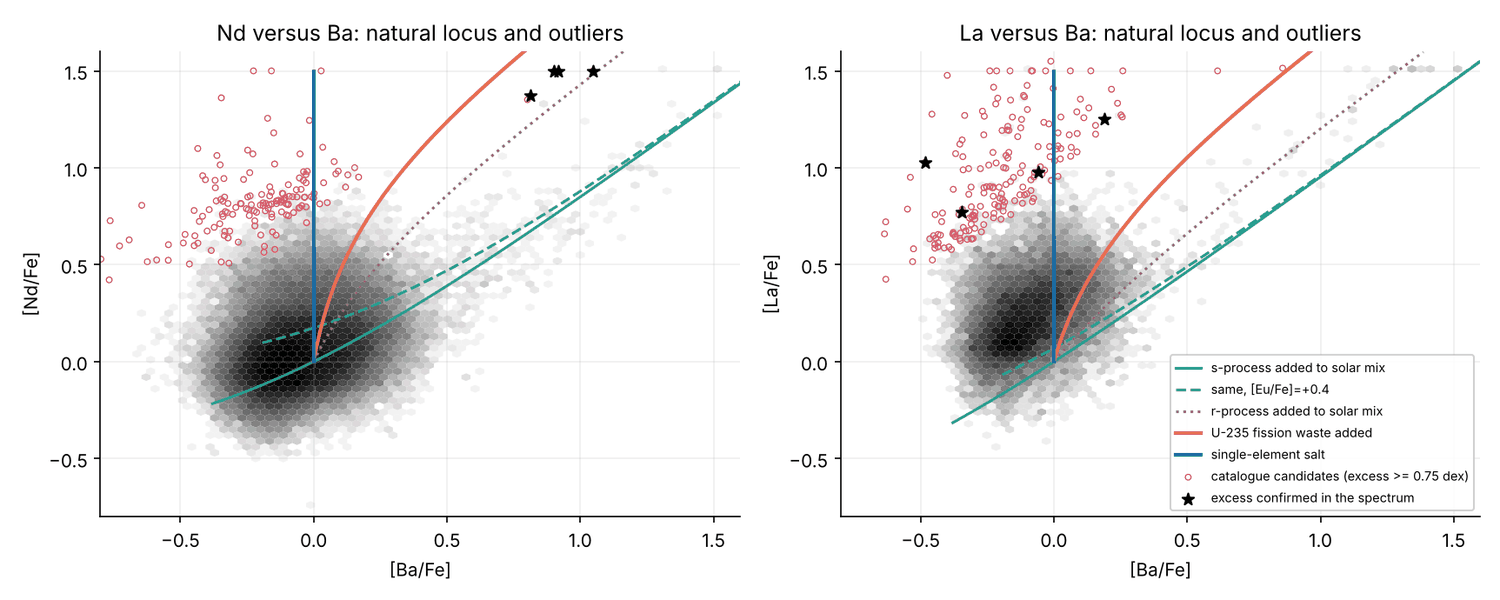
Natural pattern. Each star's heavy elements are modelled as a mixture of the solar s- and r-process patterns, with Ba (Y for Zr) fixing the s-component and Eu, or the disc [Eu/Fe] trend, the r-component. The statistic is the excess Ex = [X/Fe] - prediction - zero point (core scatter 0.14 dex for Nd, up to 0.25 dex for Sm and Eu). Ba and Y are anchors, so Ba-only and Y-only salts are not constrained.
What is limited. The baseline limit is on the fraction of stars whose true excess over the natural prediction is at least L. That is the same as an added amount of (10^L - 1) times the predicted natural abundance: at L >= 1 the salt outweighs the natural content 9:1, so the star's own natural scatter moves the excess by under 0.02 dex. A second, stricter reading ("the star's own natural abundance multiplied by 10^S") is tabulated separately. There a salted star lying naturally below the prediction shows less than S, so candidates are refuted only below S - 0.10 dex and the efficiency is reduced by the natural scatter, taken as wholly intrinsic.
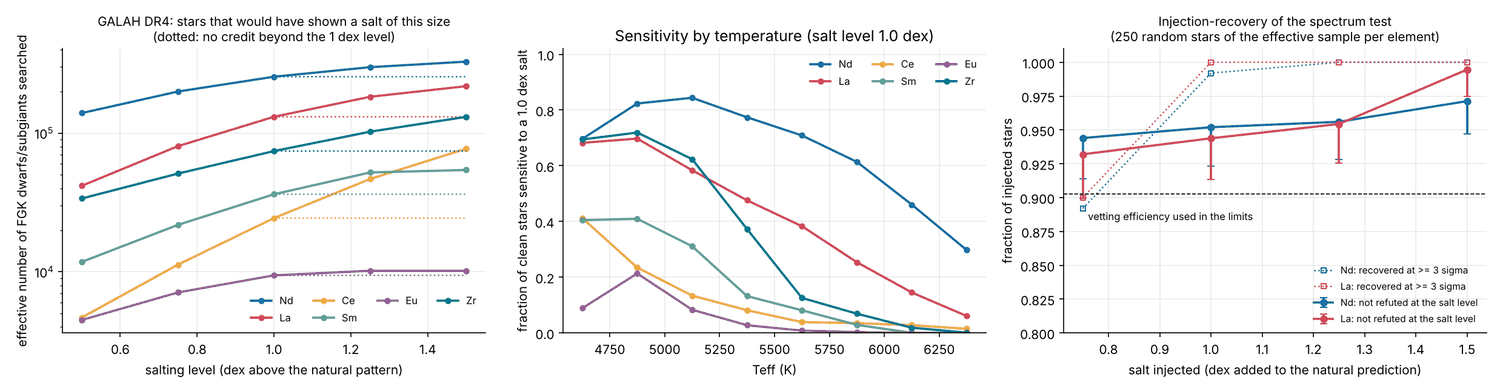
Effective sample. A logistic model gives each star's 90% detection threshold. N_eff(X, L) sums over clean stars the probability that an excess of L would be catalogued as a secure detection with Ex >= T = L - 0.25. Sensitivity above L = 1.0 is extrapolated, so limits without that credit are also given.
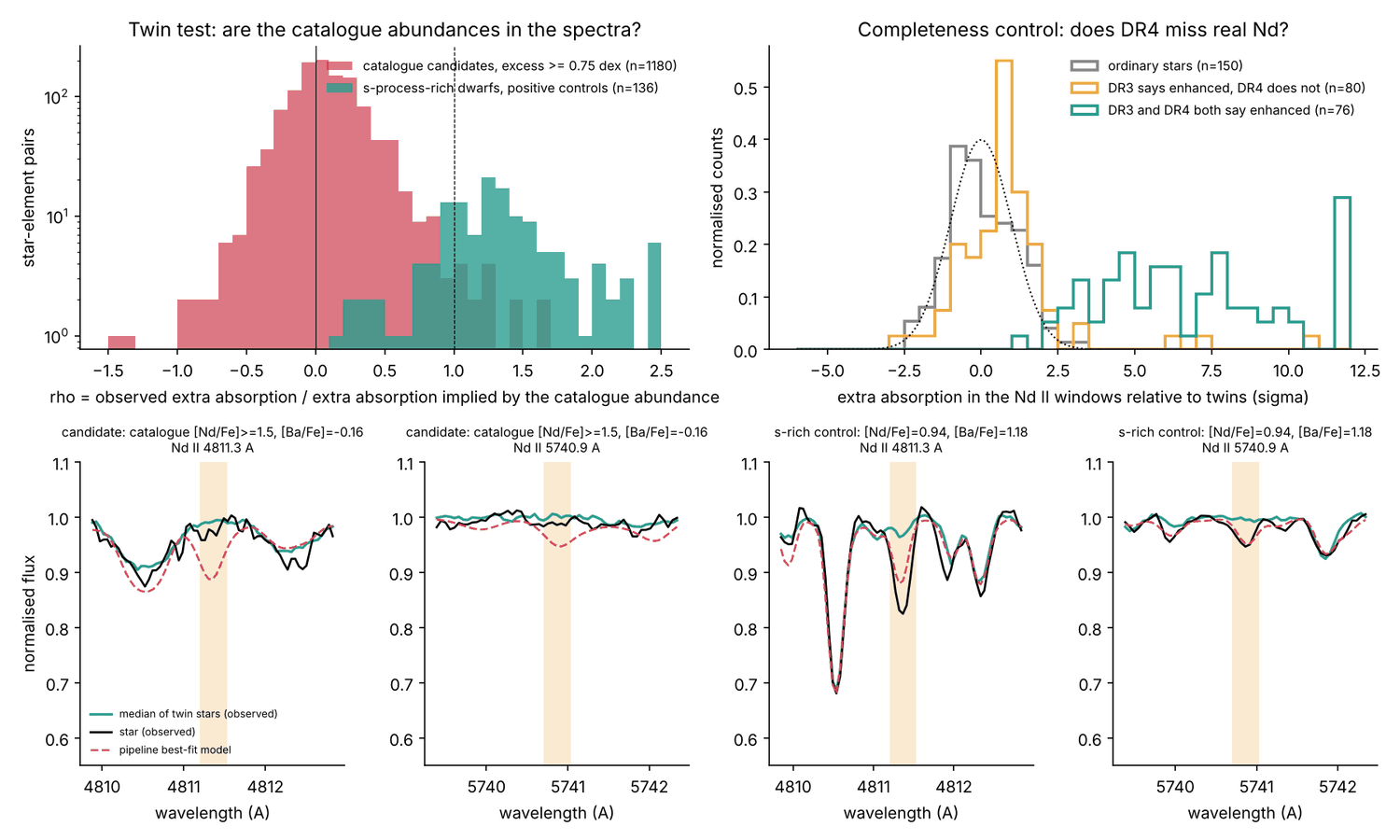
Twin test. All 3,490 clean stars with a catalogue excess >= 0.75 dex in any element, plus a random 200 per element at 0.5-0.75 dex, were tested on their own spectra against up to three twin stars. A matched filter over the element's lines gives rho = observed extra absorption / extra absorption implied by the pipeline's models. A candidate is refuted if rho + 2 sigma implies an excess below L, supported if not refuted and rho >= 3 sigma, otherwise ambiguous. New in the revision: a star whose spectrum supports an abundance at or beyond the model-grid edge cannot be refuted, because the linear conversion is not valid there.
Efficiency. 0.903 (95% lower bound from 145 s-rich positive controls, 8 wrongly refuted) times 0.892 (catalogue completeness from a DR3-versus-DR4 control) = 0.81.
Limit. f95 = Poisson 95% upper limit on k / (N_eff x efficiency), where k counts every non-refuted candidate, explained or not.
Injection-recovery (new). For 250 random stars per element drawn from the effective sample, the absorption of a salt of S dex was added to the observed spectrum and the vetting rerun. Line strengths came from a fit to the pipeline's own models.
Flagged stars (new). All 615 Nd and La candidates among the 87,480 flagged dwarfs were twin-tested. Each supported one was then examined in nine elements (Nd, La, Ce, Sm, Eu, Zr, Y, Ba, Sr).
4. Results
Vetting at L = 1.0 dex (clean stars):
| Element | N_eff | Catalogue candidates | Refuted | Supported | Ambiguous or unverifiable | k |
|---|---|---|---|---|---|---|
| Nd | 254,780 | 149 | 133 | 4 | 12 | 16 |
| La | 131,040 | 181 | 157 | 4 | 20 | 24 |
| Ce | 24,401 | 833 | 689 | 3 | 141 | 144 |
| Sm | 36,241 | 367 | 248 | 5 | 114 | 119 |
| Eu | 9,431 | 130 | 113 | 5 | 12 | 17 |
| Zr | 74,164 | 747 | 502 | 7 | 238 | 245 |
The four supported Nd stars are all barium dwarfs with Nd at the grid edge: HD 271808 (32 sigma), TYC 1400-812-1, GALAH 210706003401329 and 180126001601170 ([Ba/Fe] +0.81 to +1.05; three are binaries by RUWE or SIMBAD). They count in k.
What the spectra say about the catalogue candidates: 89% of Nd candidates are excluded as >= 1 dex excesses and 78% are inconsistent with their own catalogue value at 2 sigma. For the other elements the two fractions are La 87%/87%, Ce 83%/81%, Eu 87%/62%, Sm 68%/49%, Zr 67%/42%. "Refuted at 1 dex" is not the same as "artefact": 30 Nd candidates are consistent with their catalogue value.
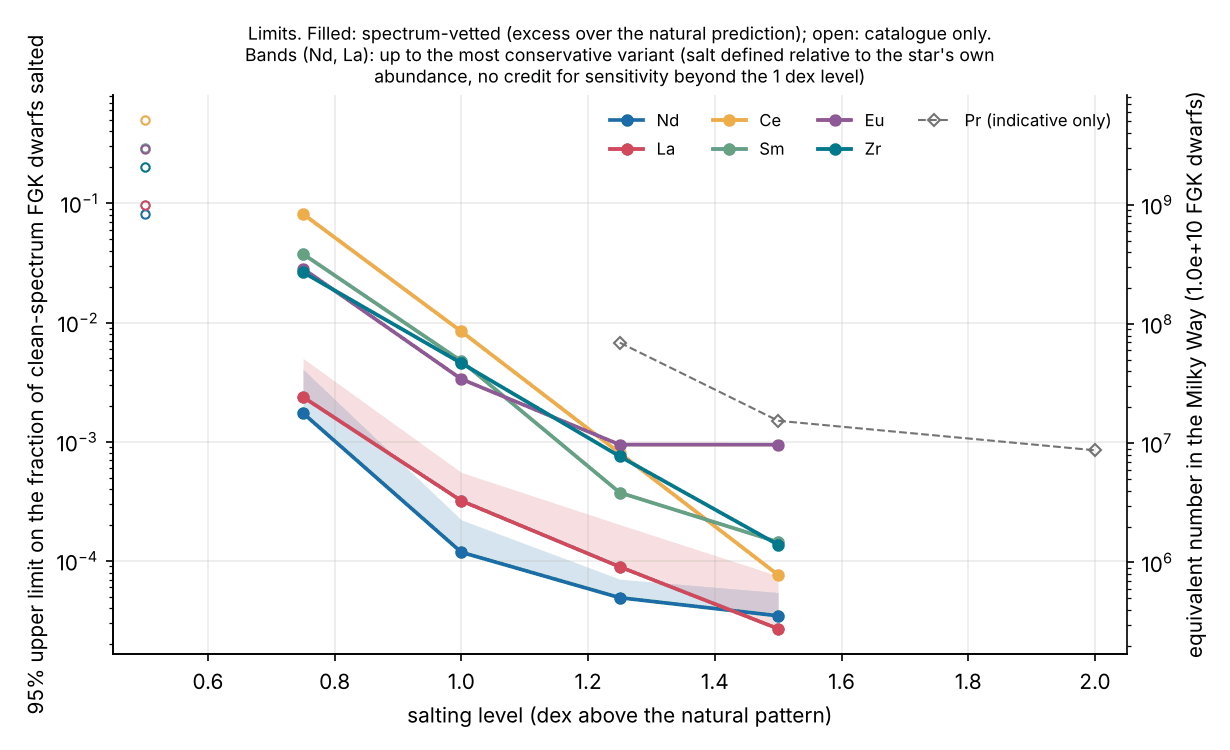
95% upper limits on the fraction of clean FGK dwarfs and subgiants with excess >= L (Fig. 5). Values in brackets give no sensitivity credit beyond the 1 dex level.
| L (dex) | Nd | La | Ce | Sm | Eu | Zr |
|---|---|---|---|---|---|---|
| 0.5 (catalogue only) | 8.2e-2 | 9.6e-2 | 0.50 | 0.29 | 0.29 | 0.20 |
| 0.75 | 1.7e-3 | 2.4e-3 | 8.1e-2 | 3.8e-2 | 2.8e-2 | 2.6e-2 |
| 1.0 | 1.2e-4 | 3.2e-4 | 8.4e-3 | 4.7e-3 | 3.4e-3 | 4.6e-3 |
| 1.25 | 4.9e-5 (5.8e-5) | 8.9e-5 (1.3e-4) | 8.0e-4 (1.5e-3) | 3.7e-4 (5.4e-4) | 9.5e-4 (1.0e-3) | 7.5e-4 (1.0e-3) |
| 1.5 | 3.5e-5 (4.5e-5) | 2.7e-5 (4.5e-5) | 7.6e-5 (2.4e-4) | 1.4e-4 (2.2e-4) | 9.5e-4 (1.0e-3) | 1.4e-4 (2.4e-4) |
With zero survivors the 1 dex Nd limit would be 1.5e-5.
Multiplicative salt definition (refutation at S - 0.10 dex):
| S (dex) | Nd | La |
|---|---|---|
| 0.75 | 4.1e-3 | 5.0e-3 |
| 1.0 | 2.2e-4 | 5.5e-4 |
| 1.25 | 6.0e-5 (7.0e-5) | 1.5e-4 (2.0e-4) |
| 1.5 | 4.3e-5 (5.4e-5) | 4.6e-5 (7.5e-5) |
Injection-recovery (Fig. 1, right). A 1.0 dex salt is not refuted in 95.2% of Nd receivers (95% lower bound 92.3%) and 94.4% of La receivers (91.3%). The range is 93-99% over S = 0.75-1.5, and 99-100% are recovered at >= 3 sigma for S >= 1.0. The recovered excess is unbiased (offset 0.003 dex, rms 0.04 dex at 1 dex). Un-injected spectra give 0/250 (Nd) and 2/250 (La) false supports. The assumed vetting efficiency of 0.903 is therefore conservative for an additive salt. The test does not cover the catalogue stage or errors in the model line strengths.
Fission waste. Fission waste raises Ba too, so the observed Nd excess E saturates (0.74, 0.85, 0.93 dex for U-235 waste raising Nd by 1.0, 1.25, 1.5 dex). Refuting candidates at min(T, E):
| Fuel | Nd +1.0 | Nd +1.25 | Nd +1.5 |
|---|---|---|---|
| U-235 | 6.8e-4 | 4.4e-4 | 3.9e-4 |
| Pu-239 | 1.3e-3 | 5.8e-4 | 4.7e-4 |
The first-pass values (1.2e-4, 1.8e-4) were wrong by factors of 3-5.
Pr, direct (indicative only). There is no Pr-only detection in 7,573 spectra: 36 of 37 detections are s-rich stars and the other fails its control windows. With the measured recovery of 16/24 (95% lower bound 0.48) applied, f < 1.5e-3 for [Pr/Fe] >= +1.5 (4,173 sensitive stars) and < 8.5e-4 for >= +2.0 (7,376). The spectra are those downloaded for vetting, not a random sample: the sensitive stars have median S/N 81/109 against 33/45 for all clean dwarfs. The calibrators span predicted [Pr/Fe] 0.45-1.29, so both levels are extrapolations.
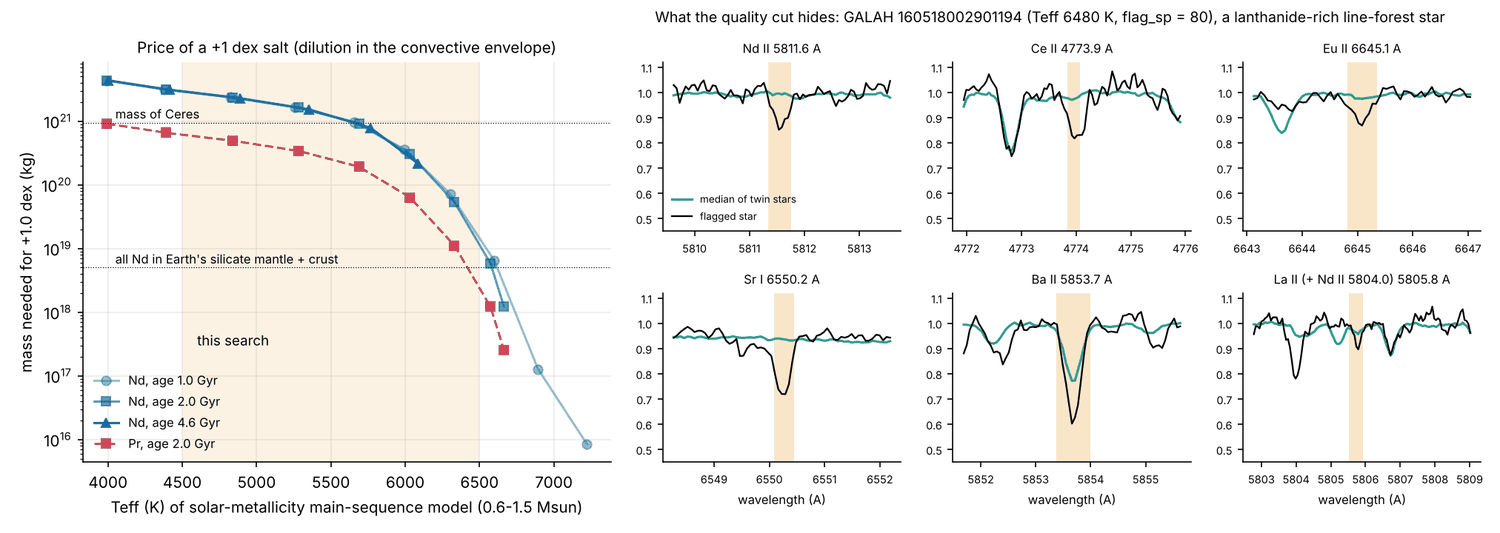
Flagged stars (Fig. 4, right). Flagged dwarfs have 10.0 times (Nd, 319 candidates) and 7.6 times (La, 296) the clean-star candidate rate. 227 flagged stars have Nd above the model range, against 19 clean stars.
| Refuted | Ambiguous | Supported | Unverifiable | |
|---|---|---|---|---|
| Nd (319) | 225 | 51 | 32 | 11 |
| La (296) | 197 | 28 | 68 | 3 |
For stars whose only flag is "unusual chi2" the result is Nd 32 refuted and 2 ambiguous of 34, La 20 refuted, 5 ambiguous and 2 supported of 27. The 100 supported pairs divide as follows:
- 4 Ap-like line-forest stars, with Sr, Eu and several lanthanides all strong at 9-47 sigma: GALAH 160518002901194 (RA 265.547, Dec -56.410, 6480 K), 170509006701167 (280.883, -22.660, 6493 K), 190211004301273 (231.189, -69.453, 6447 K) and 170614002101309 (201.791, -49.122, 6041 K, RUWE 2.2).
- 73 in which Ba or Y lines are much shallower than in the twins (composite or broadened spectra; twins invalid).
- 15 with several elements strong together.
- 8 element-specific with matching twins (1 Nd, 7 La), unresolved. By eye they are noisy and none is convincing.
The four Ap-like stars are not in the Renson & Manfroid catalogue, and they show the classical SrCrEu pattern of natural chemically peculiar stars, not a single-element salt. In the catalogue their La, Ce, Sm, Eu and Zr are "not measured" and only Nd sits at or near the grid edge, so a catalogue search for multi-lanthanide stars does not find them. No limit is quoted for flagged stars.
Other surveys (not vetted). Gaia GSP-Spec has 28 good-flag dwarfs (22 Ce, 6 Nd), all at the +2.0 dex grid edge from a single line, out of 1,578,585 FGK dwarfs with GSP-Spec parameters. None is in GALAH DR4. Seven have public RVS spectra: the line depth is 2.0-4.1% against a median of about 1% in comparison dwarfs (excess 1.0-3.3%). These are weak single-line dips, neither confirmed nor refuted. APOGEE has 29 dwarfs with [Ce/Fe] > 1; 28 have [M/H] < -0.4 (20 below -1), and the one in GALAH DR4 has a Ce upper limit of +0.46 there. The null is restricted to GALAH DR4.
Unexplained candidates: none convincing. Of 28 spectrum-supported pairs at L >= 1 dex in clean stars, 13 have a natural or instrumental explanation. Of the 15 others, 9 carry a star-specific caveat (same-plate clusters of candidates, lines mutually inconsistent, DR3 disagreement, absorption 2-3 times the catalogue value). Six have only a generic K-dwarf blend caveat or are marginal (below 5 sigma). Four pass a follow-up threshold of 4.5 sigma with no specific caveat:
| Element | GALAH sobject_id | RA, Dec (deg) | Teff (K) | Sigma | By eye |
|---|---|---|---|---|---|
| La | 230509002101104 | 235.6314, -39.3460 | 4695 | 5.0 | no visible features |
| Zr | 150606002901118 | 198.2580, -43.6699 | 5666 | 5.0 | model line absent in the data |
| Eu | 210523001601010 | 171.6068, -54.1423 | 5473 | 4.7 | defect near 6643-6645 A; second line empty |
| Zr | 140413004901136 | 248.4310, -30.4401 | 5735 | 4.6 | messy window |
The null-control false-positive rate predicts about 25 chance Zr
supports (7 seen) and about one each for Nd and Eu. The lists are in
data/supported_candidates_vetted.csv,
followup_targets.csv and
surviving_candidates_all.csv (1,707 pairs).
Beacon numbers. With 0.0088 FGK dwarfs per cubic parsec (GCNS), there are 1.3e7 within the 970 pc radius holding 90% of the sample and about 1.0e10 in the Galaxy.
| Nd excess | Within 970 pc | Galaxy |
|---|---|---|
| >= 1.0 dex | < 1,600-2,900 | < 1.2e6-2.3e6 |
| >= 1.25 dex | < 650-930 | < 5.1e5-7.2e5 |
| >= 1.5 dex | < 460-720 | < 3.6e5-5.6e5 |
Cost and persistence (Fig. 4, left). With the solar envelope mass of 0.025 Msun, +1 dex needs 1.25e21 kg of Nd (1.3 Ceres masses) or 2.6e20 kg of Pr. That falls to 5e19 kg at 6330 K and 6e18 kg at 6570 K. Settling out of a solar-type envelope takes far longer than a Gyr (Turcotte et al. 1998; quoted, not recomputed). The time-integrated reading ("ever salted") is defensible only for G-K dwarfs with logg >= 4.0 and Teff < 6000 K, which make up 61% of the Nd effective sample. For them the limits are 1.5e-4 (Nd) and 4.9e-4 (La) at 1 dex. Subgiants (26% of N_eff has logg < 4.0) dilute a salt as their envelopes deepen: the 1.5 Msun model's envelope grows 170-fold between 1 and 2 Gyr. F stars settle faster.
The 6500 K boundary and Przybylski's Star. Among stars in which two lanthanides at +0.9 dex would have been detectable, GALAH finds 0 of 1,968 at 6250-6500 K (< 0.15%) and 0 of 8,586 at 6000-6250 K. The first-pass "0 of 17,527" used a denominator that was mostly insensitive. Above 6500 K the raw, unvetted fractions are 0.15% (6500-6750 K) and 2.1-2.7% (6750-7500 K). The boundary therefore rests on the literature (Michaud 1970; Richer et al. 2000), and it is not clean: three of the four Ap-like flagged stars lie at 6450-6500 K. No survey used here observed Przybylski's Star (nearest GALAH DR4 star 0.53 degrees away; no APOGEE, RVS or LAMOST coverage). How GALAH would report it is conjecture. The four Ap-like stars give the only empirical guide: a bad-fit flag and unmeasured lanthanides, not a row of extreme values.
5. Robustness
| Variant (same salt level, 1.0 dex) | Nd | La |
|---|---|---|
| Baseline | 1.2e-4 | 3.2e-4 |
| Multiplicative definition (margin sweep 0-0.25 dex) | 2.2e-4 (1.9e-4-3.6e-4) | 5.5e-4 (4.8e-4-6.8e-4) |
| G-K dwarfs only (logg >= 4.0, Teff < 6000 K) | 1.5e-4 | 4.9e-4 |
| S/N >= 50 | 1.6e-4 | 2.3e-4 |
| Teff < 6250 K / Teff >= 5250 K | 1.2e-4 / 0.9e-4 | 3.3e-4 / 1.4e-4 |
| RUWE < 1.4, no second RV component | 1.1e-4 | 3.0e-4 |
| Alternative s-fractions | 1.2e-4 | 3.2e-4 |
| Saturation allowance for rho > 1 | 1.8e-4 | 3.5e-4 |
| No clipping, worst line dropped | 1.9e-4 | 5.7e-4 |
| 50% detection threshold (extra candidates unvetted) | 4.3e-4 | 5.6e-4 |
| Optimistic: spectrum-supported candidates only (not used) | 4.1e-5 | 8.0e-5 |
Same-level variants span 0.9e-4 to 4.3e-4 (Nd) and 1.4e-4 to 6.8e-4 (La). Changing the catalogue margin changes the salt level itself: a margin of 0.15 dex gives the limit at 0.9 dex (Nd 2.0e-4, La 5.0e-4) and 0.35 dex the limit at 1.1 dex (0.8e-4, 2.3e-4). The first-pass rule that refuted grid-edge stars gave 1.0e-4 and is not valid. A separate completeness check on Ba+Y-rich dwarfs finds Nd securely reported in 291/299 (95% lower bound 95%) and La in 107/118 (85%).
6. Limitations
- Clean spectra only; flagged stars are vetted but get no limit, and 8 flagged pairs remain unresolved.
- The limits are confusion-limited by non-refuted candidates. The twin test cannot tell element-specific absorption from an unmodelled blend.
- The injection test covers the spectrum stage only and uses the pipeline's own models. The catalogue stage is calibrated on natural s-rich stars and on about six events of the DR3-DR4 control.
- Sensitivity beyond 1 dex is extrapolated (bracketed values remove that credit).
- Ba-only or Y-only salts, s-process-mimicking salts and strong fission salts (seen as barium stars) are not excluded.
- Tc and Pm are untested. Pr is indicative only.
- GSP-Spec (28) and APOGEE (29) extreme dwarfs are unvetted. LAMOST and repeat spectra were not used.
- The Galactic extrapolation is uncertain by about a factor of two. Persistence times are from the literature.
7. Closest prior work and what is new
I found no published systematic search of a spectroscopic survey for salted main-sequence stars (arXiv and web searches, October 2026); I cannot rule out one I missed. Closest work:
- Whitmire & Wright (1980): the proposal.
- Carrigan (2010, arXiv:1001.5455) and Vidal et al. (2026, arXiv:2605.21093): reviews that list stellar pollution without a search.
- Tarter & Steel (2024): confirmed only through its citation in Vidal et al.; I did not locate the original.
- Stevens, Forgan & O'Malley-James (2016, arXiv:1507.08530): signatures of self-destructive civilisations (title verified, not re-read).
- Huang, Tao & Zhang (2026, arXiv:2605.29811): a chemical-technosignature search over 697 abundance records of at least 397 polluted white dwarfs.
- Andrievsky, Korotin & Werner (2023, arXiv:2308.04479, 2304.13623): Tc and Pm in Przybylski's Star.
- Escorza et al. (2026, A&A 712, A111) and Yang et al. (2026, arXiv:2602.21014; 486 barium stars): the natural s-process-rich stars in GALAH DR4.
New here: (i) a quantitative limit, with selection function and injection test, on single-lanthanide and fission-pattern excesses in clean-spectrum FGK dwarfs; (ii) spectrum-level evidence that most extreme GALAH DR4 lanthanide outliers in dwarfs are not supported by their spectra; (iii) the finding that quality flags hide Ap-like stars the catalogue does not report; (iv) an indicative Pr search; (v) the cost-versus-temperature curve.
8. Implications for the Fermi paradox
Fewer than about 1 in 4,500 to 8,400 clean-spectrum Sun-like stars carries a Nd excess of 1 dex or more, and fewer than 1 in 14,000 to 29,000 one of 1.25-1.5 dex. For G-K dwarfs proper this bounds the fraction ever salted this way at about 1.5e-4. One to two million such beacons in the Galaxy remain allowed, so only the "common and conspicuous" corner is removed. Nothing is said about weak marks, Tc or Pm, flagged spectra, or hot stars, where salting is cheapest and nature imitates it. The Ap-like stars behind the quality flags show that a Przybylski-like object would be invisible to a catalogue search.
Code: code/run_all.py regenerates every number and
figure (6-8 minutes from cached downloads; raw data are re-downloaded if
absent). Figures: fig1_effective_sample.png,
fig2_natural_pattern.png, fig3_twin_test.png,
fig4_cost_and_flagged_cp_star.png,
fig5_limits.png.
9. Response to referee
- Nd limit and beacon counts. Accepted. Headline is now 1.2e-4 to 2.2e-4; beacons < 1,600-2,900 within 970 pc and < 1.2e6-2.3e6 in the Galaxy; stated as applying to clean GALAH DR4 spectra.
- Fission margin bug. Accepted and fixed in
fission_rows(). Limits rise to 4.4e-4 to 1.3e-3. The referee's refute-at-E values are tabulated; I adopt refutation at min(T, E), which is equal or more conservative. - "67-91% artefacts". Accepted. Replaced by two
separate fractions (excluded as >= 1 dex; inconsistent with the
catalogue value), in
candidate_consistency.csv. - CP onset "0 of 17,527". Accepted. Restated with sensitive denominators (0 of 1,968); the claim that GALAH shows the onset directly is withdrawn.
- flag_sp. Accepted and extended. Census with real numbers, twin test of all 615 flagged Nd/La candidates (not only the chi2 subset) and a nine-element check. Found four hidden Ap-like stars. For the chi2-only subset I get 0 Nd and 2 La supported, where the referee reported 2 and 3; both are stated.
- Grid-edge stars. Accepted. Stars with spectrum-supported abundance at the grid edge can no longer be refuted; the three named barium dwarfs now count, k = 16, limit 1.2e-4.
- Definition of the limited quantity. Accepted, with one part rejected (see below). The quantity is defined in Section 3, and limits for the multiplicative definition are tabulated.
- Robustness range and margin rows. Accepted. Range corrected to 0.9e-4 to 4.3e-4; margin rows relabelled as limits at 0.9 and 1.1 dex; extrapolation of N_eff above 1 dex disclosed and a no-extrapolation column added.
- Pr. Accepted. Marked indicative; recovery 16/24 applied (limits doubled); sample described.
- Time-integrated claim. Accepted. Restricted to G-K dwarfs with logg >= 4.0 and Teff < 6000 K and to Nd and La at >= 1 dex. I used a stricter cut (61% of N_eff) than the referee's logg-only 73%. Subgiant dilution is noted.
- Other surveys. Accepted. 28 GSP-Spec and 29 APOGEE dwarfs disclosed as unvetted, with a partial RVS check of 7; null restricted to GALAH DR4.
- Caveats. Accepted. Star-specific and generic caveats are separated; four follow-up targets listed (including the two named). The star in field 170516001601 is flagged by a same-plate cluster of 6 candidates and RUWE 5.7. I did not independently verify the corrupt blue arm.
- Citations. Accepted. Huang et al. corrected to 697 records of at least 397 white dwarfs; Stevens et al. and Yang et al. added; Tarter & Steel added with the caveat that I could not locate the original.
- No injection-recovery. Accepted and done (Section 4). The catalogue stage remains calibrated on natural stars and is listed as a limitation.
- Przybylski description. Accepted. Marked as conjecture, with the four Ap-like stars as the only empirical guide.
Not accepted. The referee's estimate that vetting efficiency for a salt of exactly L dex is only 50-85% holds only for the multiplicative definition. For an additive salt the injection test measures 94-97%. Both cases are reported and the headline range covers both.
Key numbers
| Quantity | Value | Uncertainty | Note |
|---|---|---|---|
| GALAH DR4 rows / FGK dwarfs+subgiants (4500<=Teff<6500 K, logg>=3.5) / with flag_sp==0 / flagged | 917,588 / 495,976 / 408,496 / 87,480 | cut flow in data/cut_flow.csv; all limits refer to the flag_sp==0 stars only | |
| 95% upper limit, fraction of clean FGK dwarfs with Nd excess >= 1.0 dex over the natural prediction | 1.2e-4 | 2.2e-4 for the multiplicative salt definition (1.9e-4 to 3.6e-4 over its margin sweep); 0.9e-4 to 4.3e-4 over all same-level variants | N_eff 254,780; 149 catalogue candidates: 133 refuted, 4 supported (all barium dwarfs at the model-grid edge), 11 ambiguous, 1 unverifiable; k = 16; efficiency 0.81 |
| 95% upper limit, Nd excess >= 1.25 dex / >= 1.5 dex | 4.9e-5 / 3.5e-5 | 5.8e-5 / 4.5e-5 with no sensitivity credit beyond the 1 dex level; 7.0e-5 / 5.4e-5 most conservative | 6 and 4 non-refuted candidates |
| 95% upper limit, Nd excess >= 0.75 dex / >= 0.5 dex | 1.7e-3 / 8.2e-2 | 0.75 dex uses a vetted random subsample of 200 of 1,203 band candidates; 0.5 dex is catalogue-only and confusion-limited | |
| 95% upper limit, La excess >= 1.0 / 1.25 / 1.5 dex | 3.2e-4 / 8.9e-5 / 2.7e-5 | 5.5e-4 / 2.0e-4 / 7.5e-5 most conservative | 24, 7 and 1 non-refuted candidates; N_eff 131,040 at 1 dex |
| 95% upper limits at >= 1.0 dex for Ce, Sm, Eu, Zr | 8.4e-3, 4.7e-3, 3.4e-3, 4.6e-3 | weak because 17 to 245 candidates per element are not refuted (blends, single lines) | |
| G-K dwarfs only (logg >= 4.0, Teff < 6000 K), Nd / La excess >= 1.0 dex | 1.5e-4 / 4.9e-4 | 61% of the Nd effective sample; the only subsample for which the time-integrated reading is defensible | |
| Fission-waste salt, U-235, raising Nd by 1.0 / 1.25 / 1.5 dex | f < 6.8e-4 / 4.4e-4 / 3.9e-4 | referee's refutation rule gives 6.8e-4 / 2.8e-4 / 1.8e-4 | Pu-239: 1.3e-3 / 5.8e-4 / 4.7e-4; first-pass values (1.2e-4, 1.8e-4) were wrong by a factor 3-5 (margin bug) |
| Injection-recovery of the spectrum test: injected 1.0 dex salt not refuted | Nd 95.2%, La 94.4% | 95% lower bounds 92.3% and 91.3% | 250 receivers per element; 99-100% recovered at >= 3 sigma; assumed vetting efficiency was 90.3% |
| Catalogue candidates (excess >= 0.75 dex) excluded as >= 1 dex by their spectra / inconsistent with their own catalogue value at 2 sigma | Nd 89% / 78%; La 87% / 87%; Ce 83% / 81%; Eu 87% / 62%; Sm 68% / 49%; Zr 67% / 42% | replaces the first-pass statement that 67-91% are pipeline artefacts | |
| Flagged dwarfs (flag_sp != 0): Nd / La candidate rate relative to clean stars | 10.0x / 7.6x (319 and 296 candidates) | 227 flagged stars have Nd above the model range against 19 clean stars | |
| Twin test of all flagged Nd / La candidates | Nd: 225 refuted, 51 ambiguous, 32 supported, 11 unverifiable; La: 197, 28, 68, 3 | of 100 supported pairs: 4 Ap-like line-forest stars, 73 twin mismatch, 15 multi-element, 8 element-specific and unresolved; no limit is quoted for flagged stars | |
| Nd beacons (>= 1.0 dex) allowed within 970 pc (1.3e7 FGK dwarfs) / in the Galaxy (1.0e10) | < 1,600 to 2,900 / < 1.2e6 to 2.3e6 | Galactic star count uncertain by about a factor of 2 | 1.25 dex: < 650-930 and < 5.1e5-7.2e5; 1.5 dex: < 460-720 and < 3.6e5-5.6e5; assumes the local clean-spectrum sample is representative |
| Direct Pr II search (indicative only) | f < 1.5e-3 for [Pr/Fe] >= +1.5; < 8.5e-4 for >= +2.0 | recovery 16/24, 95% lower bound 0.48, applied | 4,173 and 7,376 sensitive stars from a non-random high-S/N sample; sensitivity extrapolated 0.2-0.7 dex beyond the calibrators |
| Spectrum-supported candidates at salt level >= 1 dex (clean stars) | 28 star-element pairs: 13 explained, 15 unexplained (9 with star-specific caveats, 6 with only generic or marginal ones) | 4 follow-up targets, none convincing by eye; null-control false-positive rate predicts about 25 chance Zr supports (7 seen) | |
| Twin-test efficiency and catalogue completeness | 0.945 (95% lower bound 0.903) and 0.89 (95% lower bound 0.77); product used 0.81 | 145 positive controls, 8 wrongly refuted; completeness from the GALAH DR3-vs-DR4 control; independent check on Ba+Y-rich dwarfs: Nd secure in 291/299 | |
| Lanthanide-rich stars (>= 2 of La, Ce, Nd at >= +0.9 dex) among stars sensitive to them | 0 of 1,968 at 6250-6500 K (< 0.15%); 0 of 8,586 at 6000-6250 K | the first-pass '0 of 17,527' used an insensitive denominator; above 6500 K the raw unvetted fractions are 0.15% to 2.7% | |
| Other surveys: extreme dwarfs not vetted | 28 Gaia GSP-Spec (22 Ce, 6 Nd) + 29 APOGEE (Ce) | GSP-Spec values all at the +2.0 grid edge from one line, out of 1,578,585 FGK dwarfs; 7 with public RVS spectra show 2-4% dips against about 1% in comparison stars | |
| Mass needed for +1.0 dex in a Sun-like star (M_cz = 0.025 Msun) | Nd 1.25e21 kg; Pr 2.6e20 kg | 1.3 Ceres masses of Nd; falls to 5e19 kg at 6330 K and 6e18 kg at 6570 K (unchanged from first pass) |
Changes made after the referee report
- Headline Nd limit at 1 dex changed from 1.0e-4 to 1.2e-4 (baseline) to 2.2e-4 (multiplicative salt definition); beacon counts rescaled to < 1,600-2,900 within 970 pc and < 1.2e6-2.3e6 in the Galaxy; limits now stated as applying to clean (flag_sp == 0) GALAH DR4 spectra only.
- Fixed the fission-salt margin bug in fission_rows(): candidates are now refuted at min(T, E) instead of T + 0.25; limits rise from 1.2e-4/1.8e-4 to 4.4e-4/6.8e-4 (U-235) and 5.8e-4/1.3e-3 (Pu-239); the referee's refute-at-E values are tabulated alongside.
- New edge rule in the twin test: a star whose spectrum supports an abundance at or beyond the model-grid edge cannot be refuted; three barium dwarfs previously refuted now count (Nd k = 16 instead of 13). First-pass rule and a saturation-allowance rule kept as robustness variants.
- Replaced the '67-91% are pipeline artefacts' claim with two measured fractions per element (excluded as >= 1 dex; inconsistent with the catalogue value at 2 sigma), written to candidate_consistency.csv.
- Defined the limited quantity explicitly (excess over the natural prediction >= L) and added a table of limits for the multiplicative definition with a sweep of the refutation margin (limits_salt_added.csv).
- Added an injection-recovery test of the vetting stage (new step s12_injection.py): 250 receivers per element, 94-97% not refuted, 99-100% recovered at >= 3 sigma for salts >= 1 dex.
- Added a census and twin test of all 615 Nd and La candidates among flag_sp != 0 dwarfs with a nine-element specificity check (new step s11_flagged.py): 10x candidate rate, four Ap-like line-forest stars found, 8 pairs unresolved, no limit quoted.
- Added a no-extrapolation column (no sensitivity credit above the 1 dex level) to the limits and to Fig. 5; corrected the robustness range to 0.9e-4-4.3e-4 and relabelled the margin rows as limits at 0.9 and 1.1 dex.
- Added a G-K-dwarf-only variant (logg >= 4.0, Teff < 6000 K; 61% of N_eff) and restricted the time-integrated statement to it and to Nd/La at >= 1 dex; noted subgiant dilution.
- Restated the hot-star onset with sensitive denominators (0 of 1,968, not 0 of 17,527) and withdrew the claim that GALAH shows the onset directly.
- Pr search downgraded to indicative: recovery 16/24 (95% lower bound 0.48) now applied, limits doubled to 1.5e-3 and 8.5e-4; the non-random high-S/N sample and the extrapolation beyond calibrators are described.
- Other surveys: disclosed 28 Gaia GSP-Spec grid-edge dwarfs and 29 APOGEE dwarfs as unvetted, added a partial check with public Gaia RVS spectra (7 stars), and restricted the null to GALAH DR4.
- Supported-candidate vetting now separates star-specific from generic caveats and flags same-plate clusters; 28 supported pairs (13 explained, 15 unexplained, 6 without a specific caveat); a follow-up list of four targets is written to followup_targets.csv.
- Citations corrected and added: Huang et al. is 697 abundance records of at least 397 white dwarfs; Stevens et al. 2016 and Yang et al. 2026 added; Tarter & Steel 2024 added with the caveat that only its citation in Vidal et al. was confirmed.
- Przybylski's Star paragraph marked as conjecture, with the four Ap-like flagged stars as the only empirical guide to how GALAH treats such spectra.
- Figures regenerated: Fig. 1 gains an injection-recovery panel, Fig. 4 replaces the hot-star onset panel with line windows of a flagged Ap-like star (file renamed fig4_cost_and_flagged_cp_star.png), Fig. 5 gains conservative bands and labels Pr as indicative. Spectra are now cached as compact line segments; the whole pipeline was rerun twice end to end from run_all.py with identical results.
Referee points not accepted
- Partly rejected: the estimate that the vetting efficiency for a salt of exactly L dex is only 50-85%. That holds only if the salt multiplies the star's own natural abundance and all natural scatter is intrinsic. For an additive salt of 1 dex or more the salt outweighs the natural content 9:1 and the injection test measures 94-97% not refuted (95% lower bounds 91-95%). Both definitions are now tabulated and the headline range (1.2e-4 to 2.2e-4) covers both.
- Not adopted as given: the referee's replacement fission limits (refutation at the expected excess E, e.g. 2.8e-4 for U-235 at Nd +1.25). The bug is accepted and fixed, but I adopt refutation at min(T, E), which gives equal or more conservative limits (4.4e-4); the referee's values are tabulated next to mine.
- Not reproduced: the referee's count of 2 Nd and 3 La spectrum-supported candidates in the chi2-only flagged subset. My twin test gives 0 Nd supported (2 ambiguous of 34) and 2 La supported (of 27). The conclusion the referee drew, that flagged stars need spectrum-level vetting, is accepted and was extended to all 615 flagged Nd and La candidates.
- Modified, not rejected: the suggested 'logg >= 4.0, about 73% of N_eff' restriction for the time-integrated statement. I used the stricter logg >= 4.0 and Teff < 6000 K cut (61% of N_eff), because F dwarfs settle faster.
Figures
Code
Every number above is produced by these scripts from public data. The data tables themselves are not hosted here; the scripts download them.
common.py run_all.py s00_download.py s01_prepare.py s02_sensitivity.py s03_candidates.py s04_vetting.py s05_physics.py s06_limits.py s07_other_surveys.py s08_figures.py s09_pr_search.py s10_survivors.py s11_flagged.py s12_injection.py spectra.py
Referee report
A second, separate analysis re-ran the code, recomputed the main numbers by its own route and tried to break the result. Like the first, it was run by Claude for this project; it is not an outside expert. In its report “the analyst” is the first analysis, which wrote the paper, and file names that are not linked on this page are its own working files. The paper above is the version revised in response.
Verdict: sound with fixes. Results reproduced: yes.
WHAT I RAN. I copied the analyst's code to a separate working folder, redirected only the output and cache paths, and reran run_all.py from step 1 (catalogue extraction, detection thresholds, natural-pattern model, twin test on 6,161 spectra, physics, other surveys, limits, Pr search, survivor vetting, figures).
RESULT OF THE RERUN. Every derived table I compared is byte-identical to the analyst's: limits_by_element.csv, robustness_variants.csv, limits_fission_salt.csv, cut_flow.csv, dr3_control_counts.csv, vetting_twin_test_raw.csv, surviving_candidates_all.csv, supported_candidates_vetted.csv, supported_candidates_summary.json, key_numbers.json, other_surveys_summary.json, fission_pattern.csv, convective_envelope_mass.csv, cp_onset_vs_teff.csv, extreme_multi_lanthanide_stars.csv, pr_direct_search.csv and pr_direct_search_summary.json. The headline numbers follow: 917,588 / 495,976 / 408,496 stars; N_eff(Nd, 1 dex) = 254,780; 149 candidates, 136 refuted, 13 not refuted; efficiency 0.8055; f95 = 1.01e-4.
INDEPENDENT RECOMPUTATION OF THE HEADLINE (my own scripts in referee/mycode, reading the FITS file directly).
- Sample: 408,496 clean stars confirmed; no duplicate Gaia IDs among them.
- Sensitivity: a non-parametric, binned detection threshold (Teff x S/N x [Fe/H] cells, no logistic regression) with an empirical Nd-versus-Ba relation gives 227,066 stars sensitive to a 1 dex Nd salt, against the analyst's 254,780 (11% lower).
- Vetting: my own twin test (different twin selection, four Nd lines, own noise calibration; 134 extra spectra downloaded) on my own 240 candidates leaves 18 not refuted. Its efficiency on 164 s-rich positive controls is 0.933.
- Limit: f95(Nd >= 1.0 dex) = 1.3e-4 to 1.4e-4, against the analyst's 1.0e-4. At 1.25 and 1.5 dex I get 1.5e-5 (analyst 3.2e-5 and 1.8e-5). Agreement is within a factor of about 1.4 at 1 dex and about 2 at 1.25 dex.
INDEPENDENT COMPLETENESS CHECK (no DR3 involved). Among clean dwarfs that are securely rich in both Ba and Y, and whose own threshold says Nd should be detected with a 0.25 dex margin, DR4 reports a secure Nd detection in 97% (n = 250) and one within 0.4 dex of the prediction in 94%. For La the figures are 96% and 92% (n = 106). This supports the analyst's catalogue completeness of 0.89 for real strong absorbers.
SPECTRA INSPECTED BY EYE. Five refuted Nd candidates show model Nd lines at 4811 and 5741 A that are absent from the data, so they are genuine artefacts. HD 271808 shows real Nd lines deeper than the model. The top "unexplained" La, Zr and Ce candidates are unconvincing: weak or absent La features, a badly fitted Zr region, and a one-pixel defect at the Ce line.
BACK-OF-ENVELOPE CHECKS THAT PASS.
- Mass for +1 dex: Nd 1.25e21 kg and Pr 2.6e20 kg for a 0.025 Msun envelope.
- U-235 fission pattern at Nd +1.0, from cumulative chain yields recalled by hand: Pr 1.11, La 0.83, Ce 0.67, Ba 0.34, Zr 0.28.
- GCNS density 37,055 / 4.19e6 pc^3 = 0.00885 per pc^3; 1.3e7 stars in the 968 pc volume; 1.03e10 in the Galaxy.
- Poisson limit: UL(13) = 20.67, divided by 254,780 x 0.8055 = 1.01e-4.
CITATIONS AND IDENTIFICATIONS CHECKED. arXiv 2605.29811, 2605.21093, 2308.04479, 2304.13623 and 1001.5455 exist and match the descriptions. Escorza et al. 2026 (A&A 712, A111; arXiv 2604.15197) exists. SIMBAD confirms HD 101065 = Gaia DR3 5372587514128271232 at the coordinates used, and HD 271808 as a spectroscopic binary. The Gaia GSP-Spec flag positions for Zr, Ce and Nd are correct.
WHAT DID NOT SURVIVE CHECKING. The fission-salt limits (a coding inconsistency), the "91% artefacts" wording, the claim that GALAH shows the chemically-peculiar onset at 6500 K, and the statement of what was checked among flagged stars. Details are in the errors list.
Strongest objection
An abundance-survey expert would say the denominator is not validated for the thing being searched for.
The effective sample of 254,780 stars comes from a logistic model of the DR4 detection flag. The catalogue's high-abundance tail is, by the study's own finding, about 80% wrong. The efficiency (0.90 x 0.89) is calibrated only on natural s-process-rich stars, in which Ba, Y, La, Ce and Nd rise together. Nobody has shown how the DR4 neural-network fit responds to a star with one lanthanide raised 1-2 dex and everything else normal. There is no injection-recovery test. The quality cut flag_sp == 0 also removes 18% of dwarfs, and among those the rate of extreme Nd values is ten times higher. If a strong salt degrades the global fit, salted stars would be removed before the search begins.
Does the conclusion survive? Yes, at the factor-of-two level for Nd and La at 1 dex or more in clean-spectrum stars. The evidence I gathered:
- A non-parametric sensitivity estimate reproduces N_eff to 11%.
- Among dwarfs securely rich in both Ba and Y, DR4 reports the expected strong Nd in 94-97% and La in 92-96%, so real strong absorbers are catalogued.
- Real absorbers at the model edge (HD 271808; 12 of 13 barium subgiants with La above the grid) keep flag_sp == 0, so moderate over-range values do not trip the cut.
- An independent twin-test implementation gives f95 = 1.3e-4 to 1.4e-4 against the quoted 1.0e-4.
- I vetted the chi-square-only flagged subset (4,032 stars; 34 Nd and 27 La candidates) and found nothing convincing; the apparent supports are corrupt blue-arm spectra.
What remains unproven: the response to a single-element anomaly as such; salts far above the model grid (2 dex or more), which may be flagged out; and the other 83,000 flagged stars. The limit should therefore be stated as about 1e-4 to 2e-4, for clean GALAH DR4 spectra, for Nd excesses of roughly 1-2 dex. The fission, Pr and chemically-peculiar-onset claims do not survive as written.
Errors found
- major. The fission-waste limits are internally
inconsistent and too optimistic by a factor of 2.2 to 4.8. In
s06_limits.py, fission_rows() computes N_eff for stars whose observed Nd
excess would be only 0.68 to 0.93 dex (because the waste also raises the
Ba anchor), but calls tally() with the default margin. Candidates are
therefore counted as refuted whenever the spectrum excludes an excess of
1.0 dex or more. A genuinely fission-salted star with a good spectrum
would itself be refuted.
- Evidence: Rerun with a consistent threshold in referee/code. U-235 Nd+1.25: observed excess 0.851, N_eff 209,208, non-refuted k rises from 13 to 35. U-235 Nd+1.0: observed excess 0.743, N_eff 139,156, k rises from 13 to 62. Pu-239 Nd+1.25: k = 51, f95 = 5.0e-4. Pu-239 Nd+1.0: k = 82, f95 = 1.3e-3.
- Fix: In fission_rows() call tally(d, c, vet, 'nd', T, margin=marg), so the refutation threshold equals the expected observed excess. Corrected 95% limits: U-235 raising Nd by 1.25 dex, 2.8e-4 (not 1.2e-4); by 1.0 dex, 6.8e-4 (not 1.8e-4). Pu-239: 5.0e-4 and 1.3e-3 (not 1.6e-4 and 2.7e-4). Replace these in the key numbers and in section 4.
- major. The headline statement that 67-91% of
extreme lanthanide outliers (91% for Nd) are pipeline artefacts whose
spectra show none of the implied absorption is not what the test
measures. "Refuted" means the spectrum excludes a true excess of at
least 1.0 dex at 2 sigma. That includes stars whose catalogued excess of
0.75-1.0 dex is real but simply below 1.0 dex.
- Evidence: From vetting_twin_test.csv for Nd: of 136 refuted, 112 have rho + 2 sigma < 1, only 51 have rho + 2 sigma < 0.5, and 24 are consistent with rho = 1. Four refuted Nd stars have real absorption at 3 sigma or more. For Zr, 206 of 502 refuted candidates are consistent with their catalogue value.
- Fix: Reword in the headline, section 4 and novelty item (ii): "91% of Nd candidates are excluded as excesses of 1 dex or more; 78% (115 of 148) are inconsistent at 2 sigma with their own catalogue value." Give the per-element inconsistent fractions: La 87%, Ce 81%, Eu 62%, Sm 49%, Zr 42%.
- major. The claim that GALAH shows the Am/Fm/Ap
onset directly (0 of 17,527 at 6250-6500 K, 0.15% at 6500-6750 K, 2.7%
at 6750-7000 K) does not hold. The zero is mainly a sensitivity effect,
and the 0.15% at 6500-6750 K equals the 0.08-0.11% found at 5000-6000 K.
The hotter-bin values are unvetted catalogue numbers of the kind the
study itself shows to be mostly wrong.
- Evidence: Only 11% of the 17,527 clean S/N > 50 stars at 6250-6500 K have detection thresholds at or below +0.9 dex for at least two of La, Ce and Nd, against 99% at 4750-5250 K. The analyst's own table gives "none" for La and Ce at 6250-6500 K. cp_onset_vs_teff.csv shows 6 of 3,986 at 6500-6750 K and 32 of 32,824 at 5500-5750 K.
- Fix: Remove "GALAH shows the onset directly" and the 0/17,527 key number, or restate it with the sensitive denominator (about 1,960 stars; 95% upper limit about 0.15%). Justify the 6500 K boundary from the literature only, and keep the caveat that Przybylski's Star at about 6400 K is inside the cut.
- major. The flag_sp == 0 cut hides a population with
a ten times higher rate of extreme values, and the report understates
what was left unchecked. It says the flagged stars were checked at
catalogue level through 15 stars with three or more extreme lanthanides.
Single-element candidates among flagged stars, which are the actual
search target, were never counted or vetted.
- Evidence: Nd candidates (excess >= 0.75 dex): 319 of 87,480 flagged (3.6e-3) against 149 of 408,496 clean (3.6e-4). Nd values above the model range: 227 flagged against 19 clean. 194 of the 319 carry the chi-square bit. I vetted the chi-square-only subset (flag_sp == 16; 4,032 stars, 34 Nd and 27 La candidates) with my own twin test: 30 of 34 Nd and 19 of 27 La are refuted. The two Nd and three La "supported" cases include field 170516001601, whose blue-arm spectra are visibly corrupt, with nothing at the green-arm lines. I found no convincing hidden candidate, but only in that subset.
- Fix: State the numbers in Limitations: 319 Nd and 296 La single-element candidates among 87,480 flagged dwarfs, at ten times the clean-sample rate. Say explicitly that the limit applies to stars with clean spectra, and that a salt strong enough to exceed the model grid might trip the chi-square flag. Vet at least the chi-square-flagged subset and report it.
- major. The praseodymium limit (f < 7.2e-4 for
[Pr/Fe] >= +1.5; 4.1e-4 for >= +2.0) is quoted without an
efficiency factor and at a sensitivity level that no calibrator reaches.
The sensitive sample is also not a random sample of FGK dwarfs: it is
mostly the high-S/N comparison stars downloaded for the twin test.
- Evidence: pr_direct_search_summary.json: validation_expected_z_ge_10 has n = 0; validation_expected_z_ge_5 has 16 of 24 detected. The limit is poisson_upper(0)/4173 with no efficiency. s-rich calibrators have predicted [Pr/Fe] of 0.45-1.29 (median 0.89). Median S/N of the sensitive sample is 81 (CCD1) and 109 (CCD2).
- Fix: Present the Pr result as indicative only and remove it from headline-level numbers. Alternatively, divide by the measured recovery (16 of 24, lower bound about 0.48) and state that the sensitivity is a linear extrapolation 0.2-0.6 dex beyond the calibrators that ignores line saturation. Describe the sample selection.
- minor. The headline Nd limit of 1.0e-4 sits at the
optimistic end of what the data support. Three effects push it up. (a)
Three strongly supported, Ba-rich stars at or near the model edge are
refuted by a weak-line linear extrapolation that is not valid for
saturating lines above the grid. (b) A star salted by exactly L whose
natural abundance lies below the prediction is refuted when its spectrum
is good, so efficiency for exactly-L salts is roughly 50-85%, not 94.5%;
the positive-control test does not measure this. (c) N_eff at L >=
1.25 is an extrapolation of the logistic model beyond where natural
stars exist.
- Evidence: (a) 160108003601020 (flag 8, rho = 1.21 +/- 0.07, DR3 gives 1.56), 210706003401329 (flag 8, rho = 1.25 +/- 0.16) and 180126001601170 (x = 1.37, rho = 1.49 +/- 0.09, upper bound 0.97). With k = 16 the limit is 1.2e-4. (b) The analyst's own margin-0.15 variant (refutation threshold 0.9) gives 1.9e-4. My independent implementation gives 1.3e-4 to 1.4e-4. (c) My non-parametric sensitive count saturates at 237,915 for L >= 1.25, against the analyst's 298,463 and 327,154.
- Fix: Quote the Nd >= 1 dex limit as about 1e-4 to 2e-4 and scale the beacon counts (fewer than 1,300-2,600 within 970 pc; fewer than 1e6-2e6 in the Galaxy). Count edge stars with rho >= 1 as non-refuted. Define the limit explicitly as on true excess over the natural prediction of at least L, and note that in terms of salt added it applies at L plus about 0.15-0.25 dex. State that N_eff at 1.25 and 1.5 dex is extrapolated.
- minor. The robustness range "0.6e-4 to 4.2e-4 under
every variant tried" mixes different salt levels. The margin-0.15 and
margin-0.35 rows are limits at L = 0.9 and L = 1.1, not variants of the
1.0 dex limit. The low end (5.6e-5) is the 1.1 dex limit.
- Evidence: robustness_variants.csv: "margin 0.15 dex" has salt_level_dex 0.90 and f = 1.94e-4; "margin 0.35 dex" has 1.10 and 5.6e-5.
- Fix: Quote the range of true L = 1.0 variants: 0.7e-4 (Teff >= 5250 K) to 4.2e-4 (50% threshold). Label the margin rows as limits at 0.9 and 1.1 dex.
- minor. The time-integrated interpretation ("bounds
every civilisation that ever chose this channel"; "fraction of FGK stars
that ever hosted a salting civilisation is below 1e-4") ignores that
26.5% of the Nd-sensitive sample has logg < 4.0 and 10.6% has logg
< 3.8. In such stars the deepening convective envelope dilutes a
main-sequence mark by up to about 1 dex. 18% of the sample is hotter
than 6000 K, where settling is faster.
- Evidence: eff_weight for Nd at T = 0.75: fraction with logg < 4.0 is 0.265, logg < 3.8 is 0.106, Teff >= 6000 K is 0.184. STAREVOL envelope masses in convective_envelope_mass.csv rise steeply towards lower gravity and lower mass.
- Fix: Restrict the time-integrated statement to G and K dwarfs with logg >= 4.0 (about 73% of N_eff), or weaken the limit by about 1.35 for that statement. Note that it also assumes the salt was Nd or La at 1 dex or more.
- minor. The other-survey candidates are described
incompletely. The report gives "Good-flag dwarfs: Ce 23, Nd 6, Zr 0, so
unusable" for Gaia GSP-Spec without saying that 22 of the 23 Ce values
and all 6 Nd values are above +1 dex. These are formally 28 candidates
at +2 dex. With the 29 APOGEE dwarfs at [Ce/Fe] > 1 they remain
unvetted, so "no convincing salted star" is a GALAH DR4 statement only.
- Evidence: gspspec_ncap.csv: every listed good-flag dwarf has cefe_gspspec or ndfe_gspspec = 2.0 with nlines = 1, except one star at 0.6. None matches a GALAH DR4 source.
- Fix: State that 22 Ce and 6 Nd good-flag GSP-Spec dwarfs sit at the +2.0 grid edge from a single line (almost certainly grid-edge artefacts, none in GALAH) and, with the 29 APOGEE stars, were not vetted. Restrict the null result to GALAH DR4.
- minor. "Every one [of the 14 unexplained
candidates] carries a caveat" is true partly by construction. One caveat
("K dwarf: line windows sit in MgH/CN-affected regions") is applied
automatically to every star with Teff < 4900 K and logg > 4.2. It
is the only caveat on the 5.0 sigma La candidate 230509002101104.
- Evidence: s10_survivors.py assigns the K-dwarf caveat from Teff and logg alone. My plots of 230509002101104 show no striking La features against twins, so it remains unconvincing but not disproved.
- Fix: Separate star-specific caveats from generic ones. Name the candidates with significance of 5 sigma or more and no star-specific defect (La 230509002101104; Zr 150606002901118 at 4.95 sigma) as the follow-up list.
- minor. Citation details. Huang, Tao & Zhang
(arXiv 2605.29811) analysed 697 star-paper abundance sets spanning at
least 397 distinct white dwarfs, not 697 white dwarfs. Relevant prior
work is missing.
- Evidence: arXiv abstract of 2605.29811; arXiv 2605.21093 section on stellar pollution; web search result for arXiv 2602.21014.
- Fix: Correct to "697 abundance records of at least 397 polluted white dwarfs". Add Tarter & Steel 2024 and Stevens et al. 2016 (cited in Vidal et al. 2026 for fission waste and Przybylski's Star), and Yang et al. 2026 (ApJS, arXiv 2602.21014: 486 barium stars in GALAH DR4).
- minor. The selection function has no
injection-recovery validation, and the report does not say so plainly.
Twin-test efficiency and catalogue completeness are both calibrated on
natural s-process-rich stars, where many lines strengthen together. The
response of the DR4 neural-network fit to a single-element anomaly is
assumed, not measured.
- Evidence: My Ba+Y-rich check gives 94-97% completeness for Nd (n = 134-250) and 92-96% for La, but again on natural stars.
- Fix: Add an explicit limitation. Cite the Ba+Y-rich completeness check as supporting evidence. If time allows, run a spectrum-level injection (add scaled Nd-line absorption from s-rich stars to ordinary spectra) through the twin test to validate at least the vetting stage.
Overclaims
- Headline: "Between 67% and 91% of the catalogue's extreme lanthanide outliers (91% for Nd) are pipeline artefacts refuted by their spectra." The data show that 91% of Nd candidates are excluded as excesses of 1 dex or more, and 78% are inconsistent with their own catalogue value. For Zr only 42% are inconsistent, for Sm 49%.
- Headline Nd limit of 1.0e-4 given to two significant figures. The defensible statement is about 1e-4 to 2e-4 (independent recomputation 1.3e-4 to 1.4e-4; 1.2e-4 with the three edge stars kept; 1.9e-4 with a refutation threshold that protects exactly-1-dex salts).
- Fission-salt limits of 1.2e-4 / 1.8e-4 (U-235) and 1.6e-4 / 2.7e-4 (Pu-239). Corrected values are 2.8e-4 / 6.8e-4 and 5.0e-4 / 1.3e-3.
- "GALAH shows the onset directly" with 0 of 17,527 lanthanide-rich stars at 6250-6500 K as justification of the 6500 K boundary. The zero reflects lost sensitivity (11% of those stars could show the signature), and the hotter-bin fractions are unvetted.
- "This bounds every civilisation that ever chose this channel ... the fraction of FGK stars that ever hosted a salting civilisation is below 1e-4." This holds only for G-K dwarfs with logg >= 4.0 (about 73% of the sample), only for Nd or La at 1 dex or more, and only for stars with clean GALAH spectra.
- Pr limit "f < 7.2e-4 for [Pr/Fe] >= +1.5" presented alongside the vetted limits. It has no efficiency correction, no calibrator at the claimed sensitivity, and a non-random high-S/N sample.
- "No convincing artificially salted star was found" reads as covering all surveys used. It is established for clean-spectrum GALAH DR4 dwarfs only. 319 Nd and 296 La candidates among flagged GALAH stars, 29 APOGEE Ce-rich dwarfs and 28 Gaia GSP-Spec grid-edge values were not vetted by the analyst.
- "14 ... every one carries a caveat." For some the only caveat is a generic one assigned from Teff and logg.
- "The Nd limit at 1 dex therefore lies between 0.6e-4 and 4e-4 under every variant tried." The lower bound is a 1.1 dex limit.
- "Had GALAH observed [Przybylski's Star], lanthanides 3-4 dex high would exceed the model range and appear as several flag-8 elements." This is conjecture. Nothing tests how the pipeline treats such a spectrum, and the flagged-star evidence suggests it could equally be discarded by flag_sp.
Novelty check
Novel: yes. I found no published systematic search of a large spectroscopic survey for artificially salted main-sequence stars, and no published upper limit on their frequency. I searched arXiv (API queries on technosignature with abundance/photosphere/GALAH/APOGEE/LAMOST, Przybylski with SETI, nuclear waste) and the web. The proposal literature (Whitmire & Wright 1980; Carrigan 2010; Tarter & Steel 2024; the Vidal et al. 2026 review) discusses the idea and Przybylski's Star without a survey. The closest executed search is Huang, Tao & Zhang 2026, on polluted white dwarfs, a different stellar class and method. The natural background in the same data has been catalogued (Escorza et al. 2026; Yang et al. 2026), so the outlier-finding step overlaps with barium-star work. The technosignature framing, the explicit selection function, the spectrum-level vetting and the limit are new. Confidence is medium: a null search is hard to prove absent, and the analyst's own "medium" is appropriate.
- Whitmire & Wright 1980, Icarus 42, 149: proposal of fission-waste salting, no search
- Carrigan 2010, arXiv:1001.5455: interstellar archaeology review, no search
- Vidal et al. 2026, arXiv:2605.21093: technosignature review; cites Whitmire & Wright 1980, Carrigan 2010, Stevens et al. 2016, Tarter & Steel 2024 and Wright 2017 on stellar pollution and Przybylski's Star; no survey
- Huang, Tao & Zhang 2026, arXiv:2605.29811: Bayesian chemical-technosignature search in 697 abundance records of at least 397 polluted white dwarfs
- Andrievsky, Korotin & Werner 2023, arXiv:2308.04479 and arXiv:2304.13623: Tc and Pm in Przybylski's Star only
- Escorza et al. 2026, A&A 712, A111 (arXiv:2604.15197): s-process-polluted binaries in GALAH DR4
- Yang et al. 2026, ApJS (arXiv:2602.21014): catalogue of 486 barium stars in GALAH DR4 (not cited by the analyst)
Required changes
- Headline and section 4: quote the Nd limit for a 1 dex or larger excess as "about 1e-4 to 2e-4" (baseline 1.0e-4; the referee’s own recomputation 1.3e-4 to 1.4e-4). Scale the beacon numbers to "fewer than about 1,300-2,600 within 970 pc" and "fewer than about 1e6-2e6 in the Galaxy". Say the limit applies to stars with clean GALAH DR4 spectra.
- Fix s06_limits.py fission_rows(): pass margin=marg to tally(). Replace the fission limits everywhere with the corrected values: U-235 2.8e-4 (Nd +1.25) and 6.8e-4 (Nd +1.0); Pu-239 5.0e-4 and 1.3e-3.
- Replace "67-91% (91% for Nd) are pipeline artefacts" in the headline, section 4 and novelty item (ii) with: "91% of Nd candidates are excluded as excesses of 1 dex or more; the share whose spectrum is inconsistent at 2 sigma with the catalogue value is 78% for Nd, 87% La, 81% Ce, 62% Eu, 49% Sm, 42% Zr."
- Section 2, "Why 6500 K", and the corresponding key number: delete "GALAH shows the onset directly" and the 0/17,527 figure, or restate it with the sensitive denominator (about 11% of those stars; upper limit about 0.15%, the same as the 6500-6750 K bin). Justify the boundary from the literature and keep the Przybylski caveat.
- Limitations, flag_sp bullet: give the actual numbers (319 Nd and 296 La single-element candidates among 87,480 flagged dwarfs, ten times the clean-sample rate; 227 Nd values above the model range against 19 in clean stars). Report a spectrum-level vetting of at least the chi-square-flagged subset. The referee's check of the 4,032 chi-square-only stars found no convincing candidate. State that a salt far above the model grid may be removed by this cut.
- Twin-test classification: do not refute flag-8 or near-edge stars with rho >= 1 by linear extrapolation. Count 160108003601020, 210706003401329 and 180126001601170 as non-refuted (natural Ba-rich stars) and recompute (k = 16 gives 1.2e-4).
- Section 3: define the limited quantity explicitly as "true excess over the natural prediction of at least L". Add that for a salt of exactly L dex added to a star the efficiency is about 50-85%, not 94.5%, so in terms of salt added the limits apply at L plus about 0.15-0.25 dex. Point to the margin-0.15 variant (1.9e-4) as the conservative 1 dex number.
- Section 5: correct the robustness range to 0.7e-4 to 4.2e-4 for true L = 1.0 variants. Label the two margin rows as limits at 0.9 and 1.1 dex. Add that N_eff at 1.25 and 1.5 dex is extrapolated beyond the abundance range populated by natural stars.
- Pr search: remove the Pr limit from headline-level key numbers or mark it "indicative". Apply the measured recovery (16 of 24) or its lower bound. State that no calibrator reaches the quoted sensitivity and that the 4,173 stars are mostly high-S/N comparison stars, not a random FGK sample.
- Section 8 and the stated implications: restrict "bounds every civilisation that ever chose this channel" to G-K dwarfs with logg >= 4.0 (about 73% of the effective sample). Mention subgiant dilution, and that the statement covers only Nd or La marks of 1 dex or more.
- Section 2 and Limitations: disclose that 22 Ce and 6 Nd good-flag Gaia GSP-Spec dwarfs sit at the +2.0 grid edge from a single line and were not vetted, alongside the 29 APOGEE dwarfs. Restrict "no convincing salted star" to GALAH DR4.
- Candidate table: separate star-specific caveats from the automatic K-dwarf caveat. List the best follow-up targets explicitly (La 230509002101104 at 5.0 sigma; Zr 150606002901118 at 4.95 sigma). Note that field 170516001601 has corrupt blue-arm spectra, which affects Zr candidate 170516001601152.
- Section 7: correct the Huang et al. description to 697 abundance records of at least 397 white dwarfs. Add Tarter & Steel 2024, Stevens et al. 2016 and Yang et al. 2026 (486 barium stars in GALAH DR4).
- Limitations: add a plain statement that no injection-recovery test was done and that efficiency and completeness are calibrated on natural s-rich stars. The referee's Ba+Y-rich completeness check (94-97% for Nd, 92-96% for La) may be cited as supporting evidence.
- Przybylski paragraph: mark the description of how GALAH would have reported the star as conjecture.