Where is everybody? · Working papers
Dimmed spiral galaxies: a Tully-Fisher search for harvested starlight
Revised after a second, separate analysis run for this project tried to break it. Neither analysis is an outside expert.
A Tully-Fisher search for star-harvesting (Kardashev III) disc galaxies
Summary. In 9,379 unique HI-rich disc galaxies (7,619 from Cosmicflows-4 plus 1,760 found only in ALFALFA-SDSS) no galaxy can be confirmed as star-harvested, but 34 galaxies that lie at least 1.5 mag below the Tully-Fisher relation remain unexplained after automated vetting. Counting every one of them as real, the 95% upper limit on the fraction of discs in which at least a fraction f of the starlight is intercepted is 2.6% for f >= 0.75 (34 unresolved / effective sample 1,766; analysis variants give 1.9% to 3.5%) and 1.5% for f >= 0.9 (5 / 683; variants 0.9% to 3.4%). The uniformly HI-selected ALFALFA subsample taken alone gives weaker limits, 4.5% and 3.1%. For f >= 0.5 the method is not constraining (15%). Main caveats: (1) the test only has power for rotation velocities of at least 120 km/s, where the limits are 1.7% and 1.4%; (2) the limits hold at full strength only if the waste heat is cooler than about 250 K, and weaken to 3.1% and 3.2% at 300 K and to about 6% and 5% above 400 K; (3) the probability that a dimmed galaxy would still be in the catalogues is modelled, not measured, and the result moves by a factor of about 1.3 (f >= 0.75) to 2 (f >= 0.9) with that model; (4) the limits are set by unexplained outliers, not by sample size. The first-pass headline (1.8%, 0.90%, "any temperature") does not survive the referee's corrections.
1. Question
A civilisation that encloses most of a galaxy's stars removes starlight but leaves the mass that sets the rotation speed. Such a galaxy sits far below the Tully-Fisher (TF) relation, whatever the temperature of the waste heat (Annis 1999). What fraction of local disc galaxies can be that dim for their rotation speed, in a sample about seven times larger than the last such search (Zackrisson et al. 2015), with every outlier vetted against ordinary explanations?
2. Data
| Source | Access | Rows | Use |
|---|---|---|---|
| ALFALFA a.100 (Haynes et al. 2018) | VizieR J/ApJ/861/49 | 31,502 | HI widths, fluxes, distances, counterparts |
| ALFALFA-SDSS (Durbala et al. 2020) | VizieR J/AJ/160/271 | 31,501 | SDSS i photometry, b/a, unWISE W1 stellar mass |
| Cosmicflows-4 TF catalogue (Kourkchi et al. 2020) | VizieR J/ApJ/902/145 | 10,737 | widths, by-eye inclinations, SDSS and WISE photometry |
| SDSS DR12 galaxies (Tempel et al. 2017) | VizieR J/A+A/602/A100 | 119,347 | confusion flag |
| SDSS DR16 | VizieR V/154 | 4,992 radii; 852 cones | Petrosian radii; spectroscopic neighbours |
| SIMBAD | TAP | cones of 10 arcmin | same-velocity galaxies near each target |
| AllWISE, 2MASS XSC | CDS XMatch | 9,670 and 6,529 matches | W3, W4 fluxes |
| Legacy Survey DR9/DR10 (SDSS, PS1 fallback) | cutout service | 754 FITS, 135 JPEG | aperture photometry, inspection |
ALFALFA-SDSS "gold" sample, every cut and its reason.
| Cut | Reason | N left |
|---|---|---|
| HI code 1 | reliable detections | 25,434 |
| Durbala flag 1 | SDSS photometry errors below 0.05 mag in g and i | 22,311 |
| W1 stellar mass available | second, dust-insensitive band | 22,083 |
| b/a <= 0.70 | inclination above about 47 degrees, so the width correction is below 1.4 | 15,123 |
| Distance >= 40 Mpc | peculiar velocities below about 10% of distance | 13,638 |
| Rotation velocity >= 80 km/s | below this the stellar TF relation breaks down | 10,077 |
| HI S/N >= 10 | reliable line widths | 4,992 |
Rotation velocity is V = (W50/(1+z) - 6.5 km/s) / (2 sin i), with intrinsic disc thickness 0.2.
Cosmicflows-4 (CF4). Of 10,737 rows, 3 have no VizieR coordinates and are dropped. I require CMB-frame velocity >= 3,000 km/s (redshift distance, H0 = 75), V >= 80 km/s, and photometry quality >= 3 in i (5,486 galaxies) or W1 (3,588): 7,619 galaxies. The catalogue itself only contains galaxies inclined by at least 45 degrees. 3,264 of these are not in a.100 at all, so their widths come from other telescopes with larger beams.
Union. CF4 values are used where a galaxy is in both catalogues (3,238 galaxies; the two residuals differ by a median of -0.04 dex with 0.10 dex scatter). The union has 9,379 galaxies: 3,215 with both bands, 4,031 with i only and 2,133 with W1 only.
3. Method
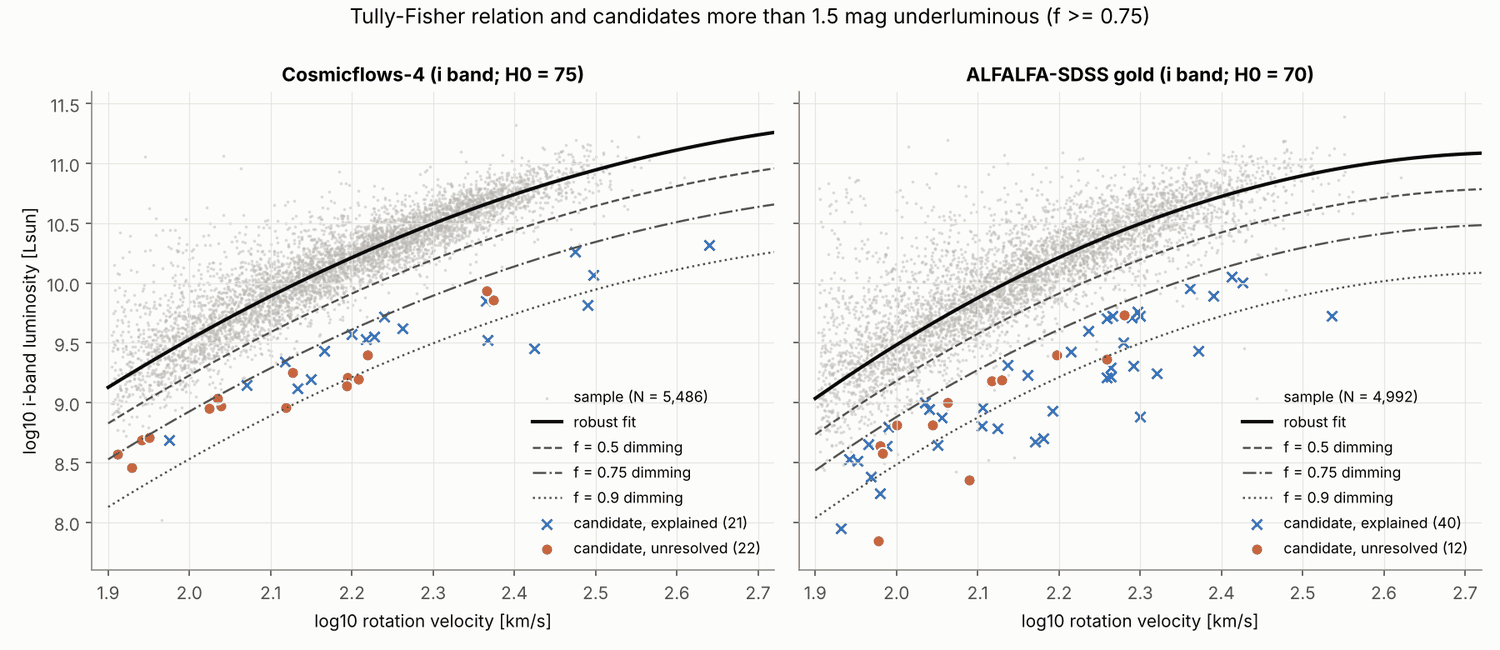
Residual. Distances come from redshift, not from the TF relation, because a TF distance would absorb the signal. For each catalogue and band I fit luminosity against log V with a sigma-clipped quadratic (Figure 1). The scatter is 0.145 dex (i) and 0.155 dex (W1) in CF4, and 0.197 and 0.203 dex in ALFALFA-SDSS. The statistic D is the residual in the least under-luminous available band, so a photometric failure in one band cannot create a candidate where two bands exist. A galaxy is a candidate for harvested fraction f when D < log10(1-f): -0.30, -0.60 and -1.00 dex for f = 0.5, 0.75 and 0.9.
Vetting. Stage 1 uses catalogue flags, applied identically to every galaxy: a same-redshift SDSS spectroscopic galaxy 20 to 120 arcsec away (5.2% of the sample), a second a.100 detection within 4 arcmin (4.5%), an HI centroid more than 40 arcsec from the optical counterpart (5.8%), a width error above 20 km/s (5.4%), or a same-velocity SIMBAD galaxy within 5 arcmin (22.6%). 6,689 galaxies (71%) pass. Stage 2 uses SDSS DR16 cones (a spectroscopic neighbour in the beam, or a counterpart redshift that disagrees with the HI) and, for ALFALFA-only galaxies, my own aperture photometry on Legacy Survey images. The aperture magnitude is accepted only when the measured segment is centred within 6 arcsec of the target and less than 20% masked. Stage 3 is a blind by-eye classification of 135 contact-sheet images. It is not used for the primary limits, because it did not separate candidates from controls (section 4.3).
Effective sample. A galaxy with residual D0 would be pushed below the threshold by dimming only if D0 < 0. The effective sample is the sum, over catalogue-clean galaxies with D0 < 0 (3,223), of three factors: a selection weight (1 if, after dimming, both the apparent magnitude and the mean surface brightness stay within the 98th percentile of the galaxy's own catalogue, else 0); the stage-2 survival rate of clean control galaxies (0.995, from 210 controls); and, for ALFALFA-only galaxies, the probability of not being excused by the aperture check, measured on 248 magnitude-matched controls (0.89, 0.86 and 0.82 for the three f). The limit is the classical 95% Poisson upper limit on the unresolved count divided by this sum, with no background subtraction.
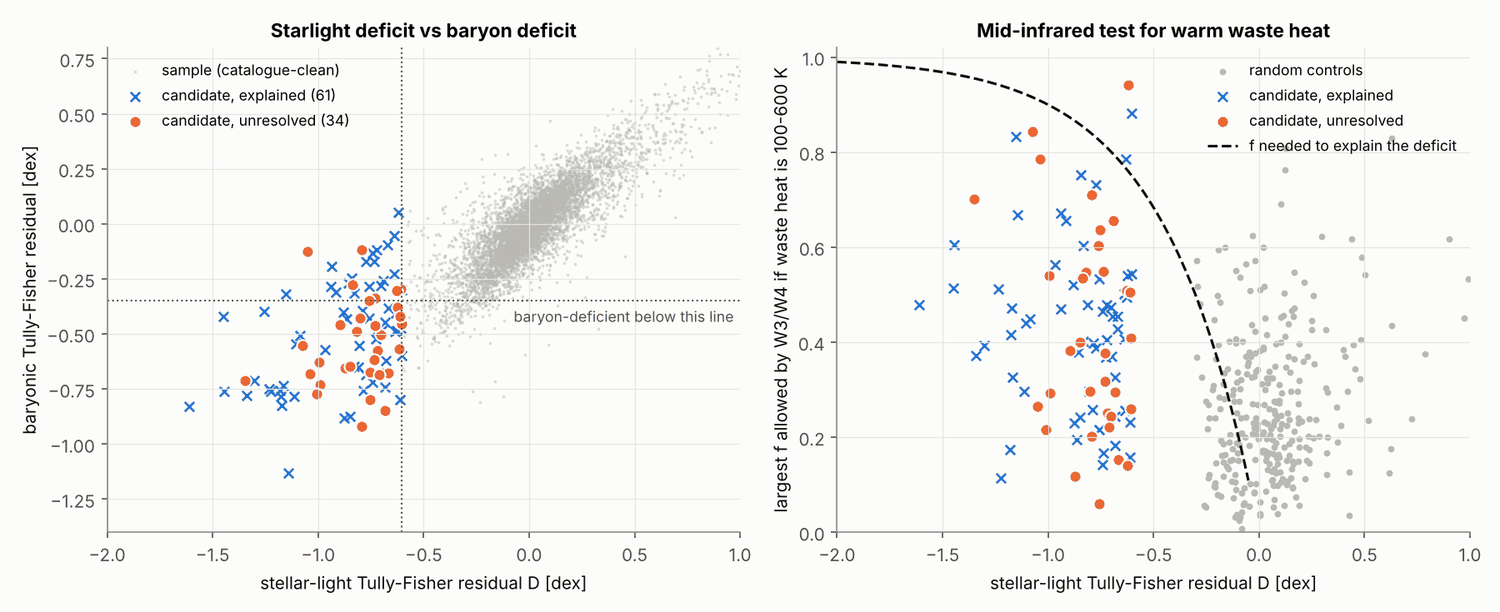
Waste-heat temperature. Warm waste heat adds flux at 3.4 microns and can lift the W1 residual. For each galaxy I add to the W1 residual the shift log10[1 + f/(1-f) x B(3.4 um, T) x L_bol / nuL_nu(W1)], with L_bol = 2.0 x nuL_nu(i) (an assumption) and B the blackbody nuL_nu at 3.4 microns as a fraction of the bolometric power, then recount the effective sample. Separately, W3 and W4 fluxes (with a factor 2.5 allowance for extended emission) cap the waste heat each candidate can emit at each temperature.
Closed accounting. For the HI-selected subsample the selection model can be bypassed. Every broad-line HI source in the SDSS footprint is either tested, or lacks usable photometry. The bound is the sum of the candidate fraction among tested galaxies (no selection weight) and the fraction of the parent sample without usable photometry, each taken at 97.5% confidence.
Clustering. Galaxies beyond 60 Mpc are tiled into groups of at least 5 within radius R. A group is flagged when its median residual is below -0.20 dex. A permutation null gives the expected number, and an injection test (dim every member by 50%, then remove members that would leave the catalogue) gives the efficiency.
4. Results
4.1 Funnel
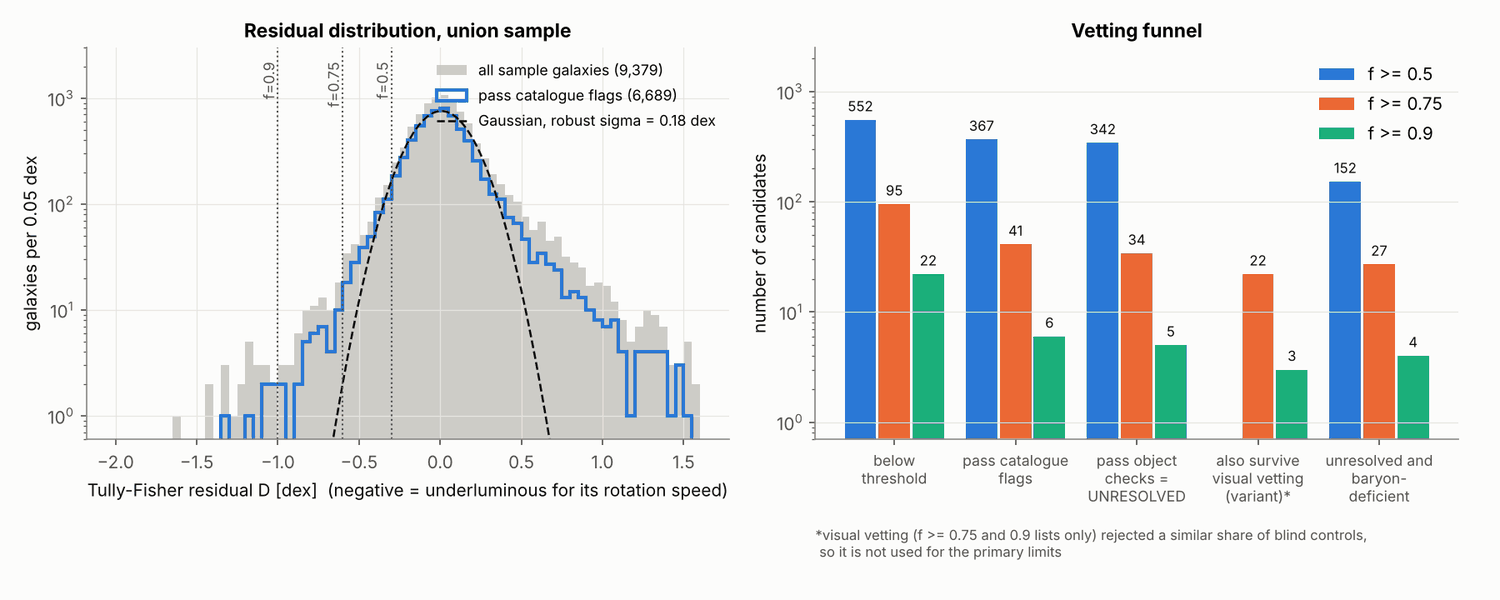
| f >= 0.5 | f >= 0.75 | f >= 0.9 | |
|---|---|---|---|
| Threshold (dex) | -0.30 | -0.60 | -1.00 |
| Raw candidates | 552 | 95 | 22 |
| After stage 1 (catalogue flags) | 367 | 41 | 6 |
| After stage 2 = unresolved (primary) | 342 | 34 | 5 |
| ... of which baryon-deficient | 152 | 27 | 4 |
| ... of which without an a.100 detection | 117 | 11 | 2 |
| After visual vetting (variant only) | not done | 22 | 3 |
Of the 95 candidates at f >= 0.75, 54 carry a catalogue flag, 7 are explained by a catalogue magnitude that is too faint, and 34 are unresolved.
4.2 Limits
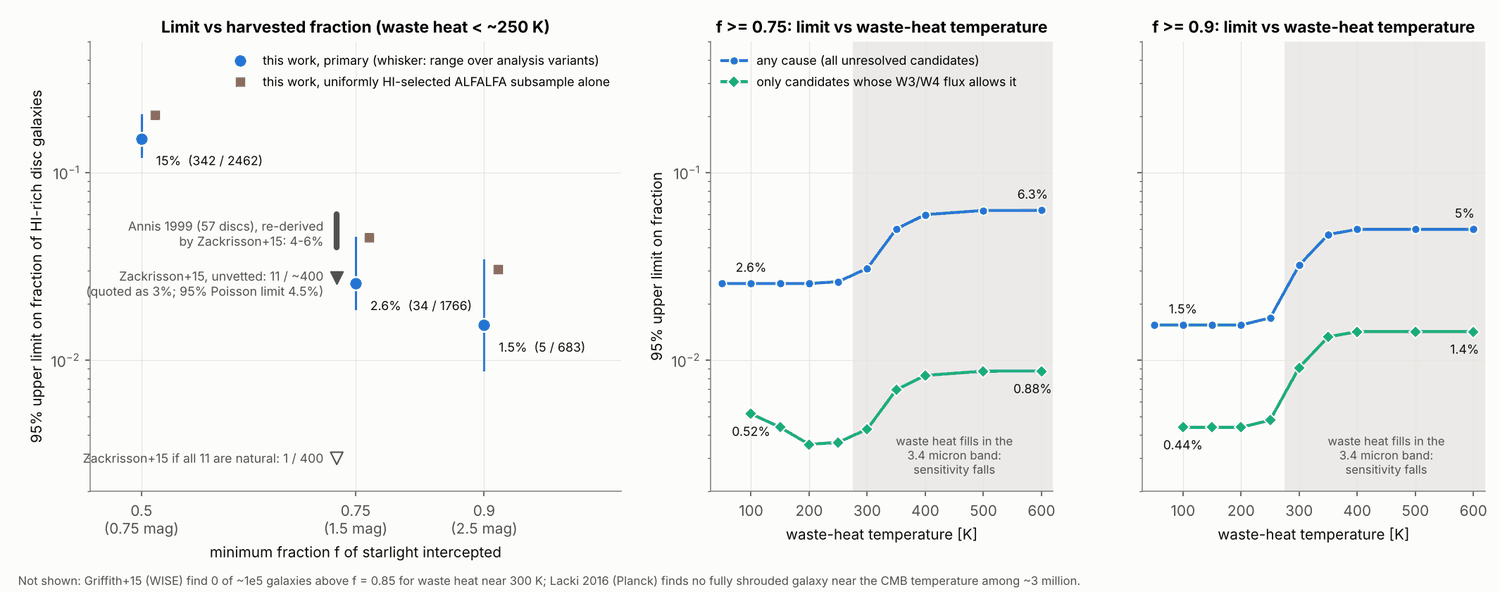
| Case | f >= 0.75: n / N_eff, limit | f >= 0.9: n / N_eff, limit |
|---|---|---|
| Primary (stages 1 and 2) | 34 / 1,766, 2.6% | 5 / 683, 1.5% |
| With visual vetting | 22 / 1,325, 2.4% | 3 / 512, 1.5% |
| Baryon-deficient candidates only | 27 / 1,390, 2.7% | 4 / 661, 1.4% |
| V >= 120 km/s | 20 / 1,680, 1.7% | 4 / 678, 1.4% |
| V < 120 km/s | 14 / 87, 25% | 1 / 5, 92% |
| CF4 members | 22 / 1,593, 2.0% | 3 / 617, 1.3% |
| ALFALFA-only members | 12 / 173, 11% | 2 / 66, 9.5% |
| ALFALFA gold alone (uniform HI selection) | 21 / 672, 4.5% | 2 / 206, 3.1% |
| CF4 outside ALFALFA gold | 13 / 1,095, 1.9% | 3 / 477, 1.6% |
| Selection limit at 95th percentile | 34 / 1,311, 3.5% | 5 / 307, 3.4% |
| Selection limit at 99.5th percentile | 34 / 2,226, 2.0% | 5 / 1,185, 0.9% |
| No aperture check | 41 / 1,796, 3.0% | 6 / 698, 1.7% |
| No SIMBAD flag | 47 / 2,057, 2.9% | 8 / 797, 1.8% |
| Running-median TF relation | 43 / 1,780, 3.1% | 5 / 682, 1.5% |
| Visual vetting at its 95% lower efficiency | 22 / 1,027, 3.1% | 3 / 397, 2.0% |
| No vetting at all | 95 / 2,476, 4.6% | 22 / 950, 3.3% |
| Closed accounting, ALFALFA gold, W50 >= 120 km/s | 4.1% | 2.5% |
| Closed accounting, W50 >= 200 km/s | 3.3% | 1.7% |
| For reference, if all candidates are natural (n = 0) | 0.17% | 0.44% |
The effective sample is 18.8% of the 9,379 galaxies at f >= 0.75 and 7.3% at f >= 0.9. At f >= 0.5 the primary limit is 15% (342 / 2,463; variants 12% to 20%). The observed unresolved fractions are 1.9% and 0.7%; the limits are 95% upper bounds on these.
4.3 Visual vetting did not discriminate
Visual inspection would excuse 12 of the 34 unresolved candidates (companion, merger, superposed star or ambiguous counterpart), but it excuses 7 of 28 clean control galaxies in the same way (35% against 25%; Fisher exact p = 0.42). The candidates do not look different from ordinary galaxies at a level this test can show, so visual classes are reported in the candidate table but not used to remove anything.
4.4 Rotation velocity
All of the power is at V >= 120 km/s. Below that, 14 unresolved candidates sit in an effective sample of 87, because the scatter of the stellar TF relation reaches 0.3 to 0.35 dex in gas-dominated dwarfs.
4.5 Temperature
| Waste-heat temperature | f >= 0.75: N_eff kept, limit | f >= 0.9: N_eff kept, limit |
|---|---|---|
| 200 K or cooler | 100%, 2.6% | 100%, 1.5% |
| 250 K | 98%, 2.6% | 92%, 1.7% |
| 300 K | 83%, 3.1% | 48%, 3.2% |
| 350 K | 51%, 5.0% | 33%, 4.7% |
| 400 K | 43%, 6.0% | 31%, 5.0% |
| 500 to 600 K | 41%, 6.3% | 31%, 5.0% |
Above 400 K only galaxies with i-band photometry contribute. If the waste heat is assumed to be at a given temperature between 100 and 600 K, the W3 and W4 fluxes rule out most candidates: 2 to 4 of 34 remain possible at f >= 0.75 (limit 0.4% to 0.9%) and none of 5 at f >= 0.9 (0.4% to 1.4%). These warm-case limits are weaker than the mid-infrared surveys of Griffith et al. (2015) and add nothing to them.
4.6 The 34 unresolved candidates
Bold marks the five that also pass f >= 0.9. cz and widths in km/s. "a.100" says whether an ALFALFA detection exists; where it does not, the width comes from a larger beam and the 5 arcmin confusion search is too small. Visual class: N normal isolated disc, L low surface brightness, E edge-on, C comparable companion in the beam, M merger or disturbed, S superposed star, X ambiguous counterpart.
| # | Galaxy | RA, Dec (deg) | cz | W ± err | V | Bands | D | r_bar | a.100 | Vis. |
|---|---|---|---|---|---|---|---|---|---|---|
| 1 | AGC 229291 | 188.731, +29.037 | 2841 | 163 ± 2 | 95 | i+W1 | -1.35 | -0.71 | yes | X |
| 2 | AGC 103316 | 3.254, +22.104 | 6478 | 197 ± 6 | 123 | i+W1 | -1.07 | -0.55 | yes | C |
| 3 | ESO 575-009 | 192.870, -21.913 | 4817 | 312 ± 16 | 156 | i+W1 | -1.05 | -0.13 | no | E |
| 4 | PGC 3091794 | 31.130, +6.636 | 3365 | 258 ± 5 | 161 | i | -1.04 | -0.68 | yes | N |
| 5 | UGC 3741 | 108.448, +50.257 | 5404 | 544 ± 19 | 308 | W1 | -1.01 | -0.77 | no | N |
| 6 | SDSS J112331.25-011539.8 | 170.880, -1.261 | 5709 | 255 ± 20 | 132 | i | -0.99 | -0.63 | no | C |
| 7 | PGC 86799 | 38.360, +30.858 | 5047 | 287 ± 12 | 157 | i | -0.99 | -0.73 | yes | C |
| 8 | UGC 3626 | 105.674, +70.971 | 3276 | 300 ± 12 | 153 | W1 | -0.90 | -0.46 | no | S |
| 9 | ESO 540-010 | 9.893, -20.384 | 4029 | 295 ± 20 | 166 | i+W1 | -0.87 | -0.66 | no | N |
| 10 | AGC 183095 | 123.620, +25.279 | 4671 | 197 ± 6 | 111 | i+W1 | -0.85 | -0.65 | yes | N |
| 11 | AGC 112351 | 16.770, +31.396 | 6282 | 159 ± 2 | 96 | i+W1 | -0.83 | -0.28 | yes | L |
| 12 | 2MASX J02260178+2051373 | 36.507, +20.860 | 10209 | 442 ± 10 | 237 | i | -0.82 | -0.49 | yes | C |
| 13 | AGC 125085 | 37.827, +20.161 | 8759 | 266 ± 5 | 157 | i+W1 | -0.80 | -0.43 | yes | L |
| 14 | AGC 6569 | 173.964, +17.447 | 3311 | 208 ± 15 | 135 | i+W1 | -0.79 | -0.92 | yes | N |
| 15 | AGC 123169 | 40.574, +29.677 | 5176 | 163 ± 8 | 85 | i | -0.79 | -0.12 | yes | L |
| 16 | AGC 123139 | 35.266, +29.401 | 5277 | 195 ± 16 | 95 | i+W1 | -0.76 | -0.35 | yes | M |
| 17 | ESO 418-011 | 53.570, -30.733 | 5455 | 578 ± 20 | 378 | W1 | -0.76 | -0.80 | no | N |
| 18 | AGC 320380 | 342.128, +31.781 | 3826 | 200 ± 15 | 131 | i+W1 | -0.75 | -0.67 | yes | N |
| 19 | AGC 101840 | 11.862, +31.151 | 5294 | 187 ± 8 | 116 | i+W1 | -0.74 | -0.62 | yes | L |
| 20 | PGC 36249 | 175.255, +5.256 | 9412 | 464 ± 7 | 232 | i | -0.73 | -0.46 | yes | C |
| 21 | AGC 102815 | 13.336, +31.712 | 7342 | 217 ± 5 | 134 | i | -0.73 | -0.34 | yes | C |
| 22 | UGC 12795 | 357.294, +46.553 | 4672 | 404 ± 20 | 219 | W1 | -0.72 | -0.57 | no | N |
| 23 | AGC 213240 | 165.369, +11.889 | 7959 | 357 ± 17 | 191 | i+W1 | -0.71 | -0.69 | yes | C |
| 24 | PGC 1495086 | 204.553, +15.863 | 4515 | 212 ± 13 | 109 | i | -0.70 | -0.50 | yes | C |
| 25 | PGC 166736 | 331.051, +36.899 | 5884 | 275 ± 18 | 172 | W1 | -0.69 | -0.68 | no | M |
| 26 | IC 1491 | 352.353, -16.317 | 3435 | 242 ± 20 | 144 | W1 | -0.68 | -0.85 | no | N |
| 27 | PGC 1434312 | 345.820, +13.563 | 3604 | 210 ± 17 | 106 | i | -0.67 | -0.68 | yes | N |
| 28 | AGC 731635 | 169.973, +24.388 | 4640 | 176 ± 9 | 89 | i | -0.63 | -0.30 | yes | N |
| 29 | PGC 1736432 | 174.062, +25.435 | 3165 | 171 ± 5 | 108 | i | -0.62 | -0.38 | yes | N |
| 30 | AGC 728360 | 192.578, +32.547 | 6887 | 281 ± 8 | 182 | i+W1 | -0.62 | -0.57 | yes | N |
| 31 | AGC 205891 | 150.147, +33.937 | 5043 | 157 ± 3 | 100 | i+W1 | -0.61 | -0.42 | yes | L |
| 32 | PGC 2271763 | 137.861, +45.874 | 3375 | 143 ± 16 | 87 | i | -0.61 | -0.42 | no | L |
| 33 | SDSS J115503.88+190459.8 | 178.766, +19.083 | 3880 | 132 ± 5 | 82 | i | -0.61 | -0.29 | yes | L |
| 34 | PGC 91654 | 290.260, +54.815 | 4387 | 185 ± 17 | 92 | W1 | -0.60 | -0.46 | no | E |
None of these is a strong candidate. Fourteen have V < 120 km/s,
15 have width errors of 15 km/s or more, 11 have no ALFALFA detection,
and only 14 are measured in both bands. Notes on the five at f >=
0.9: AGC 229291 has an ambiguous counterpart (two compact sources on a
faint streak). AGC 103316 is a blue low-surface-brightness spiral next
to a red early-type galaxy. ESO 575-009 is an 87-degree edge-on disc
with a normal baryonic mass (r_bar = -0.13), so it is gas-rich and
probably dust-dimmed, not star-poor. UGC 3741 has a same-velocity galaxy
(Z 234-108) 8.6 arcmin away, within reach of the larger single-dish
beams that supplied CF4 widths outside ALFALFA; the referee places it at
the core of Abell 569. PGC 3091794 (AGC 124237) is the cleanest: an
isolated galaxy with a compact bulge and a faint extended disc, an
ALFALFA detection at S/N 30 with W50 = 264 ± 4 km/s, and only one band
(i). Its inclination of 53 degrees rests on the faint disc; a wrong
inclination, or a bulge-dominated system with an extended HI disc, are
the ordinary explanations. It is the best single follow-up target. Full
details are in data/unresolved_candidates.csv and
data/candidates_final.csv.
4.7 Galaxies too dim to be in the catalogues
A fully harvested galaxy (f above about 0.99) would show HI rotation and no optical counterpart. Of 25,434 code-1 a.100 sources, 344 (1.35%) have no counterpart, and 55% of those lie within 300 kpc and 300 km/s of an a.100 galaxy. Among broad-line sources (W50 >= 200 km/s, S/N >= 10, distance >= 40 Mpc) there are 6 of 5,237 without a counterpart (95% limit 0.23%), and 2 that are also isolated (0.12%). This matches the ALFALFA team's own findings: fewer than 2% of sources lack a feasible counterpart (Haynes et al. 2011), about three quarters of those are probably tidal debris (Cannon et al. 2015), and the best-studied "almost dark" objects are narrow-line dwarfs or tidal features (Janowiecki et al. 2015; Leisman et al. 2017, 2021; Kent et al. 2007). Griffith et al. (2015) searched optically dark HI galaxies for mid-infrared emission and found none.
"No counterpart" is not the only place a dimmed disc could hide. In the SDSS footprint, 4,916 sources pass the broad-line cuts. 4,837 have usable photometry; 35 have a counterpart but bad or no SDSS photometry; 6 have no counterpart; and 38 have good photometry but no W1 mass (34 of these are inclined enough to test in i alone, and 2 are 1.5 mag or more under-luminous: AGC 123026 and AGC 193880). So at most 43 of 4,916 (0.87%; 95% limit 1.13%) could be hidden harvested discs. I inspected the 35 sources with bad photometry by eye: 33 are ordinary bright galaxies whose photometry failed because of size, a bright star or a field edge, 1 is low surface brightness (AGC 257946) and 1 is ambiguous (AGC 227926). For W50 >= 120 km/s the same accounting gives 131 of 7,811 (1.68%; limit 1.94%), not inspected. The range f = 0.9 to 0.99 is covered only by this accounting and by the small f >= 0.9 effective sample.
4.8 Clustering
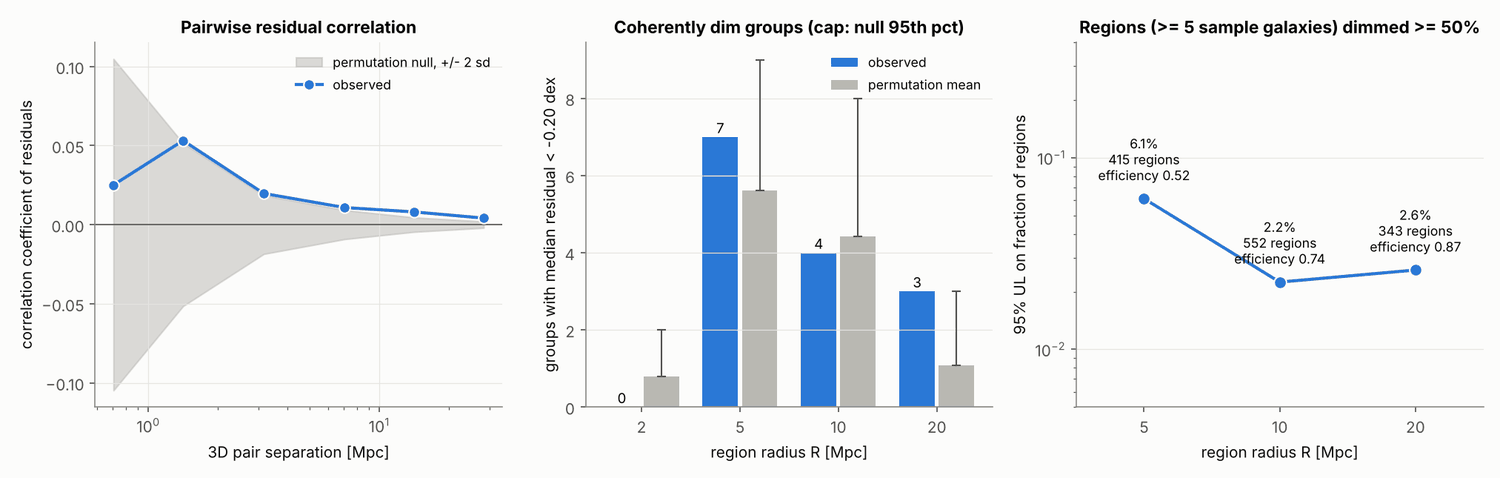
| R (Mpc) | Groups | Flagged | Expected | p | Efficiency (without selection loss) | 95% limit on dimmed regions |
|---|---|---|---|---|---|---|
| 5 | 415 | 7 | 5.6 | 0.35 | 0.52 (0.84) | 6.1% |
| 10 | 552 | 4 | 4.4 | 0.65 | 0.74 (0.92) | 2.2% |
| 20 | 343 | 3 | 1.1 | 0.10 | 0.87 (0.93) | 2.6% |
No scale shows an excess of dim groups. The limits refer to regions that contain at least 5 sample galaxies, dimmed uniformly by 50% or more; they are not limits on arbitrary volumes. R = 2 Mpc (44 groups, efficiency 0.36) is below the redshift-space smearing scale and is not meaningful. Pair correlations of the residuals are weakly positive (+0.020 ± 0.009 at 2 to 5 Mpc, +0.004 ± 0.001 at 20 to 40 Mpc), and the HI-mass residuals, which harvesting cannot affect, correlate more strongly (+0.15 and +0.02), so the signal is a distance or environment systematic.
5. Robustness checks
- Sample cuts (
data/robustness.csv). The fraction of galaxies below -0.6 dex is 1.4% in the baseline gold sample, 0.8% for S/N >= 15, 1.0% for b/a <= 0.5, 3.9% for S/N >= 6.5; in CF4 it is 0.56%, and 0.43% for the best photometry grade. - Fit form. With a 15-bin running median in place of the quadratic, catalogue-clean galaxies below -0.6 dex go from 41 to 50 and below -1.0 dex from 6 to 7. Propagated through the whole chain the limits become 3.1% and 1.5%.
- Aperture check. Among 248 ALFALFA-only controls the segment is centred for 68% to 88% depending on magnitude; the catalogue-minus-aperture scatter is 0.12 to 0.19 mag; no centred control is wrong by more than 1 mag.
- CF4 curation. Among 3,123 ordinary ALFALFA gold galaxies, the fraction that CF4 includes falls from 0.77 at i < 14 to 0.56 at i = 16.5 to 17 and 0.47 at 17 to 17.5, and from 0.78 at mean surface brightness 21 to 21.5 to 0.57 at 22.5 to 23 and 0.29 at 23 to 23.5. CF4 does de-select faint, diffuse galaxies, gradually; the 98th-percentile cut is a step-function stand-in for this.
- Axis ratio. The fraction of HI-selected galaxies passing b/a <= 0.70 does not fall with faintness down to i = 18 (0.67 to 0.84), so dimming would not move a disc out of the tested set through the inclination cut.
- Tail symmetry. For V >= 150 km/s the faint tail (95 galaxies) is no larger than the mirrored bright tail (109).
6. Limitations
- Selection of dimmed galaxies is modelled. CF4 was assembled by people choosing galaxies suitable for distance work. Its efficiency for a dimmed disc is unmeasured outside the ALFALFA footprint; I use a magnitude and surface-brightness cut and vary it. This is the largest systematic.
- The closed accounting has loopholes. It assumes the HI was assigned to the right optical galaxy (a harvested host next to a brighter galaxy could be mis-assigned and look normal; the 40 arcsec offset flag only partly covers this), and only the W50 >= 200 km/s parent was inspected.
- Low-mass galaxies are not constrained (V < 120 km/s), and neither are gas-poor galaxies (ellipticals, lenticulars), which have no HI width.
- Temperature. The fill-in calculation assumes a single-temperature blackbody and L_bol = 2 x nuL_nu(i).
- Uniform dimming is assumed. Harvesting only the outer disc or only low-mass stars changes colours and sizes in ways not modelled.
- Fit form changes the candidate count by about 20% (41 against 50).
- Hand-entered inputs: 135 visual classes (variant only), 35 by-eye classes of sources with bad photometry, notes on 9 dark sources. The classes are mine, from single images.
- The 34 candidates are not followed up. Resolved HI maps or optical rotation curves would settle most of them.
7. Closest prior work and what is new
Annis (1999) introduced the method with 57 discs and found no outlier at 1.5 mag; Zackrisson et al. (2015) re-derive that as a limit of 4% to 6%. Zackrisson et al. (2015, arXiv:1508.02406) used 1,359 SFI++ discs: 11 candidates, about 400 galaxies that would have stayed in the sample, hence "about 3%" (a 95% Poisson limit of 4.6%), and 0.3% if all 11 are natural. Griffith et al. (2015, arXiv:1504.03418) find no galaxy among about 100,000 with more than 85% of its starlight re-radiated in the mid-infrared. Lacki (2016, arXiv:1604.07844) uses Planck to exclude galaxies veiled by a screen just above the CMB temperature among about 3 million galaxies, and roughly 1 in 30,000 for a screen that absorbs 10%; for that temperature regime this is far stronger than anything here. Curtis et al. (2026, arXiv:2608.12458) propose, but do not perform, a stellar-to-dynamical-mass screen.
Before vetting, my outlier rate (95 / 2,476 = 3.8%) is no lower than Zackrisson's (11 / 400 = 2.8%), and the 95% limits are the same, 4.6%. The larger sample by itself gains nothing, because the count is dominated by ordinary outliers. The improvement to 2.6% comes entirely from vetting with data they did not have. What is new: (a) seven times more galaxies, with catalogue-level vetting of every outlier and efficiencies measured on controls; (b) a limit at f >= 0.9 from this method; (c) the dependence of a TF limit on waste-heat temperature; (d) a closed accounting of an HI-selected parent sample, including sources without usable photometry; (e) a clustering test on 5 to 20 Mpc scales. I am moderately confident that (c), (d) and (e) have not been done; I could not search the full literature.
8. Implications for the Fermi paradox
Fewer than about 1 in 40 HI-rich disc galaxies (1 in 58 for V >= 120 km/s) can have 75% of their starlight intercepted, and fewer than about 1 in 65 (1 in 74) can have 90% intercepted, if the waste heat is cooler than about 250 K. This tightens the Zackrisson et al. Poisson limit by a factor of about 1.8 at f >= 0.75, and it is weaker than their optimistic 0.3%. It does not close any loophole by itself: mid-infrared surveys already exclude warm waste heat far more strongly, and Lacki (2016) excludes galaxy-wide screens near the CMB temperature far more strongly. The contribution is in the gap between them, mostly harvested discs (f of 0.75 to 0.9) whose waste heat emerges in the far-infrared, where this is the only direct limit and it is at the per-cent level. A model of galaxy-spanning expansion should take from this study a ceiling of about 2% to 3% on mostly harvested, massive, HI-rich disc galaxies in that regime, should not use the 0.17% "if all are natural" figure as a measurement, and should note that civilisations harvesting less than half the starlight, dwarf galaxies and gas-poor galaxies are not constrained (15% at f >= 0.5). No candidate here is evidence for harvesting; the sample has the outlier rate expected from confusion, distance errors, dust and low surface brightness.
9. Reproducibility and status
python3 code/run_all.py regenerates every table and
figure (2 minutes with a warm cache in raw/; about an hour
from a cold cache, limited by remote services). The numbers in this
report are from the run of 2026-10-12.
10. Response to referee
- Write a real report; remove statements that it does not exist. This text is that report, with every cut, the funnel, the candidate list and the dark-source literature.
- Aperture-photometry rescue. Accepted. The aperture magnitude is now used only when the segment is centred within 6 arcsec and less than 20% masked. On re-inspection AGC 320380 (aperture had measured a bright star's halo), AGC 112351 (merged with a star), AGC 123139 (segment 8.5 arcsec off, disturbed pair) and AGC 103316 (merged with a neighbour) return to unresolved. AGC 102806 stays explained: it is a real edge-on low-surface-brightness disc whose catalogue magnitude (18.85) is 2.6 mag fainter than a centred aperture (16.27). The step's efficiency, measured on 248 magnitude-matched controls (200 newly downloaded), is folded into the effective sample.
- Surface-brightness selection; CF4 curation; gold subsample. Accepted. A surface-brightness term is added for both catalogues (SDSS DR16 Petrosian radii were downloaded for the ALFALFA galaxies). CF4 curation is stated as unmeasured outside ALFALFA, and its dependence on magnitude and surface brightness inside ALFALFA is shown (section 5). The gold subsample is reported separately (4.5% and 3.1%), with a closed-accounting bound.
- Headline. Changed. The referee suggested about 2.3% (2.0% to 2.9%) and 1.4% (0.9% to 1.8%). I obtain 2.6% (1.9% to 3.5%) and 1.5% (0.9% to 3.4%). Mine are slightly weaker because visual vetting is no longer used and the aperture efficiency and ALFALFA surface-brightness term are included; the ranges are wider because the selection percentile matters more than the referee allowed for. "1 in 55 / 1 in 110" is replaced by "1 in 40 / 1 in 65".
- Temperature. Accepted, and the correction is larger than the referee proposed: full strength holds only below about 250 K, not 300 K. The 0.49% and 0.35% figures for 350 to 600 K are withdrawn; the recomputed numbers are in section 4.5.
- V >= 120 km/s. Accepted; stated in the summary with stratified numbers. I keep the pooled number as primary because it is the more conservative one.
- Zackrisson comparison; Lacki 2016. Accepted. The unvetted limits are stated as identical and the gain attributed to vetting; the Lacki 3-million-galaxy result is cited and the "closes the cold loophole" claim is withdrawn.
- Visual vetting. Accepted. The no-visual-vetting result is primary; the report states that visual vetting did not separate candidates from controls (12 of 34 against 7 of 28).
- Dark sources. Accepted. The 35 broad-line sources with unusable photometry are reported and inspected, the weak coverage of f = 0.9 to 0.99 is stated, and Griffith et al. (2015) is cited.
- Clustering. Accepted. Selection loss is applied in the injection (efficiencies fall from 0.84 to 0.93 down to 0.52 to 0.87), R = 2 Mpc is dropped as not meaningful, and the limit is described as applying to regions with at least 5 sample galaxies.
- Fit-form sensitivity. Accepted; added to robustness and limitations (41 against 50), and propagated as a variant.
- Minor. The 3 dropped CF4 rows are stated. The large-beam caveat is in the candidate table.
Where I disagree. The referee wrote that all three first-pass f >= 0.9 survivors are large-beam width cases. That is right for UGC 3741 and ESO 575-009 but not for PGC 3091794, which is AGC 124237 in a.100 (S/N 30, W50 = 264 ± 4 km/s from the 3.5 arcmin Arecibo beam), with no flagged neighbour within 10 arcmin. It remains the cleanest unresolved object. The referee's suggested headline range is also too narrow (point 4). Nothing else in the referee report is rejected.
Key numbers
| Quantity | Value | Uncertainty | Note |
|---|---|---|---|
| Union sample size | 9,379 unique disc galaxies | 7,619 Cosmicflows-4 (CF4) + 1,760 ALFALFA-SDSS-only; 3,215 with both i and W1, 4,031 i only, 2,133 W1 only; 6,689 pass catalogue flags | |
| Vetting funnel, f >= 0.75 (D < -0.60 dex) | 95 raw -> 41 after catalogue flags -> 34 unresolved | 54 carry a catalogue flag, 7 explained by a too-faint catalogue magnitude (centred aperture photometry), 34 unresolved; 27 of the 34 are also baryon-deficient, 11 have no ALFALFA detection, 14 have V < 120 km/s | |
| Vetting funnel, f >= 0.9 (D < -1.00 dex) | 22 raw -> 6 -> 5 unresolved | AGC 229291, AGC 103316, ESO 575-009, PGC 3091794, UGC 3741 | |
| Vetting funnel, f >= 0.5 (D < -0.30 dex) | 552 raw -> 367 -> 342 unresolved | not constraining | |
| Effective sample N_eff (f >= 0.5 / 0.75 / 0.9) | 2,463 / 1,766 / 683 | 1,311-2,226 and 307-1,185 for selection limits at the 95th-99.5th percentile | 18.8% and 7.3% of the sample at f >= 0.75 and 0.9; includes magnitude and surface-brightness selection, stage-2 efficiency 0.995 and aperture-check efficiency 0.86 / 0.82 for ALFALFA-only galaxies |
| PRIMARY 95% upper limit, f >= 0.75, waste heat cooler than ~250 K | 2.6% (34 / 1,766) | analysis variants 1.9%-3.5%; ALFALFA gold subsample alone 4.5% | classical Poisson limit, every unresolved candidate counted as real, no visual vetting; observed fraction 1.9% |
| PRIMARY 95% upper limit, f >= 0.9, waste heat cooler than ~250 K | 1.5% (5 / 683) | analysis variants 0.9%-3.4%; ALFALFA gold subsample alone 3.1% | observed fraction 0.7% |
| 95% upper limit, f >= 0.5 | 15% (342 / 2,463) | variants 12%-20% | method not constraining |
| Limits for V >= 120 km/s only | 1.7% (20 / 1,680) for f >= 0.75; 1.4% (4 / 678) for f >= 0.9 | V < 120 km/s: 14 / 87 -> 25% and 1 / 5 -> 92%, i.e. no power | |
| ALFALFA gold subsample alone (uniform HI selection) | 4.5% (21 / 672) for f >= 0.75; 3.1% (2 / 206) for f >= 0.9 | CF4 outside gold: 1.9% (13 / 1,095) and 1.6% (3 / 477) | |
| Closed-accounting bound, ALFALFA gold (no optical selection model) | f >= 0.75: 4.1% (W50 >= 120 km/s parent), 3.3% (W50 >= 200), 2.5% (W50 >= 200 after by-eye inspection); f >= 0.9: 2.5%, 1.7%, 0.9% | sum of two 97.5% limits: candidate fraction among tested galaxies plus fraction of HI-selected parent without usable photometry | |
| With visual vetting (variant only) | 2.4% (22 / 1,325) for f >= 0.75; 1.5% (3 / 512) for f >= 0.9 | visual vetting did not separate candidates from controls: it would excuse 12 of 34 candidates vs 7 of 28 clean controls (Fisher p = 0.42) | |
| No vetting at all (compare Zackrisson et al. 2015) | 95 / 2,476 = 3.8%, 95% limit 4.6% | Zackrisson: 11 / ~400 = 2.8%, 95% Poisson limit 4.6%; identical limits, so the gain to 2.6% is from vetting | |
| Limit vs waste-heat temperature, f >= 0.75 | 2.6% (<= 250 K), 3.1% (300 K), 5.0% (350 K), 6.0% (400 K), 6.3% (500-600 K) | N_eff retained 98%, 83%, 51%, 43%, 41%; assumes blackbody and L_bol = 2 x nuLnu(i) | |
| Limit vs waste-heat temperature, f >= 0.9 | 1.5% (<= 200 K), 1.7% (250 K), 3.2% (300 K), 4.7% (350 K), 5.0% (>= 400 K) | N_eff retained 92% at 250 K, 48% at 300 K, 31% above 400 K | |
| If waste heat is assumed at a given T in 100-600 K (W3/W4 test) | 2-4 of 34 candidates allowed -> 0.4%-0.9% (f >= 0.75); 0 of 5 -> 0.4%-1.4% (f >= 0.9) | weaker than existing mid-infrared surveys; first-pass 0.49% / 0.35% withdrawn | |
| Running-median TF relation instead of clipped quadratic | 3.1% (43 / 1,780) and 1.5% (5 / 682) | catalogue-clean galaxies below -0.6 dex: 41 vs 50; below -1.0 dex: 6 vs 7 | |
| Sensitivity floor if every candidate is natural | 0.17% (f >= 0.75), 0.44% (f >= 0.9) | not a measurement | |
| TF scatter (robust, dex) | CF4 0.145 (i), 0.155 (W1); ALFALFA-SDSS 0.197 (i), 0.203 (W1) | N = 5,486 / 3,588 / 4,992 / 4,992 | |
| ALFALFA sources without optical counterpart | 344 of 25,434 code-1 sources (1.35%); broad-line (W50 >= 200, S/N >= 10, D >= 40 Mpc): 6 of 5,237, 95% limit 0.23%; isolated: 2, limit 0.12% | 55% of the 344 lie within 300 kpc and 300 km/s of an a.100 galaxy | |
| HI-parent accounting, W50 >= 200 km/s in SDSS footprint | 4,916 sources: 4,837 usable, 35 counterpart with bad/no photometry, 6 no counterpart, 38 good photometry but no W1 mass (2 of 34 testable are >= 1.5 mag low in i) | possibly hidden 43 = 0.87% (95% limit 1.13%) | by eye, 33 of the 35 are ordinary bright galaxies, 1 low surface brightness, 1 ambiguous; W50 >= 120 km/s: 131 of 7,811 = 1.68% (limit 1.94%), not inspected |
| Clustering: regions with >= 5 sample galaxies dimmed >= 50% | 95% limit 6.1% (R = 5 Mpc), 2.2% (10 Mpc), 2.6% (20 Mpc) | flagged 7 / 4 / 3 groups vs 5.6 / 4.4 / 1.1 expected (p = 0.35, 0.65, 0.10); injection efficiency with selection loss 0.52 / 0.74 / 0.87; R = 2 Mpc not meaningful | |
| CF4 inclusion of ordinary ALFALFA gold galaxies | 0.77 at i < 14, 0.56 at i = 16.5-17, 0.47 at 17-17.5; 0.78 at mu_i = 21-21.5, 0.57 at 22.5-23, 0.29 at 23-23.5 | CF4 curation de-selects faint, diffuse galaxies gradually; N = 3,123 | |
| Aperture-check controls | 248 ALFALFA-only controls; segment centred for 68%-88%; catalogue-minus-aperture scatter 0.12-0.19 mag | no centred control wrong by more than 1 mag |
Changes made after the referee report
- Not circumvented.
- Referee 2 (aperture rescue): aperture magnitudes are accepted only when the segment is centred within 6 arcsec and < 20% masked. AGC 320380 (aperture had measured a bright star's halo), AGC 112351 (merged with a star), AGC 123139 (segment off-centre, disturbed pair) and AGC 103316 (merged with a neighbour) return to unresolved; AGC 102806 stays explained (catalogue 18.85 vs centred aperture 16.27). The step's efficiency, measured on 248 magnitude-matched controls (200 newly downloaded), is folded into N_eff.
- Referee 3 (selection): a surface-brightness term was added for both catalogues (SDSS DR16 Petrosian radii downloaded for 4,992 ALFALFA galaxies); 95th and 99.5th percentile variants added; CF4 curation stated as unmeasured outside ALFALFA and its inclusion rate inside ALFALFA measured vs magnitude and surface brightness; ALFALFA gold subsample reported separately (4.5%, 3.1%) with a closed-accounting bound that needs no optical selection model.
- Referee 4 (headline): changed from 1.8% / 0.90% to 2.6% (variants 1.9-3.5%) and 1.5% (0.9-3.4%); '1 in 55 / 1 in 110' replaced by '1 in 40 / 1 in 65'.
- Referee 5 (temperature): per-galaxy W1 fill-in implemented and limits tabulated for 50-600 K. Full strength holds only below about 250 K (stricter than the referee's 300 K); 3.1% / 3.2% at 300 K, about 6% / 5% above 400 K. The 0.49% / 0.35% figures for 350-600 K are withdrawn and replaced by 0.4-0.9% and 0.4-1.4%.
- Referee 6 (rotation velocity): limits stated as valid for V >= 120 km/s, with strata V >= 120 (1.7%, 1.4%), V < 120 (25%, 92%) and V >= 150 (1.6%, 1.2%).
- Referee 7 (prior work): comparison reworded (unvetted limits identical at 4.6%; gain is from vetting); Lacki 2016 3-million-galaxy result added and the 'closes the cold waste-heat loophole' claim withdrawn.
- Referee 8 (visual vetting): the primary limits no longer use visual vetting; it is a variant, and the report states it did not separate candidates from controls (12 of 34 vs 7 of 28, p = 0.42).
- Referee 9 (dark sources): the 35 broad-line sources with a counterpart but unusable photometry are reported and were inspected (33 ordinary, 1 low surface brightness, 1 ambiguous); full accounting of the HI-selected parent added; weak coverage of f = 0.9-0.99 stated; Griffith et al. 2015 and the ALFALFA dark-source literature cited.
- Referee 10 (clustering): selection loss applied in the injection test (efficiencies 0.52 / 0.74 / 0.87 instead of 0.84 / 0.92 / 0.93); R = 2 Mpc dropped as not meaningful; limits described as applying to regions with at least 5 sample galaxies.
- Referee 11 (fit form): running-median relation added and propagated through the whole chain (3.1% and 1.5%); 41 vs 50 sensitivity stated in limitations.
- Minor: the 3 CF4 rows without coordinates are logged and stated; large-beam caveat attached to candidates without an ALFALFA detection; new outputs data/unresolved_candidates.csv, limits_vs_temperature.csv, hi_parent_accounting.csv, aperture_efficiency.csv, selection_limits.csv, cf4_membership.csv, ba_vs_magnitude.csv; figure 3 redrawn with variant ranges and a temperature panel.
- Full pipeline rerun end to end after the last functional change (exit 0, 2.0 min with warm cache); only comments and a docstring were edited afterwards.
Referee points not accepted
- 'All three f >= 0.9 survivors are large-beam width cases': true for UGC 3741 and ESO 575-009, false for PGC 3091794. It is AGC 124237 in a.100 (S/N 30, W50 = 264 +/- 4 km/s from the 3.5 arcmin Arecibo beam; CF4 flags its width as ALFALFA) with no flagged neighbour within 10 arcmin. It remains the cleanest unresolved object and the best follow-up target.
- The referee's suggested replacement headline (about 2.3% [2.0-2.9%] and 1.4% [0.9-1.8%]) is too optimistic and its ranges too narrow. With visual vetting removed (as the referee also asked) and the aperture efficiency and ALFALFA surface-brightness term included, the primary values are 2.6% and 1.5%, variants reach 3.5% and 3.4%, and the HI-selected subsample alone gives 4.5% and 3.1%.
- Restricting the headline to V >= 120 km/s: partly declined. The pooled V >= 80 km/s limit is kept as primary because it is the more conservative number and the stratification was chosen after seeing the data; the V >= 120 km/s limits are quoted alongside it.
Code
Every number above is produced by these scripts from public data. The data tables themselves are not hosted here; the scripts download them.
common.py run_all.py s01_download.py s02_build_alfalfa.py s03_fit_tf.py s04_xmatch.py s05_simbad.py s06_cf4.py s07_union.py s08_vet_download.py s09_aperture_phot.py s10_vet_table.py s11_dark.py s12_clustering.py s13_contact_sheets.py s14_limits.py s15_figures.py s16_robustness.py
Referee report
A second, separate analysis re-ran the code, recomputed the main numbers by its own route and tried to break the result. Like the first, it was run by Claude for this project; it is not an outside expert. In its report “the analyst” is the first analysis, which wrote the paper, and file names that are not linked on this page are its own working files. The paper above is the version revised in response.
Verdict: sound with fixes. Results reproduced: yes.
Full rerun of run_all.py in referee scratch (code copied, STUDY/RAW repointed, copy of the analyst's cache; 1.8 min): all 29 CSVs in data/ are byte-identical to the analyst's and the log matches apart from timings and download warnings. Fresh VizieR downloads of a.100, both Durbala tables and CF4 table 1 are byte-identical to the cached files. Not tested: cold-cache re-download of the 852 cones / ~1,000 cutouts and the SIMBAD re-query. Poisson arithmetic verified (UL95(20)=29.06 -> 1.82%; UL95(3)=7.75 -> 0.90%; 6/5,237 -> 0.23%). Independent route (own V_CMB, distances, and a 15-bin running-median TF instead of the clipped quadratic): CF4 D differs by median -0.003 / robust sigma 0.011 dex; f>=0.9 counts identical (22 raw, 6 flag-clean); f>=0.75 gives 106 raw / 51 flag-clean versus the analyst's 95 / 41, i.e. about 25% fit-form sensitivity, mostly at V<120 km/s; base N for N_eff agrees (2,129 vs 2,134; 1,116 vs 1,150). Catalogue columns, solar magnitudes, Vega zero points, HI-mass and blackbody formulae checked against the ReadMe files and found correct; no duplicate keys in joins.
Strongest objection
You can only bound what you could have seen, and the detection efficiency is extrapolated outside the catalogue. A disc with 75-90% of its starlight removed is a low-surface-brightness object. About 88% of N_eff comes from Cosmicflows-4, a hand-curated catalogue (type Sa or later, by-eye inclination, 'no gross anomaly', photometry-quality assessment) that contains almost nothing at the surface brightness a dimmed median disc would have; the ALFALFA-only part relies on SDSS pipeline photometry, which is known to fail on such objects. The injection is done on catalogue magnitudes with a magnitude cut only, not on images or on the curation. The conclusion survives in weakened form: with a surface-brightness range added and the aperture-photometry error fixed the limits are about 2.3% (f>=0.75) and 1.4% (f>=0.9), and the uniformly HI-selected ALFALFA gold subsample alone gives about 3% and 1.0%. The f>=0.75 claim is fairly robust; the f>=0.9 claim is uncertain by a factor of about 2. The headline as stated (1.8%, 0.90%, 'any temperature') does not survive.
Errors found
- major. Aperture-photometry 'rescue' (the whole of
stage 2; removes 11 of 41 clean f>=0.75 candidates) has no check that
the photometered segment is centred on the target. At least two
candidates are wrongly marked 'explained: catalogue flux too faint'. The
efficiency of this step for a truly dimmed galaxy is also not in N_eff.
- Evidence: data/aperture_phot.csv / vet_table.csv: A320380 cen_off=43 arcsec, dmag=3.2 (segment is the halo of a saturated star 45 arcsec away; visual class N); A112351 cen_off=15 arcsec, dmag=1.4 (merged with a star; class L); A103316 cen_off=58 arcsec, dmag=5.1 (merged with a neighbour; removed by class C anyway). Confirmed on cutouts (referee/work/m_ap.png). Requiring cen_off<=6 px: 22 unresolved, UL 1.97%. No aperture rescue at all: 27 unresolved, 2.34%.
- Fix: In s09/s10/s14 accept D_ap only when the segment is centred on the target (e.g. cen_off<=6 px, low frac_masked); re-inspect A320380, A112351, A102806, A123139; report 22 unresolved; fold the step's efficiency (referee estimate ~0.83 for ALFALFA-only) into N_eff or drop the step.
- major. N_eff models selection with a magnitude
range only. Uniformly dimmed discs fall outside the surface-brightness
range of the CF4 catalogue, and CF4's hand curation (Sa or later, 'no
gross anomaly', photometry quality, by-eye inclination; 19,905 ->
10,737) is assigned efficiency 1. The f>=0.9 limit is too tight and
lies outside the analyst's own quoted range once a surface-brightness
term is added.
- Evidence: CF4 mean i-band surface brightness within the half-light ellipse: median 20.7, 99.5th percentile 22.95 mag/arcsec^2; a median disc dimmed 2.5 mag lands at 23.2. Applying the analyst's 98th-percentile logic to surface brightness: CF4 N_eff 1,407 -> 1,204 (f>=0.75) and 767 -> 469 (f>=0.9); totals 1,389 and 561; limits 2.26% (with the aperture fix) and 1.38%. Among flag-clean ALFALFA gold galaxies with V>120 and b/a<0.6, CF4 membership is 84-86% for |D|<0.15 but 43-46% for D<-0.45 (D from ALFALFA-SDSS data). ALFALFA-gold-only subsample: 11/657 -> 2.8% (13/657 -> 3.1% with the aperture fix) and 0/310 -> 0.97%.
- Fix: Add a surface-brightness term to inlim_f in s07_union.py for CF4; state that CF4 curation efficiency for dimmed discs is unmeasured; report the uniformly HI-selected ALFALFA gold subsample separately; revise headline to about 2.3% (range 2.0-2.9%) for f>=0.75 and about 1.4% (range 0.9-1.8%) for f>=0.9.
- major. The statistic D = max(r_i, r_W1) is blind to
waste heat hotter than about 300-350 K in the 57% of the base sample
that uses W1, because the waste heat itself fills in the 3.4 micron
band. 'Any waste-heat temperature' and the '100-600 K' warm limits
(0.49%, 0.35%) are therefore overstated.
- Evidence: With stellar nuLnu(3.4um)/L_bol ~0.08 (referee estimate), the W1 residual shifts by +0.07/+0.23/+0.45 dex at 300/350/400 K for f=0.75 and +0.18/+0.49/+0.81 dex for f=0.9. Fraction of N_eff retained: f>=0.75: 0.98 (250 K), 0.83 (300 K), 0.53 (350 K), 0.43-0.44 (>=400 K); f>=0.9: 0.92, 0.53, 0.41, 0.40. W1 is present for 1,226 of 2,134 base galaxies.
- Fix: State the headline as valid for waste heat cooler than about 300 K (hotter is the regime of WISE searches). Recompute the warm case with the i band only or restrict it to 100-300 K; the 0.49% and 0.35% values cannot be quoted for 350-600 K (they are too tight by up to ~2.3-2.5x there).
- major. No followable method section, no candidate
table, no figures in text; run_all.py refers to a 'Method' section that
is absent; the study plan's requested literature interpretation of
ALFALFA dark sources is missing.
- Evidence:
- Fix:
- minor. 'About 2.5 times tighter than Zackrisson et
al. on a like-for-like basis' is not like-for-like: their 11/~400 is a
raw, unvetted count, and the raw outlier rate here is no lower.
- Evidence: Raw f>=0.75 here: 95 / 2,875 = 3.3% (95% limit 3.9%) versus Zackrisson 11/400 = 2.75% (4.5%). The gain to ~2% comes entirely from vetting. Their 'all natural' 1/400 = 0.25% compares with 1/1,593 = 0.06% here (0.19% as a 95% limit).
- Fix: Reword: raw rates are comparable; the factor ~2 improvement comes from vetting, confirming the method is systematics-limited.
- minor. The quoted 'range across analysis variants'
(1.2-2.4%; 0.32-1.2%) is lopsided: the optimistic ends come from
dropping the selection requirement altogether, and no pessimistic
combination is included.
- Evidence: limit_variants.csv: 1.2% and 0.32% are the 'no magnitude-range requirement' rows. Referee combinations give 2.0-2.9% and 0.9-1.8%.
- Fix: Replace the ranges with ones spanning defensible variants only.
- minor. The limit is effectively for V>=120 km/s;
the pooled number assumes harvesting prevalence is independent of galaxy
mass, and '9,379 discs' oversells the effective sample.
- Evidence: With the aperture fix: V>=120: 11 unresolved / N_eff 1,440 -> 1.26%; V<120: 11 / 153 -> 12%. N_eff is 17% of the sample at f>=0.75 and 9% at f>=0.9.
- Fix: State the velocity range of validity and give the stratified limits.
- minor. Visual vetting shows no discriminating power
and its blindness cannot be verified (single classifier, hand-entered
file, controls visibly brighter/larger than candidates). Class C
('comparable companion') depends on target brightness, so the control
efficiency may be too high for dimmed discs.
- Evidence: Rejected 10 of 30 stage-2 survivors versus 7 of 28 clean controls.
- Fix: Quote the no-visual-vetting variant as primary or alongside, and say plainly that visual vetting did not separate candidates from controls.
- minor. TF fit-form sensitivity of the f>=0.75
candidate count is not in the limitations.
- Evidence: Running-median TF: 51 flag-clean candidates versus 41 with the clipped quadratic (f>=0.9 unchanged at 6); the 10 extra were never vetted.
- Fix: Add to limitations and to the variant table.
- minor. Clustering test: the 50% injection ignores
the inlim_0.5 selection (about 19% of dimmed members would drop out),
R=2 Mpc is not meaningful in redshift space, and the limit is on the
fraction of tiles with >=5 sample galaxies, not the volume-filling
fraction the study plan asked for.
- Evidence: s12_clustering.py injection uses Dd+shift for all members; base N at f=0.5 is 2,726 of ~3,345 clean D<0 galaxies.
- Fix: Apply inlim_0.5 in the injection, drop or caveat R=2 Mpc, and describe the quantity limited accurately.
- minor. Dark-source summary omits the 35 broad-line
HI sources (0.7%) that have a counterpart but unusable SDSS photometry,
a larger bin than the 6 with no counterpart; dimming between f~0.9 and
~0.99 is weakly covered by either test. Griffith et al. 2015's
mid-infrared search of dark HI galaxies is not cited.
- Evidence: data/no_photometry_sources.csv (35 rows). Referee inspected the 14 unnamed/faint ones: 12 ordinary galaxies with bad photometry near bright stars/artefacts, 1 ambiguous counterpart (AGC 227926), 1 low-surface-brightness galaxy (AGC 257946).
- Fix: Report this bin and what it contains next to the '1 in 430' statement; note the coverage gap; cite Griffith et al. 2015.
- minor. SIMBAD confusion flag stops at 5 arcmin
although CF4 widths outside ALFALFA come from 9-22 arcmin beams; all
three f>=0.9 survivors are such objects. Three CF4 rows without
VizieR coordinates are dropped silently.
- Evidence: UGC 3741 lies 8.5 arcmin from the Abell 569 core at the same velocity and has log M* ~10.0, inconsistent with V=308 km/s; IC 1491 and ESO 418-011 have weak HI (m21 = 17.96, 17.03) with 20 km/s width errors. cf4_t1.csv 10,737 rows -> 10,734 used.
- Fix: Note in the candidate table that the f>=0.9 survivors are large-beam width cases; mention the 3 dropped rows.
Overclaims
- Headline limits 1.8% (f>=0.75) and 0.90% (f>=0.9) are too tight; referee values are about 2.3% (range 2.0-2.9%) and 1.4% (range 0.9-1.8%). '1 in 55' and '1 in 110' should be about 1 in 45 and 1 in 70.
- 'At any waste-heat temperature' / 'do not depend on waste-heat temperature': valid only for waste heat cooler than about 300 K, because hotter waste heat fills in the W1 band used for 57% of the sample.
- Warm-case limits 0.49% and 0.35% for '100-600 K' are too tight by up to ~2.3-2.5x above ~350 K.
- 'About 2.5 times tighter than Zackrisson et al. on a like-for-like basis': raw outlier rates are comparable (3.3% vs 2.75%); the gain comes from vetting.
- 'Close the cold waste-heat loophole': the TF method was already temperature-independent in Annis 1999 and Zackrisson 2015, and Lacki 2016 covers the coldest case far more strongly.
- Quoted variant ranges (1.2-2.4%; 0.32-1.2%) lean optimistic; the low ends drop selection modelling entirely.
- 'Union of 9,379 discs' and a limit on 'disc galaxies' in general: sensitivity is essentially confined to V>=120 km/s (N_eff 153 below that), and N_eff is 17% / 9% of the sample.
- 'Fewer than about 1 in 430 broad-line HI discs is optically dark' omits the 35 sources (0.7%) with a counterpart but unusable photometry and the weakly covered f~0.9-0.99 gap.
- 'Limit on the volume-filling fraction' of dimmed regions is really a limit on the fraction of redshift-space tiles containing >=5 sample galaxies.
Novelty check
Novel: partly. The core result is an enlarged, better-vetted replication of Zackrisson et al. 2015 with modern catalogues; it confirms their prediction that the method is systematics-limited, and the raw outlier rate is no lower than theirs. New elements: an explicit limit at f>=0.9, the baryonic Tully-Fisher split of outliers, the 3D clustering test of TF residuals, and the ALFALFA dark-source count as the f->1 case. An arXiv search for Tully-Fisher combined with Kardashev/Dyson/technosignature/astroengineering returns only Zackrisson et al. 2015, and web searches found no later TF-based search and no prior clustering test of TF residuals. 'Closes the cold waste-heat loophole' is not new: the TF method was already temperature-independent in 1999 and 2015, and Lacki 2016 covers fully shrouded galaxies near the CMB temperature across about 3 million galaxies. All spot-checked citations (Zackrisson 2015 numbers in full text; arXiv:2608.12458, 1604.07844, 1504.03418) exist and say what is claimed.
- Zackrisson, Calissendorff, Asadi & Nyholm 2015, ApJ 810, 23 (arXiv:1508.02406): 1,359 SFI++ discs, 11 candidates, ~400 detectable, limits 3% / 0.3%
- Annis 1999, JBIS 52, 33: 57 discs + 106 ellipticals, no outliers (re-derived by Zackrisson as 4-6%)
- Lacki 2016 (arXiv:1604.07844): Planck search for cold 'blackbox' galaxies, none among ~3 million galaxies
- Griffith et al. 2015 (arXiv:1504.03418): WISE search of ~1e5 galaxies; also a mid-infrared search of optically dark HI galaxies
- Curtis et al. 2026 (arXiv:2608.12458): SED-fitting limits on warm swarms in 129 galaxies; proposes but does not perform a stellar-to-dynamical-mass offset screen
Required changes
- Fix the aperture-photometry rescue in s09/s10/s14: accept D_ap only when the segment is centred on the target (e.g. cen_off<=6 px, low frac_masked); re-inspect A320380, A112351, A102806, A123139; report 22 unresolved at f>=0.75; include the step's efficiency in N_eff or drop the step.
- Add a surface-brightness selection term to inlim_f in s07_union.py for CF4, state that CF4 curation efficiency for dimmed discs is unmeasured, and report the ALFALFA gold subsample separately (about 3% and 1.0%).
- Change the headline to about 2.3% (range 2.0-2.9%) for f>=0.75 and about 1.4% (range 0.9-1.8%) for f>=0.9; safe wording for the final report is 'fewer than about 2-3% have f>=0.75 and fewer than about 1-2% have f>=0.9'. Replace the quoted variant ranges and the '1 in 55' / '1 in 110' figures.
- Restrict the temperature claim to waste heat cooler than about 300 K; recompute the warm case with the i band only or restrict it to 100-300 K, and withdraw 0.49% / 0.35% for 350-600 K.
- State that the limits apply to HI-rich discs with V>=120 km/s and give the stratified numbers (V>=120: 1.26%; V<120: 12% at f>=0.75).
- Reword the Zackrisson comparison (raw rates comparable; factor ~2 gain from vetting) and add Lacki 2016's ~3 million galaxy result when discussing cold waste heat.
- Quote the no-visual-vetting variant as primary or alongside, and state that visual vetting did not separate candidates from controls (10/30 vs 7/28).
- Dark sources: report the 35 broad-line sources with unusable photometry and what they are, note the weak coverage of f between ~0.9 and ~0.99, and cite Griffith et al. 2015.
- Clustering: apply inlim_0.5 in the injection, drop or caveat R=2 Mpc, and describe the limit as applying to regions containing at least 5 sample galaxies rather than a volume-filling fraction.
- Add the TF fit-form sensitivity (41 vs 51 flag-clean f>=0.75 candidates with a running-median relation) to the limitations.